Transcripts
1. Introduction: If you find yourself inspired by the things you watch, read, or listen to, media
journaling is a great way to track your favorites and
document your obsessions. Hi, I'm Abby C. I'm a multidisciplinary artist,
author, and educator. I've been documenting
my life and travels for over 15
years in counting, filling numerous journals
with my experiences. Welcome to my class
Media Journal. Track your favorite
films, books, and shows. In this class, we'll geek
out on our favorite media, whether that's a TV show that you're currently
obsessed with, a book that transformed
your way of thinking or an album that
is currently on repeat. I'll share with you my process on how I record
these in my journal, as well as ideas and inspiration to get you started
with media journaling. If you're new to journaling, I suggest taking my first Skillshare class,
everyday journaling, five creative ways to
document your life, to get acquainted with the
basics. Let's get started.
2. What is a Media Journal?: A media journal is a personal
space where you can track, reflect on, and creatively document the media
that you consume. It does more than simply logging what you've
watched or read. It's a way to capture
your thoughts, emotions, and inspirations, helping you understand what resonates
with you and why. In a way, it is a form
of memory keeping. While platforms like
Good Reads or letterbox, let you rate and
review media online, a personal media journal creates
space for something more intentional and reflective
made by you, just for you. A media journal can be as simple or as creative
as you want it to be. Usually, my most used
tools are a photo printer, some stickers, stamps
and stationery, a pen, and, of
course, a journal. You might include what
you've watched or read, along with some quick thoughts, favorite moments, or
personal reflections. It can also become a creative
practice using visuals, colors, or layouts to
highlight the media itself. Ultimately, it's a way to engage more intentionally
with the media you consume and turn it into something tangible that
you can look back on.
3. Your Project: For our class project, I'd love for you
to share a page or spread featuring
your favorite book, film or TV show, or music. You can use any
materials that you like as long as it highlights
your favorite media. You can also do a combination of all of these types of media and compile them into your own specific
journal page or spread. I would love to see your
work so I could provide more feedback and offer
more ideas and inspiration. When you're ready to
upload your class project, head over to the
Projects and Resources tab and click on the
Submit Project button. First, upload a cover image
for your journal spread. It can also be the final
work that you have. You can also add in some
text if you wanted to ask certain questions or
wanted to explain a little bit more about
your journal spread. Once you're done, click Publish. Make sure to submit your work, and I'm looking
forward to seeing your journal spreads and
provide some feedback.
4. Media Journaling: Books: Oh. For media journaling, we are starting
off with printing. So I like using my photo
printer because it's compact enough and I'm able
to print usually two book covers
at the same time. So here is a sample
of what we're doing today for the books part. I'm using an A five journal, and I figured this
would be a nice way to track three
books in one page, depending on the size
of the book cover or how long or how meaty
your review is, this could definitely vary. I find that three titles are
more than enough for a page. If I have a smaller cover, maybe I would do four of them. But I think three is pretty much a good reasonable number because then if you would
do it on the opposite page, you could also have
like six in one spread. Also, it depends on
how much you read, but here is an example
of how you can document it through an
A five size like this. So I have some clear
stamps right here. I also have supplementary
stationary. I really like adding other elements to the review
page because for a while, they could look very templated
and they look very wordy. So I just added, like, little details like
this number one fan, clear stamp because
this Daisy Jones in the six is actually
music themed. So I am working around the color ways that you see
here with the book covers, but that's totally optional. I think just adding little
context of it being like a book review page is a good
idea already in itself. And for every cover
you're seeing here, I try to write the
basic information. You have title, author,
rating, review. You can definitely
add things like genre or date published, if it's information that
is important to you. I also like to add ratings, which you'll see a lot in
the examples I'm providing. But ratings are
totally optional. I think it's just a
way for you to figure out whether or not
you would find a title or a book that would
resonate with you based on the previous ratings you had on certain
genres, for example. I also like to just
add a short sentence and kind of summarize my
thoughts on the book. Not necessarily spoiler free, but just enough to kind of drug my memory when
I was reading it. Another thing you can add
is your reading period. Like, let's say you
read this throughout one week and you wanted to track how
fast you were reading. I personally don't
track it because I try to enjoy the fact
that I'm able to read. So it's really
fully customizable. I also find myself just
adding stickers as I go, especially for something
with the size, an A five size can be daunting because you have a lot
of space to fill up. But one thing I also want to share is you don't
really have to fill up every single
empty space on the page. You can simply just
add as you go, as you can see here and make sense of whatever
space is available. Because honestly, if
you have extra space, it's always a good idea
to maybe write more or it's a good thing
to remember, Oh, next time maybe I could actually add another book
cover there and have four or five books
in a page if you don't find yourself
having too much to say, and that's totally fine. One thing I also try
to tap into when it comes to reviews is not
only the critic part, but something about
the writing format. So, for example, Daisy Jones
in the six is narrated through interviews and articles and not like the
usual fiction titles. And I love that particular
aspect of the book, and that is giving me a
little nudge to be like, Oh, next time, if I see
book formats like this, then I would definitely
pick it up because it's something I
really enjoy reading. And it's something
I'm comfortable with. Like, I love reading articles. I love reading interviews. Apart from the narrative, if there was something
that resonated with you, one thing that fully resonated
with me while reading Daisy Jones was I got
into I really love music. I got into Fleetwood Mac. I got super obsessed with this
rabbit hole of 70s music. And I think that really gave me a lot of direction with, again, the genres I like and the types of books that I tend to read. So that's something
that has given me, new information on my
reading habits as of recent. Another thing I also
want to mention is, you know, it could be
the season for reading. Let's say, when you finish this book instead of
writing the exact date, you can just mention,
like you were traveling. Like, I was traveling when I was reading this book called
The Wedding People, and it was nice to be able
to have a book on hand when you're traveling because it kind of keeps you company. You can get kind of lost in another world while you're
taking the train or, like, exploring a new city. And usually I have
better memory of my trip and what I read
because they go hand in hand. And that's something I
also wrote here because that was the instant
memory for me like, Oh, yeah, I was reading
this in the winter. So I remember this was probably the first book I
read for the year. So context tools like that are really good in
order for you to figure out certain touch points on when you read this book,
how were you feeling? What did it give you afterwards? Like, did it leave you
feeling wanting more, or did you just, you know, sometimes you don't have to say that you fully enjoyed it, maybe you didn't enjoy it, and that could be
something of note so that next time you
won't pick up a title that just it's not in your radar of reading,
and that's totally fine. It's a great way really to explore not only what you
read and how you read, but also the things that
you get attracted to, for example, the types
of fiction story. Sometimes it's just hard to
imagine certain ones or, like, I don't personally
read fantasy, so I tend to gravitate
towards fiction, more contemporary fiction
and women led character. So that's the majority
of titles I read. That's a recent
discovery that I've had, and I think it's a good one
to take note of so that when I pull out titles or potential
books I want to read, I know which ones would be on my TBR or my to be Red list. So here is the final
page of my books.
5. Media Journaling: Films/TV: Oh. Here's how I
document a film, for example, in a media journal, we're going to be using
this ASIC size notebook. I printed out a
poster of the film, and I'm using some
relevant stickers. I think the fun part
about media journaling and logging about a film
that you watch or a TV show, I would say film and TV
show have the same format. Is that based on the story, I try to pull out themes
that would feel relevant, for example, for
Moonrise Kingdom. It was very camp themed. It had this, like,
vintage flare. It is one of my favorite
movies by Wes Anderson. So I had an excuse to take
out these cam stickers, and I like that they're small, so they don't take
up that much space, but enough to kind of
complement the movie poster and also the entire theme of what I'm going for for
this particular page. So when it comes to
movies or TV shows, sometimes I get
really chatty and I fill up maybe like two pages. But if I want something that's pretty much straight
to the point, I just go for, like, a one
page spread, as you see here. I really enjoy this
particular clear Stamp set because it's film related. So there's one that
has movie rating, and it's a great way to kind of constantly put
it on your page and use it as a marker
to know whether or not you liked the movie
that you watched. As you can see, I'm slowly setting everything up
before I start writing. I find that my collection of smaller side
stickers always work because it helps me add just a little bit of context and information for the pages. This is optional, but I also
like just putting a date. For example, I watched
it on this date, and I am starting with the basic info that is
in every film page, I would say, is this can be
fully customizable to you. I like writing the title in, the director and the genre. Throughout the
years, I also notice a certain genre that I've just
been gravitating towards. So that's really
important for me. The rating. You don't also
have to always put the rating, but I like putting a rating just because I want to channel
my inner movie credit, and, of course, the review. So the bigger partial of the page is reserved
for the review, I would say, like
50% of the page. I am going here with a different ink for the
actual information. I think it just adds a
little bit more contrast to the black that
I used earlier, and it's I think like an orangy color from one of my fountain pen inks
in my collection. For the reviews, I try to
be as candid as possible. Like, something that I
always start with is if I watch this for the first
time or it's a rewatch? Is it an annual rewatch? For example, Moonrise
Kingdom is one of my annual rewatch
films of choice. I also take my time out to kind of write in some things that I found interesting that lasted with me after
watching the movie. There are some scenes
here that I really like. I also would say that if you
like particular moments, you can write it here if you want to write
about certain scenes. I don't think you should
be worried too much about spoiling the film
because technically, when you do video journaling, it's for you and how
you feel about it. But this is, like, a
very broad summary of how I would say the
film lasted with me. So, for example, I really like the correspondence of the main
characters, Sam and Susie. It's a very coming of age
movie, which really, like, dictated a lot of my film
preferences moving forward. This is one of the first Wes
Anderson films I watched. And until now, I still
find myself gravitating towards the visuals
of this film, the colors that they chose, even the typography and the humor that is presented
throughout the film. So this is something that
I definitely wrote down. And summarized in
this short review. I would count this as short because usually I would
write longer ones, especially if I want to
debrief on certain topics, but I like to keep
it short and sweet. It also allows with
the consistency of doing it more frequently
if I write it like this. Of course, I needed to
shade in the movie rating. I like how this has a
very engaging part of it, where you can, color
it in and add it in. And once that's done, this is a little
bit of addition, like adding a little
bit more stickers wherever there's extra space. And that's pretty much how I
do my film or TV show pages.
6. Media Journaling: Music: If you like music like me or
listen to a lot of podcasts, this music tracking page is also a good way to take note of what you're
currently listening. I find that for music, I listen to a wide
range of genres, and today we're highlighting
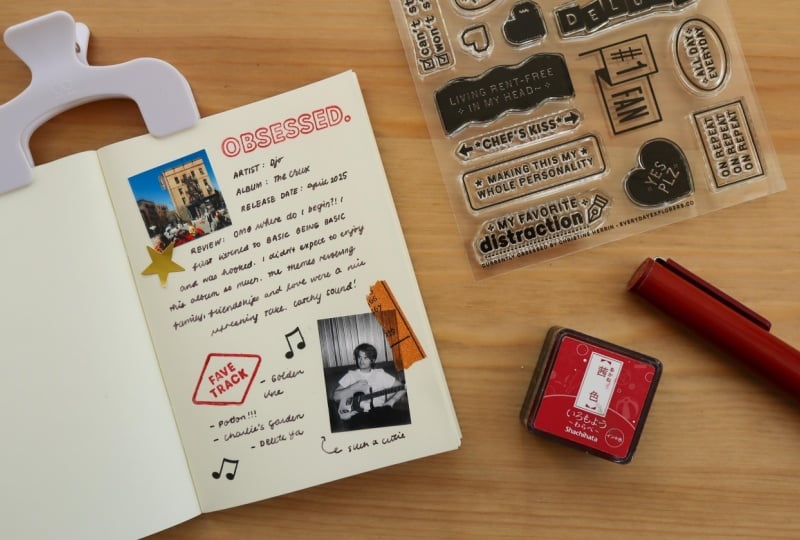
one of my favorite albums, it's the Crux by Joe, and it's one of the recent
ones that I really, really got obsessed with
and would just play the album on repeat
like nonstop no skips. So since this is a tinier you
know, album covers square. I wanted to paste in a
photo of Joe Kiri as well. And I'm using the passport size. A passport size is
also a great way to track these types of, you know, music, albums. If you attend concerts, it would also be nice
to kind of track it within the same media
journal if you're into that. I personally love just logging this because it's
a way for me to identify. Okay, what genre
was I heavily into? What types of lyrics or songs
really resonate with me? And I also want to mention
this star Sticker. I just got it from an
office supply store, but I tend to use it a
lot because it's just fun to add for every type of
media that I'm documenting. And then for this clear stamp, I'm using one that
is music theme, which I think is super in them for this particular journal
page that we're working on. Since the colors of the album
have, like, blue and red, I figured using a red stamad ink would be a nice touch
instead of the usual black. I also will say that
journaling with this format doesn't require
you to put a lot of stationery down, which
I think is great, and you don't have
to feel the need to want to fill it up
with a lot of stickers, washi tapes, at most just enough to kind
of surround the page, but because we are mostly channeling a lot of
our writing here, it's really a lot of
self reflection and thinking about why this particular media
resonated with you, why these songs have
been on your radar, or maybe some things like what got you into this kind of genre. I also picked up this
really small stamp that has a musical note
on it, musical notes. It was super cute, so I
figured that would be a nice touch as well for
this particular page. I want to say that it took me a while to document about music. I think the first time I did media journaling
was really books, and then it moved to
TV shows and films. Music, I think it's
tricky because there are a lot of things that you
can definitely write about. Info wise, we're starting with the artist album and release. It could be the
release date or month. If I don't know if
I wrote a genre, but that's also definitely
something worth looking into. In the end, these types of info would be useful
for you to look back on and just kind of track your
behavior if you wanted to know what types of music
you were listening to. And I think something that has been an information I really learn from is that
certain times of year, I tend to listen to
more upbeat music. So some months, it's
a bit more mellow. I think for summer, I'm always listening to
something very in the top. And then around winter, I am listening to
something a bit more, you know, melancholic to kind
of tie in with the season. But this one I was
listening to non stop in the winter up
until, like, early spring. I think there's just
usually like a series of experiences where I get really hyperfixated
on certain albums, and I will listen
to them non stop. And this was definitely
one of them. Another thing I like
to add more context into the journal page
that I'm writing is I would watch a lot
of commentaries or interviews about
the musician. Like, why did they decide
to write this song? What were the core themes? Like, I love that this album doesn't just focus on romance. It focuses a lot on family, friendships, and your
relationship with yourself. I just really enjoyed
the upbeat sounds. It rended me a lot
of the Beatles, which is one of my favorite
bands of all time. So I also set aside the bottom part to write my favorite
tracks from the album. So that's also something
worth pointing out, whereas, like, in books, you can't really I guess you can
pull out, like chapters, but since with music, a podcast can also be like, if you have some favorite
podcast episodes from that particular podcast, it's good to note them down if you want to replay
them in the future. So that's something I
added in as well here. It's not much pace, but
I think it's enough to kind of put down the
information I need, and here's the final page.
7. Final Thoughts: You've made it to the
end of the class. Great job, and thank you so much for spending
your time with me. I hope you enjoyed media
journaling together. Now that I've shared ideas on how to track your
favorite media, I encourage you to incorporate it into your
journaling practice. In the meantime,
if you're looking for more ideas and inspiration, I have a PDF and the Projects
and Resources tab where you can access some
media journal pages I've worked on
throughout the years, and in the project gallery, I also have an entry featuring the media journal pages we worked on together
for this class. Make sure to share your projects
in the project gallery. And if you enjoy this class, please consider leaving
this class a review. Keep documenting and
always be creating. Bye.
 Abbey Sy, Artist, Author & Educator