Transcripts
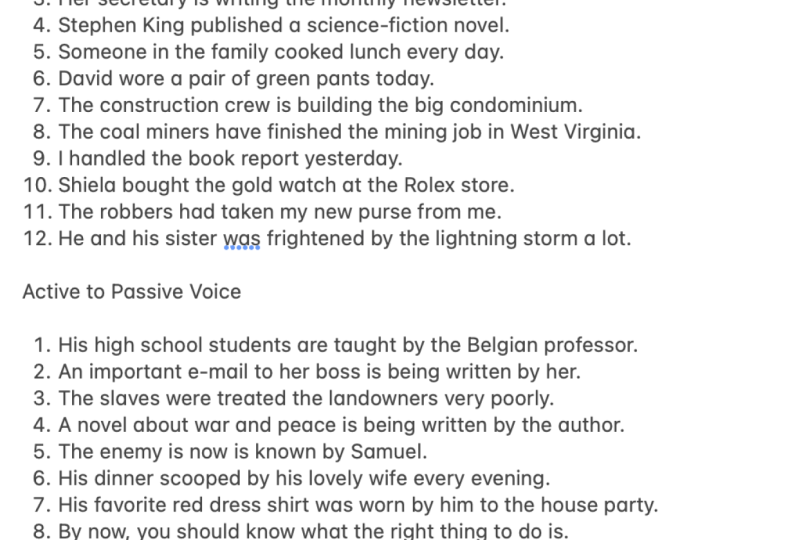
1. Active Voice: Hello, students, and welcome to the first lesson of the advanced grammar course you made it. Thank you very much for purchasing this course. So let's get started with less and one of the advanced grammar course, and that is with the active voice. So what is the active voice? You may say? So the active voice. We use it in our writing. You know, we use that when we're speaking to, but we use it for our writing as well. So the active voice means that the subject of the sentence creates the action. The subject is the main focus of the sentence, right, and it creates the action taking place way. Use the active voice toe ADM. Or impact to your writing. We want our writing to impact who's ever reading it. We want our sentences to have a direct impact on our readers feelings and their emotions. We really want to create a connection between the writer, which is you and the reader who is reading your English writing now. Sentences written in an active voice flow better and are easier to understand. We're gonna talk about the passive voice in the next video, but starting with the active voice. We should know that if it's written, if sentences air written in the active voice, they're gonna be easier to understand. Because why is that? You may ask Well, because you're gonna know right away what the subject is and what the action is. Where is the passive voice? It's really not clear until the end of the sentence. So nothing. The emphasis is on the subject of the sentence. We talked about the subject a lot if you take in my previous grammar courses. But the subject is usually right at the beginning, and the action is directly related to the action taking place. The subject in action go together. So when you when we talk about active voice, the sentence is straightforward, meaning very easy to understand and concise. So not too long, but it gets right to the point. Let me give a few examples to start us off in this lesson. So I really love this TV show. So the subject here is I write I is a subject and then really is like emphasizing how much you love this TV show. So I really love this TV show, you know, right away who The subject is, right? Me get a different marker here. All right. So I Oh, okay. Eyes are subject right here. Really is just the word we use for emphasis and then love. Love is love is our verb here. I really love this TV show. So you're showing how much you adore this TV show how much it matters. Teoh. Our second example. What is our subject? Think about it for a second. What is our subject in this sentence? Okay, Are subject is going to be guerrillas? If you said gorillas at home, give yourself a small crap around a round of applause. Guerrillas? What did they dio? They live. I should I should also give girls live. Where do they live? In the jungle. So we So where Where do the girls live? We know they live in the jungle. So guerrillas subject right here live. That's the action taking place there, living in the jungle. Okay, so this is a pretty good example of an active sentence. You have the subject and the action right next to each other. I really love this TV show. Gorillas live in the jungle. So when you see this sentence. You'll know that it's not passive voice, but it's active. So these are both active sentences. So you may be saying, Well, what if we have a passive sentence? How do we make it active? That's a good question. Let me give you a few examples, starting with this one. How do we go from passive right here, too active Because this may come up in your activities for this course or in the future? How do we go from a passive voice sentenced to an active voice? Let's start with this cost of example. The electoral ballots were counted by the volunteers. Now do you know where the subject is right away? It may be a bit confusing, but are subject, you may be thinking is not at the beginning Are the electoral ballots the subject of the sentence? Yeah, they are in a way, but they're more of what what's happening with the action. So who is actually doing accounting? Well, the electoral ballots aren't people they're not. They can't count the ballots right. The electoral ballots is kind of the focus right or the object of the sentence, But that's at the beginning. Where is volunteers that's our subject, but it's at the end. So with the passive voice, and we'll talk about this in our next lesson. The passive voice puts the object, if I should say or the ref reference the thing that's being referenced at the beginning of the sentence. So the electoral ballots were counted by the volunteers. That's more passive, right? That's not very active. You're you're not having the subject at the beginning of the sentence tied directly to the action of counting counting ballots. So if we wanted to make it active, what we want to do is basically just do a little bit of switching. So the volunteers, you're gonna want to put that at the beginning of the sentence, right? Like we did with I or gorillas. So volunteers will go at the beginning and it should be the volunteers, right? The volunteers, What did they do if we're talking about past cents, which you are they the volunteers counted on what did they count? The electoral ballots? See, that makes a big difference. That is an active voice sentence right there. So if you're a little confused right now, just think about how the volunteers are the subject of our sentence volunteers. What is the action here? Well, the action is the counting or counted because it's past tense action. And then this is kind of like the let's say the object, right? What did they counting? What are we referencing with electoral ballot, But the subject who is the focus of our Centene? It's the volunteer. So if we wanted to make the sentence active, we're going to put the volunteers right at the beginning. All right, I'm gonna take a few seconds for you guys to take a look at these notes. Take a look at these examples. This is just active, and this is going from passive to active. All right, While you're doing that, I'm gonna erase the top part. You can pause the video if necessary, as always, to collect your thoughts. I'm gonna erase the top part when you keep the examples for now, I'm gonna add one more passive to active example. All right, let me give you guys one more example of how do we go from passive to active? All right, so this is passive. So the flowers were stepped on, right? Step stepped on is like using your shoes to step on an object. The flowers were stepped on by the dog. So what do you think the subject of the sentence is? Where is it placed? Right here. Think about it for one minute. One second. Well, the subject. It's not the flowers, Right? The flowers air. Kind of what's being referenced as the object of what's being stepped on the subject right here. We know it's passive because the subject is at the end here. So when you have a passive voice sentence, the subject is gonna go at the end. Not at the beginning. However, If we're gonna make it active, what do we need to dio? We need to put the dog at the beginning. All right. The dog is our subject. It's gonna go at the beginning if we're going to start to make this active. All right? The dog. What did the dog do? Well, what was the action? The action of subject in of active voice sentence. They go together, the dogs stepped on, and this is still a past tense past participle. Regular simple past. The dogs stepped on. What did they step on? The flowers? Right, so Here we go. That's active right there. Okay, so that's how we go from passive active. You have the subject at the beginning. The action right after, you know, they got the dog. He was the subject of something th the one who stepped on the flowers. The dog stepped on the flowers, and they're kind of the object of what's being referenced here. All right. Okay. Let's continue with what's let's. Let's race all this. I'll give you guys a couple seconds at home before we move on. Okay, so we know how to create the active. We know how to move the passive active. Let's just Let's just talk a little bit more about why we use the active voice. Well, the we talked about this but active voice. What does it do? It adds, adds impact, right? You know, right away. What's going on? You know who the subject is. You know what the action is When you use passive voice, I'm gonna talk about another lesson, but you're really putting things off till the end. Whereas in the active voice at the beginning, you're diving into what the subject is and what the action is. So it adds impact to your sentence. It makes the reader know what's going on right away. About the purpose of the sentence adds impact your sentence. But we use the passive voice toe. Lessen the impact of your sentence. So if you want to make things more unclear or a little bit more difficult to understand, you're going to use the passive voice. Sometimes we we like to use the active voice to obscure who is responsible for an action. So sometimes a politician will say and this is an example of politics of active sentence, but they can also. It can also be unclear who is responsible. A politician will stay, mistakes were made and you could end the sentence Right now are right there because we have the subject mistakes and were made. We don't know who did them, who made the mistakes. We just know that this is an active sentence. Mistakes were made or if a so a soldier will shake a soldier in the battle. Shots were fired. Who fired the shots? We don't know, but this is not a passive sentences, an active sentence you're talking about in action and the subject which in this case is shots or mistakes. Those air subjects, um, or businesses will say your service will be shut off. You know, if a business is providing a service and they want to say it's over, they could say, Your business is your service will be shut off. That's passive, though a business could also for active. So these are all active examples a business could. Right? We are going to shut off. Shut off your, uh, electricity service. Okay, so what's the subject here? We know this is active, right? It's definitely active. That's active. That's active. This one is a little bit easier. The subject is we. And what are they going to do? What's the action? Shut off, Right. They're gonna turn off your electricity service. So that's what's being referenced here. So that is a active sentence. If we want to make it passive, you could say, your service, your electoral, your electricity is going to bay. Shut off. By who? What's the subject? Will the subject If a referencing it's gonna be at the end. So again, this is This is active and this is passive, all right, So instead of having the subject of the beginning with we and have you're gonna you're basically putting your electricity at the beginning. So you're switching it, right? The subject goes from beginning to end. So from active to passive, just to give you guys a bit of background, you know, the subject goes from being first to last. We always in an active sentence. We always want the subject to be At the beginning, we wanted to be first with weight at the end of us in the third person comes at the at the end. So it's passive. So I hope that makes sense. We always want to subject any action together. We're going to shut off. Your electricity is going to be shut off. That's passive. That's not using the subject at the beginning next to the action. Okay, There should be a noticeable difference here between active right here and passive. Okay, Before we finish this lesson, I want toe say that in most English sentences with an active verb, the subject performs the action decided are denoted by the verb. So the subject is always doing the verbs action. So the subject is always completing the action of the verb, right? So let me give, uh, three more examples before we finish up. Hopefully, my green marker will be working. So three more examples before we are done with this active voice lesson. Okay, for Okay, let's start with this example first, actually. Now, is this active or passive? If you said active at home, that's correct. That's an active sentence. Why? Well, we have the subject. The boy must have eaten. And that is our action. The eating of the hot dogs. And this is kind of our object, right? What are we referencing? The hot dogs. But the subject is the boy. It's completing the action. Must have eaten past simple. Must have eaten all the hot dogs. Okay, that's example. One. Okay, So Jennifer mailed him the love letter. Who mailed the love letter? Right. That would be Jennifer. So Jennifer is our subject here. She's the one who mailed the well him. Who did she mail the love letter to? She melt him. But once again, we have the the action. No. The verb male to male. Jennifer mailed him the love letter. What's being referenced? The love letter. Okay, um, you know, it's a bit confusing that is also an active sentence. Right? Jennifer comes at the beginning of the sentence as a subject. The boy is the subject. Eaten and mailed are the actions and the love letter of the hot dogs that those are the objects or the things of interest being referenced. Our last example for active voice. Okay, we have colorfully Ghana's live in the Amazon. Okay, So what is what are our subject here? What is our subject here? I should say, if you said colorful iguanas, that is correct. That's our subject. The iguanas are our subjects. And what's the action? Your What's the verb here? Well, they live, right? That's our action verb. Carful! Iguanas Live where? In the Amazon rainforest. Okay, so that is definitely an active voice sentence. Okay, subject action, object subject always goes at the beginning when it comes to an active voice sentence. So keep that in mind. It's really important. All right? Very good. So the subject is acting upon the verb in these sentences and the sentences are in the active voice or not passive. We've seen a little bit of the passive voice. Next lesson you'll click along. You fall along next lesson. We're gonna talk about the passive voice and why we do use the passive voice sometimes. Thank you guys. Take a couple seconds to write this all down. You compose the video right now if you need to. Otherwise, that's it for the active voice. Thank you very much for enrolling in this advanced grammar course, and I'll see you in the next lesson.
2. Passive Voice: All right, students, welcome to our next lesson on the passive voice square or following the active voice comes the passive voice. So what is the passive voice? Well, the passive voice and I put this in quotation with little underlying. The passive voice occurs when you make the object of an action into the subject of a sentence. So last time we talked about the subject of the sentence, keeping it where it is. Don't move it, keep it at the beginning of the sentence. But if we want to make the pasta voice, we got to make the switch where you make the object of the action into the actual subject of the sentence. So you switch it so the subject for active voice goes at the end and the object goes at the beginning to become the subject. So in this case, whoever or whatever is performed, the action is not the grammatical subject. So your normal subject for an active voice sentence is not that anymore. Instead, the object of the action becomes the grammatical subject of the sentence. So you're really flipping it around your changing the order of it, which can cost some confusion Now take a look at this example. This is a famous question we ask each other in English When you when you were little boys and girls when the English for the first time. And this is a funny take on it, we're changing it. We changed it from active voice. The passive voice Why was the road crossed by the chicken? So this looks a little strange to me as a native speaker, but for you, maybe it's OK, but this is an example of a passive sentence. So can you guess where the subject would normally be? What would what would the subject normally be, Right? Well, the subject would be the chicken, So the normal subject in an active voice sentence would be the chicken. But we're switching it so the chicken comes to the end, and it's usually at the beginning in this example. But if we're making a passive, we put the actual grammatical subject at the end. So instead we have the action. The chicken crosses the road. That is the, um, that's the active version. But now you have the grammatical subject being the road, which is kind of the object of the symptoms, right? The chicken is supposed to cross the road. But in the passive sentiment, why was the road crossed by? And this is our active verb not to be confused with active voice. So this is a good example. The passive voice altogether. So the road is the object. But now it's our grammatical subject because the chicken are subject the the person or the animal where the thing is now at the end. So why was the road cross by the chicken? So basically, the chicken goes from here. Sorry, The chicken goes from here to here, all right, when the road should be here. But it's, you know, it's up here now. So the road in the chicken, they switch places. Let's look at the active version quickly. Why did and noticed past simple could be. Why did for past tense. Why did the chicken across the road? So you can see there's a big difference in terms of where we put the chicken in the road. So in this version, this is our active version, right? Why did the chicken cross the road? The chicken goes together with the action of crossing right. That's an active verb of crossing the road. So why did the chicken cross the road? Well, we're not focusing on the answer here, but rather the chicken is our grammatical subject with active voice. But now, with passive voice, we're putting him at the end or her at the end. The chicken is at the end. The road should be at the end as the object. But right now for passive voice, the object is coming at the beginning and the subject comes at the end here. All right, we'll talk about we'll give a few more examples if you're a little confused right now. But remember, the road is the grammatical subject, not the chicken. And that's for passive voice, not for active voice. We're focusing on passive for this lesson. So how do we know it's passive? While possible voice sentences usually include a form of the verb to be, so is R M waas, where husband have been had been will be will have been being followed by this is crucial fall by the simple past or apart past participle also, but which ends in e. D. Okay, so you're gonna have the form of to be with a verb plus e day. So for four, if you're wondering how how do I find the passive voice? Usually it's gonna be to be plus past simple equals, passive voice I'm gonna give a few examples, you know, just a little bit for you guys to know But make sure when you're looking how to form the passive voice you wanna have a form of to be whether it is waas will be etcetera And you were gonna combine that with a verb, uh, past simple, which is verb plus e d and that will give you a passive sentence. It's key to keep in mind that the object goes to the subject. The subject. Ghostie objects. You're switching the subject for the object. The object for the subject. That's how we got our example of why was the road crossed by the chicken passive instead of why did the chicken cross the road? So give you guys a couple seconds, think it over so far, and we're going to dive into more examples of how do we go from, um what say Active, Active to passive. All right, let's continue. Okay, let's continue. Um, let's start out with some simple examples for you guys. Just using passive the metropolis. The metropolis has been destroyed by the dragons that down. And then our second example before we start to go over them when her home was invaded, Penelope, I had to think of ways to delay her auction. Auction is like giving household items away. Okay, so these air both passive, right? There's a both passive examples. Okay, How do we know they're passive? Well, let's look. The metropolis has been destroyed by the dragon's fire blasts. Now, in this case, the metropolis That's our object. Usually so the object that functions at the grammatical subject. And I'm just gonna keep it as the object that will go at the beginning. So the metropolis usually would be the object. What was destroyed? The metropolis. By who? The dragon. So what's our subject? The dragon. And what did he do? Well, he destroyed. Destroyed is our verb here has been destroyed, and you can tell it's passive with Remember has been of two bay. Okay, has been destroyed by the dragon's fire blast. So the dragon comes at the end of the sentence and passive instead of at the beginning. So the metropolis and the dragon. They switch places for the sentence, making it making a passive. So instead of and we're gonna we're gonna talk about how do we switch it to active from passive. But I know that the object in this case is the metropolis has been destroyed. That's a verb by the dragon. So normally the dragon would go first, right for active. But in this case, the dragon and his or her fire blast. They come at the end, continuing on when her home was invaded, Penelope had to think of ways to delay her option. Okay, so we don't know right away whose home was invaded so Penelope would be the subject. Right? Alright. Penelope is the subject, okay? And then when we think of object, it would let's say it would be her home, so her home would go at the beginning. So instead of talking about Penelope, is home directly were stating her home instead. So when her home was invaded pedal Penelope had to think of ways to delay her auction. All right, so we're referring to her in the third person with her home and waas, which is to be right to be is a was in the past. Ins to bay invaded a czar verb here. So instead of Penelope as a subject going at the beginning, we're swapping it for the object, which is her home. Okay, very good. So how do we make these two sentences active? Okay, If we wanted to make it active, I'm going to show you guys how the dragons fire. Bless. Okay. The dragon's fire bless had destroyed the metropolis. The dragon's fire blasts had destroyed the metropolis. So this is definitely active, right? Because this dragon is back here at the beginning, right with subject, and Metropolis comes at the end as the object and the verb is right here. Okay, So notice how we're swapping it around from passive to active. Um, And the second example. So when power, when Penelope ease home was invaded, she instead of her, she had to think of ways to delay her option. Okay, So, Penelope, instead of coming at the end, she's gonna come at the beginning because their subject is right here, and it's our home. Right? So Penelope is home was invaded. That's a verb. She not her. She had to think of ways to do it. Your auction. Okay, so just it's pretty simple, swapping the object for the subject and vice versa. Okay, so it's also important to remember that the key to identifying the passive voice is to look for both the form of to be like was or had and a past simple e D verb, right? Like destroyed or invaded. Right? So you want to combine the to be verb in simple future president or passed, and then the past simple or past participle, which ends in E. D. That gives it away, that it's passive voice and sometimes passive voice is the best choice out there. Um, you know, let me give a few tips in terms of when we use passive voice. Okay, that that's not so hard. Let me give you guys three instances where we should use passive voice to emphasize an object. So these are always where in which you can use passive voice or to de emphasize to de emphasize means like put less importance on to de emphasize less importance, an unknown subject or the last one. If your readers don't know who is responsible for the action, okay, so let me give one example Preach to emphasize an object were in action. 60 Senate votes are required to pass this bill. We don't know what Bill it is. We just know that 60 votes are required to pass this bill. What's the subject? This bill comes at the end to de emphasize and announced subject is another example over 120 contaminants. Contaminants means like pollution, pollutants, things that make the water dirty. Over 120 different contaminants have have been have been dumped into the river, so we don't know who the subject is or who is doing the dumping. We just know that over 120 contaminants have been dumped into the river. So that's a passive example as well. The last one. If your readers don't know who is responsible for the action if you're writing something, you don't know who is responsible for the action. Ah, let's say babies. Who is responsible? Baby? Sofia was delivered at 3:30 p.m. yesterday. So we have waas to be delivered. The action now you may be thinking, is baby Sofia This the subject here? No, because we don't know who is responsible for delivery. Deborah, Live. Bring this baby. Okay. We just know baby Sofia was delivered at 3:30 p.m. Yesterday. So that is a passive voice because we don't know who is responsible for the action. So keep these three uses for the passive voice in mind. Okay. To emphasize an object like voting for a bill to de emphasize an unknown subject. Somebody who was dumping the contaminants and the last one. If you don't know who is responsible for delivering a baby or delivering the action, then you leave it more vague. That's why we use passive voice to keep things more vague, less certain about the role of the subject. Okay, very good to finish off. I just want to give you guys an example. Each of how we use the passive voice and the active voice. Seven different ways with different verb tenses. All right, let me continue. One less thing. I'm gonna leave this up for a couple more seconds so you can pause the video if need me. Okay? So finishing up. Let's use the passive and the active voice to finish these past two lessons up in different grammar tenses. So we're gonna use both active and passive. All right. Okay. Let's start with simple present. Tense. Okay, - Okay . I'm gonna wait to the end to talk about what's active in what's passive. Let's continue simple past tense. - Right ? Next. We have simple future tense with I will, - but okay. Number four Simple future tense with going to Okay , number five, we go on to the president. Progressive, tense. Present. Aggressive. Tense. Okay, very good. One more. Okay. Continuing on the last two past. Progressive. Tense. OK, do okay . Lets I wanted to show you guys one last one. But let me just say that to the end. Let's start with these six. So simple. Present. Tense. What do we change? Quickly, Twice a month brought Brian cleans his apartment. Now, Is that active or passive? That would be active. Brian is the subject. He's at the beginning. Okay. And where does Brian go? He goes to the end, right? The apartment we've as o Brian is s the subject s cose from active to passive. Brian will be at the end there. So this is a passive sentenced. The second example the apart twice a month, the apartment is cleaned by Brian instead of Brian cleans his apartment. Okay, so, um, you know the oh, here is the apartment the EFS subject? So twice a month Brian Queens apartment active twice a month. The apartment is cleaned by Brian. You're switching the subject. Brian goes from being at the top at the beginning. To the at the end is basically at the bottom of importance now. So that's first ones active first ones. Passive keeping to go in simple past tense. John fixed the door knob. Object is dorn up here? John is the subject. The door knob goes at the beginning, so the 1st 1 is active. All right. Noticing a pattern here. All right. I put the active sentences first. I should have mixed it up a little bit more, but the door knob was fixed by John. So yes, you can see again. John goes at the end with the passive. The door knob was fixed by John. John fixed the door enough. He will finish the job by 5 p.m. Tonight. Active sentence right here. He will finish the job by 5 p.m. Tonight. He is a subject. The job will be finished by 5 p.m. tonight. Eso Actually, I should mix that. So by him, five by the job will be finished by him by 5 p.m. Tonight. So the subject goes at the end. That's our passive right here for simple future tense Number four. Simple future tense with I Should Wrote this going to going to Jackie is going to cook dinner tonight. Jackie's air subject Boom at the beginning. The object is dinner That's active, right? Jackie is going to cook dinner tonight. Active dinner is going to be cooked by Jackie tonight. That is passive, right? Dinner is the object. It goes at the beginning there, so it becomes passive. President Progressive Tense Number five. As of now, Cory is creating a science project. Who is the subject? Korea's And what is he doing? Is creating a science project. That's our object. So that is a active sentence, right? Let me see where can fit that in active right here. As of now, the science project is being created by Corey. So that is passive, right? Instead of active Corey being at the beginning, Cory's at the end. These are subject. He's at the end. That's passive. That's a passive voice sentence. Okay, well, that should say, Detective, the detective was working on the mystery murder case when his partner picked up another clue. That's a tricky one for past progressive tense. But in this case, the detective is gonna be the subject. And what's the object? Well, it's the mystery murder case. All right, So that detective is the focal point. And this is an active sentence right here because we're talking about the detective. He is the main focus. Whereas the mystery murder case was being worked on by the detective when his partner picked up another clue. So our object is the mystery murder case. If that goes at the beginning and this the detective is going at the end, that's a good clue that this is a passive version. Okay, take a couple seconds. Review the O's. And, yes, is the active in the passive the active? The key thing to keep in mind with the active is that subject is gonna go at the beginning . Object at the end. Passive voice object at the beginning. And then the subject goes at the end. So you're swapping them. Keep that in mind and you're observing the verb tense. Whether it's simple present 10 simple, future tense or past progressive tense. All right, one less one that I want to do. Uh, give you guys a couple of seconds. All right, If you want to pause the video now, go for it. We're gonna continue with one last example. Okay, So our last examples Future progressive, tense and that involves will. So 10 p.m. Tonight, HBO will be airing the new Vice Special Vices, A show on American channels called HBO The Vice Special. It's a Siri's or the other one is at 10 p.m. Tonight. The new rice special will be herring on HBO. Boom. Okay, so at 10 p.m. Tonight, HBO, HBO will be airing the new vice special. What's the subject here? HBO. So this is active because the new vice special is our object. What are we referring to? We're referring to the new vice special. So this is an active sentence at 10 p.m. Tonight. The news vice special. Our object goes ahead of this subject. Now HBO's all the way at the end at the subject. That is our passive example. Okay, so keep that in mind. We're swapping HBO for the vice special. When it goes at the beginning, that's are passive. So HBO goes from beginning to end. Vice special goes from end to beginning here. Okay, Now I know that's a lot. I've thrown a lot out of you guys in this lesson, but I really think you got a good handle on the difference between active and passive voice . How we use the active and passive voice and how we change them to be like the other and how we form it and how we use it in different example sentences, depending on the verb tense. Thank you guys again for taking this course. I hope you enjoyed these past two lessons and I'll see you in the next video.
 Benjamin Weinberg, English as a Second Language Teacher