Transcripts
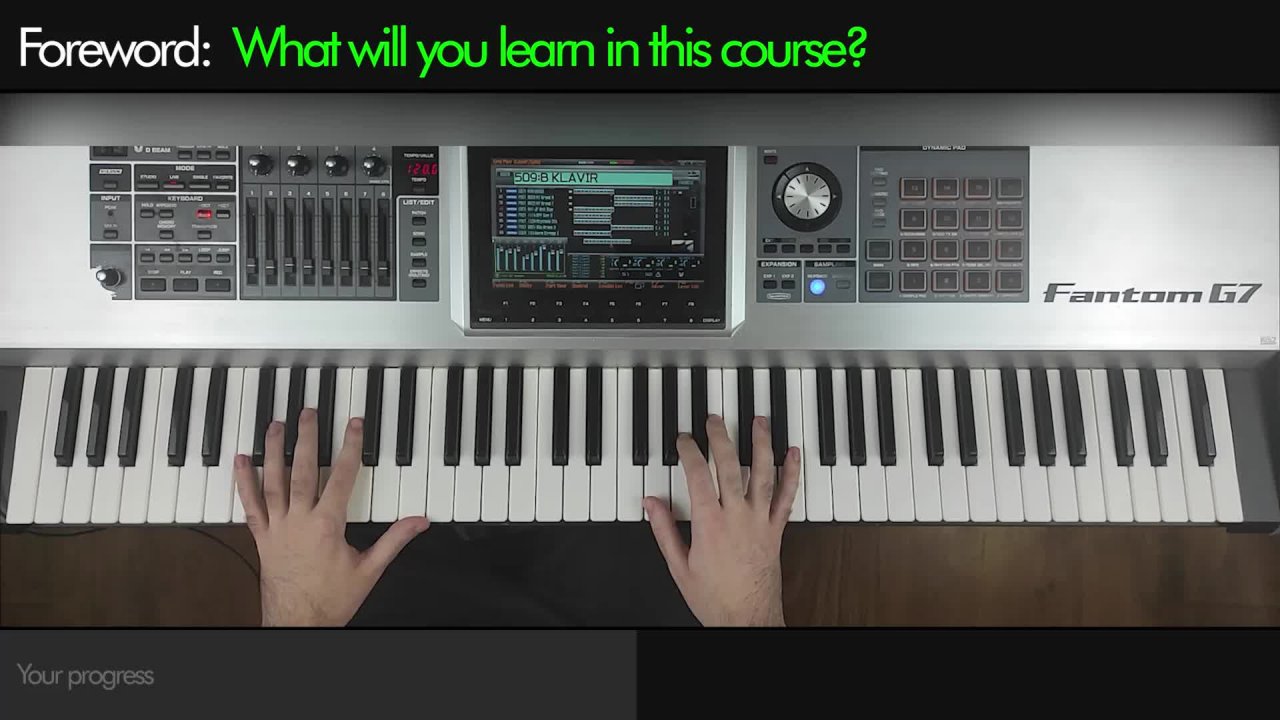
1. What can you expect in this course?: Hello everyone. In this course, I'll give my best to teach you the piano basics and
show you that it is possible to play the piano as a total beginner in
around one hour. I'll show you how cool this is. An if you are able to
count from one to 12, you'll have no other excuses to be able to play the piano. Okay. I'll see you guys inside.
2. Learn Piano in Less than 60 Minutes!: In this lesson, you
are going to learn the basics of
playing piano by ear without using nodes and without having any knowledge
about this topic, will completely focused
on things people mostly learned in
piano academies, often struggling and spending
years to make progress. So to avoid wasting time, let's start with the
tone names first by dividing them
into two groups, black and white keys. The first group is a group of two black keys surrounded by
a group of three white keys. The second group is a group of three black keys surrounded
by four white keys. And these exact patterns
are repeated throughout the whole keyboard and
it has a specific name, but we will discuss
this topic later on. Now, the first group of tool, black and three white
keys are the following. The white keys are C, and the black keys
are C-sharp, D-sharp. And depending on their role, they can also be called
D flat and E flat. Also something we
will discuss later. We can play the same notes
anywhere on the keyboard. Again. Now, the second group of three black and for white
keys are the following. The white keys are a and B, and the black keys are
F-sharp, G-sharp, A-sharp. And depending on their role, they can also be called G flat, a flat, and B flat. And again as well, we can play the same notes anywhere
on the keyboard. Now again, F, G, a, B, and F-sharp. G-sharp, A-sharp. Okay? Once we have learned the names of
tones on the keyboard, we are able to play our very
first skill called C major. If we play all the
white notes in the following array, C, D, E, F, G, a, B. We also need to form the
proper finger positions. The basic fingering for the
C major scale is 12312345, okay, which means
R1 is our thumb. R2 is pointing finger, three is our middle finger, for is our fourth finger, and five is our pinky. Okay, 12312345. The same thing
applies when playing C major scale backwards, as well as all other types of skills you'll learn
in this course. Five, 4321. When it comes to hand posture, makes sure your chair is high enough where
your back is not bent and your elbow should be within the same height
as your keyboard. So make sure your wrist
is relaxed and flexible, prepared to move along
in both axes, right? For specific types
of situations, also makes sure the most
strength comes from muscles of your fingers
and not from your arm, avoiding cramps
and physical pain, as well as fatigue. Classic piano has only 12 notes repeated in patterns
throughout the whole keyboard. We need to count
each possible note from left to right, like this, 123456789101112. This is repeated. This is one. Once again. This is called the
chromatic scale at it. And it is the biggest
scale in music. Since there are 12 tones in it, the proper finger positions
would be the following. 13113131, 12. So whenever you have a wide
key followed by a black key, play it with your thumb, followed by your
middle finger. Sorry. If there are two white
keys with no black in-between played with your
tongue and pointing finger, okay, but it happens
only in two occurrences between F and B and C. The second rule is when chromatic scale starts
with a black key, you're going to start
to play it with your middle finger and just follow the previously
explained pattern. For example, if we want to
play F-sharp chromatic scale, we'll start off with. Our middle finger. And the next scheme
is a white gate. We're going to play
it with our thumb. The next one, once
again, is a black key, so it's our middle finger,
etc. The exception. Once again, the exception. And we're done here. So once again, one day, there are two types of steps in music, half-steps
and whole-steps. A half step is a, theoretically, when you count the very
first possible physical note from your reference
point, for example, 1.5 step would be
from C to C sharp, as there is absolutely nothing in-between these
two physical nodes. A half-step is
also from F sharp, G, as there is
nothing in between, as well as from E to F, as there are no black
keys between these two, the same thing applies
from B to C. Okay? Whole-steps are when you count two half-steps from your
point of reference. For example, if we take notes
G as our reference point, we count plus two from G. And we're going to
end up on node a. So, so g is our 0012. Okay? Another example would be from
B to C sharp, for example. So B is our 0012. This is a whole step. No matter where you start, this rule is going to apply. Any tone can be referenced on or that 0 tone you
start counting from. For example, our D-sharp is our 0 hours to our starting
point, our reference point. Let's say we need one
half-step from it, and that would be node E, right? So 01, okay, this is 1.5 step. One whole step would
be note F case, since it's two half-steps away from that exact
note we started, we started counting
from one to 0. This is 1.5 step and
this is one whole step. So the names of the toes as
intervals are as following, and they might differ in a
matter of different contexts. If we start counting from C and relating everything
from that node, we get the following names. C is a perfect unison. This is plus 0 half-steps. C-sharp is a minor second. This is one half-step. Okay? D is a major second. And it's two half-steps away from our reference
point, which is a seat. Okay? D-sharp. This is
called a minor third, and it's 3.5 steps away
from our reference points. So 0123, okay. The next one is
called major third. It's four half-steps. So 01234, okay, The next step
is called perfect fourth. So 012345, It's 5.5 steps away
from our reference point. The next step is called augmented fourth or
diminished fifth. And this is F sharp
or G flat, sometimes. So 0.51234566 steps. The next one is called
the perfect fifth gait. So 01234567, half-steps,
perfect fifth. The next one is augmented
fifth or minor sixth. This is G sharp, or a flat. Okay? So it is G-sharp related to G or a flat
when you count from, hey, so once you flatten
the a, you get a flat. Okay? So this is 012345678,
half-steps, okay? The next one is major sixth, or a diminished seventh. And this is nine
half-steps away. Okay? The next one is minor seventh, which is Dan half-steps away
from our reference point. So 012345678910. Okay. The next one is major seventh. It is 11 half-steps away
from our reference point. And the last one is called
the Perfect Octave. Which is 12.5 steps away
from our reference point. So 0123456789101112. Okay, perfect unison. Minor second, major
second, minor third, major third, perfect fourth, augmented fourth, or
diminished fifth, perfect fifth, augmented fifth, or minor sixth, major sixth, or diminished seventh,
minor seventh, major seventh, and
perfect doctrine. So this means you can count any interval from
any reference point. For example, let's say our
reference point is note G, K. And we need to
count, for example, a perfect fourth, 012345. This is perfect fourth. Since it is 5.5 steps away
from our reference point, which is our notes G. There are four types of courts
are often called triads, which are used in music. So now we have major chord, we have a minor chord, we have a diminished chord
and augmented chord. Major chords are happy Course, which have a bright sound and
they're made up for root, node followed by one
major third, minor third. So how do we count these things? Let's say our root node is, we need to count one major
third from denote f, and that is 4.5
steps away from it. So 01234, which is a node a, the formula now says
one minor third, But we count from
denote we just came on. So count from note, a minor third from
node a is 0123. This is node C, okay? This means we have
nodes a and C. And this is called
F major chord with the formula of 0 as
our root node F. Then we have plus
four half-steps, which is node a. And we have plus three, which is our known seats. So 0123. Okay? So what a formula for all major chords is 0 for three. Same thing applies
for minor chords, but the formula is different. Minor course sound sad
and really depressed. Sometimes in major courts, we had 0 for three. For minor chords. It is now 034. For example, let's
build a G minor chord. So we start off from node G. We count plus three, so 0123, and that is B flat. And now we count plus four, which is 01234,
which is a node D. And this we can build any other minor chord
for any other node. For example, let's
say E minor, 1231234. This is E minor diminished chord sound kind of scary and they also have a formula
which is 033. Let's build for example,
E diminished chord. We have as our root plus
three would be 0123. Would it be an O to G? And
another plus three half-steps would be note 0123, a B-flat. Okay? So this is E diminished. For example, let's say
G-sharp diminished, 01230123. So this is G-sharp diminished. Augmented chords
sound haunting and a different type of scary
as like an individual type. Their formula is 044. And an example would be, let's say D augmented with the following
notes as our root. So 01234, this is F
sharp, and once again, plus four, so 01234, B flat, or a sharp. So this is the augmented chord. For example, b. Oh man, it would be 012341234. So this is the augmented chord. In this part, you'll learn
how to form scales with simple formulas like we used
for counting intervals. If you can do basic math
in terms of counting, along with some logic,
you're good to go. So there are four
types of basic scales, but for this course we will
cover only two of them, as they are most important
types of scales and their usage is very wide in today's mainstream
types of music. The major scales, the formula
is 0 to 21 to two to one, and fingering
formula is 12312345. If we start from a node C, that is our number
0 in the formula. It is our first node
in the C major scale, and we will play
it with our thumb. Okay? Next, the
formula says two, and it means you
need to count plus two half-steps from denotes C 012 in order to get the second note
in the C major scale. So by doing that,
you'll come to node D, OK, and we're going to play
it without pointing fingers. So C is our first 012. The second note is D. The next number in the
formula is again two, which means we now count another two half-steps
from the current node D. And we're going to end up on
denote E. So D is our 012. This is node E. This is the third note in
the C major scale. You're going to play it
with your third finger, which is a middle finger. Now, note E is our third note
in the scale of C major. And next, the forward slash
sign means we need to place our thumb once again underneath all other fingers in order to play the next node. So what is the formula
says plus one. So the thumb goes underneath. Plus one from E is
F. Means we go from E to F as that is it only possible solution
in this case, right? So there are no in-between
nodes here, between E and F. Now, the next number
is two again, and that means f plus
two half-steps is G. 012 half-steps. This is G. This is the fifth note
in the scale of C major. And this has played with
are pointing finger. Again, it says in the
formula, plus two half-steps, which is a node a with
our middle fingers. So 012 half-steps. This is a middle finger. So once again it says plus two, which is a node, be played with our fourth finger. So 012. This is node B. And finally, in the end it says one, which means plus 1.5 steps, which is node C played
with our pinky, as there is absolutely nothing
in between the B and C. So once again, the
C major scale, 1212345, backwards is the same, 54321. We have minor scales next, and the formula is 0212122 and fingering
formula is 12312345. The same as for D major
scale. In the seat. Everything is the same, so except the counting
of half-steps. And now let's read the
formula and played along. So C is our 0 plus two is d. K plus one is E-flat or D-sharp. But within the C minor
scale, we've have E-flat. Okay, you'll see why later on. Now it says plus two once again. So 012, thumb. Once again plus two, which is 01 to the
next it says plus one. This is a flat. The next it says plus 2012, so it is B flat. And in the end it says
once again, plus two. So 012, C, C, E-flat, G, a flat, B flat, C. Scale nodes have
also degree names, and they are the following. Tonic, supertonic
media and subdominant, dominant, submediant,
and leading tone. Also the same thing applies
for minor scales to, and any other types of scales, but denotes actually differ. In the example of C major scale, we have c is our tonic. It's our first-degree in this
scale, is our supertonic. The second-degree in
the scale is media, and our third degree in the
scale, F is subdominant. Our fourth degree in the scale, G is dominant, or fifth
degree in the scale. A is our submediant. Our sixth degree in the scale. B is our leading tone, the seventh degree in the scale. And once again, we come
to the root position, which is our tonic note C. Okay, Our first degree in scale. Harmonic functions
represent the roles of chords in specific tonality. For example, we are
able to measure simple triads or courts for every node in a specific scale just by using the
notes of that scale. For example, C major, our root node is C. And
the first possible chord, just by using the notes of
the C major scale would be exactly C major
chord. But why is that? Remember when we learned
how to form cords, and we said that C is our root. And then we have a major third. And we have a minor thirds
stacked on top of each other. Well, in this example, the C major is our first chord, and the notes in
this cord are also denotes a C major scale, right? The next chord in the C major scale would
be formed if we just played the next note in the C major scale for
all three current nodes. That means the note
C would become D. Denote E, would it become, and denote g would become a. Now let's count the half
steps between them in order to find out
which chord that is. So 012301234. We have d as the root, and then F is plus
3.5 steps away, which means it's a minor third. And then a is plus
four from f, k, so 01234, which
makes a major third. Now, if you remember
the formulas 034, it makes a minor chord. So if our root node is dy, that means the second chord in this progression is D minor. This is a D minor chord. We can just continue doing this. And until our thumb gets to see, once again, we're
gonna be doing, we're going to be
making chords from each node in the C major scale by using all the nodes
from this C major scale. So the first chord is C major. The second chord is D minor. The next chord
would be E minor K. So this is E minor. The fourth chord would be, this is F-major,
the fifth chord. G-major, the sixth chord. This is a minor chord.
The seventh chord. This is B diminished. Okay? This is B diminished because 01230123033 means the
chord is diminished gate. And in the end we have C
major chord once again, and that's where we stopped. So the best formula to
learn would be like this. For major scales, we
have major minor, minor, major, major, minor, diminished, a major chord. For minor scales, we have
the minor, diminished, major, minor, minor, major, major, and minor chord. Okay? So for, for example, a C minor scale. Since we already know the
scale and the scale nodes. So C, D, E-flat, F, G, A-flat, B-flat. And see, the first
possible chord is C minor. Now we move through the C
minor scale. C goes to D. If it goes to F, and G goes to a flat. Okay? So what's this? 01230123. This is a diminished chord. So this means on the second
degree of C minor scale, we have a diminished chord. Now, next, E flat
major, F minor, G minor, next, a flat major, B flat major, and once
again C minor, okay? Chord inversions really serve
a great purpose in music because they help us to navigate through different course easily. Imagine how hard
would it be if we use only root positions
of each chord. For example, jumping
from C major to F-Major would mean
literally this, right? But for this problem, we have chord inversions. Chord inversions are actually
really easy to understand. As all we have to do is
just swap the lowest note in our chord and played
within the upper octave. Okay, let's say we have a
chord, G-major root 1234123. Okay? This is G-Major. We have no, it's the G, B, and D. So the note G right here is the lowest
note, our tonic note. If we played one octave higher, we get the first inversion
of the chord, G major. So g one octave higher would mean we were going
to play the G here. Now we have this be done and g. The same thing is going to apply for the second inversion. When you invert the
first inversion, first inversion would be this. Now the lowest note is B. We're going to swap this
B with this B here. So now we have this. This is the second inversion
of the chord, G major. And that's also valid
for minor chords, diminished and
augmented as well. For example, let's
say a C minor chord. This is the root position. First inversion is c goes here, and we have, This is
the first inversion, second inversion, this
is the lowest note. Now, this became
the lowest note, so e-flat goes to
one octave higher, and we have G, C, and E flat. This is the second inversion
of the chord, C minor. For example, let's say, let's say G
diminished, 01230123. This is the root position
of the chord G diminished. The first inversion, G
goes one octave higher, and we have this, the
second inversion. This is the lowest note. Now, the B flat is going to
this position and we have, This is the second inversion
of the chord, G diminished. Let's say, let's
say E augmented. So 0123401234. This is E augmented chord in
first inversion egos here. This is the first inversion. Now G-sharp goes one octave higher and we get
second inversion. But the fun thing with
these augmented chords, for example, this is
the root position of E augmented chord. And once we inverted for the
first inversion, egos here, we're going to get
the root position of the G-sharp augmented
chord as well. For example, this is
the root 0123401234. So at the same time, this is the first inversion of the E augmented chord
and the root position of the G sharp augmented
chord as well in the second inversion
where they're going to get C augmented. Okay, so 01234012301234
once again. So in the second inversion, this is also the root of the
C augmented chord. Okay? Let me show you some examples. If you play some
chords with inversions where you actually don't jump
physically that much, okay? For example, let's say, let's say C major, G major. This is the first inversion. Now a minor chord
in first inversion. E minor chord, and
second inversion. F major chord, second inversion. Once again, C major route. F major second inversion,
G-major second inversion. C major in first inversion,
with the left hand. So G major, a minor, E minor, F major, C major. F major. G major and C Major. Now we will train
our ear to listen to the famous 145 progression. So in the example
of C major scale, we have C major as
our first chord. F major is our
fourth chord, right? And G major is our fifth chord. In the scale of C major. This is one, this is two. This is the third chord. The fourth chord chord
for seventh chord. Once again, first-quarter, okay? So only by using the notes
of the C-Major Scale, we're gonna get the
exact same chords, which we need to get. C major, D minor, E minor, F major, G major, a minor, diminished, and C
Major once again. Okay, now let's see what do they sound like
compared to each other? First of all, we will
start off with C major, and regardless of the
chord inversions we're in, we will be able to see how
each of these chords sound. But before we begin, I just want to tell you that
you can play bass notes from every chord by simply playing a root note of the
chord you're on. For example, let's
say a C major chord. The root node is node
C. And we're going to play the bass note
with our left hand, which is one octave lower, or for example,
two octaves lower. Also, you can play with your, with your pinky finger
and your thumb, which makes a double, double node C here, right? Okay, so the tonic, the octave, and
in the right hand you're going to play
the C major chord. So our C major chord is R1 and we will jump
to the five chord, which is a G major, right? Okay, So this is G major, but this is the first
inversion because it's easier to do this C major, G major rather than
doing manger and jumping all left to here. It's a lot of physical
movements here. So, and here, our C
major chord sounds like a home cord where we feel safe and we don't need
to change anything. Okay, once we jumped
to the five chord, G major, sorry, we feel like there's an uprising tangent which
needs to be resolved. Would you agree with me here? Okay, So C major, what would happen if I
just left the piano now? Would you feel like
something is unfinished and you would probably
start hating me a little. Okay. But that's not
what we want here. It's just it's just a way of expressing myself
to do the show. How you can feel when something
in music is unfinished, okay, So C major. And now I'm gone, and I haven't finished
this harmonic progression. So something needs
to be resolved. Okay? There's an uprising
tangent which needs to be resolved once
we get back from, let's say, C major, G major, or for
example, C major. Let's invert it. Once we get back to
the C major chord, we feel like that
tension is resolved. So by returning
to the chord one, the problem is solved right? Now, let's see what
happens when we go from one to four chord, okay? And what is C major? The four chord is F major k. Does this sound remind you of something that brings
your hopes up? This F major chord says, something new is coming. It's on its way, but it's
not quite there yet, okay. Once again, so the hopes are present and something
new is on its way, okay, but it's not quite there yet as we
already, already said. Okay, once we're on the F-Major, we can go to the G major, for example, which
is here, right? It's very, very near. And we're going to
build the tangent once again, as we said, the fifth chord is
in the tangent mode. And then once again, we're going to resolve this
back to the C major or to go back, to go back home. Okay, So once again, for the five is our, this is our C major
chord once again, okay, This is our home court. We went back home, right? But going from F major to C major is also
possible, for example. But it sounds not so heavy like it sounds when
doing five to one, for example, G to C. Okay, if you would
agree with me. So this is not as heavy as it is when we go
from five to one. There's not enough tangent
here in this fourth chord. So this is where you
need to practice these things by ear to get into these things and how
each of these chords sounds compared to each other
in a specific progression. Through time, your
muscle memory will build itself and your course
will become fluent, as well as you'll be able to finally play some
music, okay, also, if you learn to hear
the 145 floridly, you'll be able to play. Let's say, 90% of the today's pop mainstream
music with ease, regardless of the
scale you're playing. Let's play the same progression
from another scale, regardless of the fact that
you are still unable to play. For example, within the
intonation of D major. D major is those like this. And the courts within the D major scale
would be like this. D major, E minor,
F-sharp, minor, G major, a major, D minor, C sharp diminished. And the major wants again. So for example, let's see, let's, let's use some inversions to make the heavier sound. Another thing worth
mentioning is that 145 are the major chords
in all major scales, and that 236 are minor chords. The seventh chord is
always diminished. So 145, in the example
of C major scale, are always major chords. Now. 26 are always minor chords. And the seventh chord
is B diminished. In this example
of C major scale, it's always diminished chord on the seventh degree,
the major scale. How do they react with
each other? Let's see. For example, C major, followed by D minor. Sounds kinda depressed, right? Once again, this sounds
kinda depressed to me. I don't know if this
works for you too, but for me, this is depression. Now, C major,
followed by E minor. I would say that this sounds
kind of nostalgic to me. Can you agree with me here? So once again, danger. Now, let's say C major, followed by a minor. This sounds pure sad to me. So this is the transition,
once again, Major. This is a different
level of sadness to me, and this is a pure status. If you ask, how do I react
to these chord transitions? Okay? And now when combining
both major and minor chords, we often tend to get
back to the home chord, which in our case
is a C major chord, for example, like this, let's say a major,
major uprising. Now let's say,
let's play a minor. This is pure sad. And five chord is G major, which needs to be
resolved back to the home chord,
which is C major. Now, let me play once again
without me saying anything, just imagined the transitions
between these chords. And imagine how do
you feel internally. It doesn't have to be that
you agree with my thoughts, which are, which are,
for example, I said, depressing, depressing
transitions, nostalgic transition
is pure sadness, tangents, et cetera,
uprising. I don't know. Just imagine this lesson, what I'm going to play
and close your eyes. You don't even have to watch
this while I'm playing now. Okay, So once again, before we begin explaining
these new types of courts, we must clarify
that every type of course we learned so far
are called Quinta courts, as they have the
roots C major third, which is a node E
and a perfect fifth. This is G. Note, when counting the
distances from the root node, the word Quinta means five. And as we have a perfect
fifth, which is a G, That is where the word
Quinta cord is derived from. On the other side, we
now have septa courts, which literally means the
court has seven notes in it. So we will need to
play these types, of course with four
fingers at once. Basic example of a septa court, would it be C major
seventh chord? We build this chord by adding an extra major third
above the perfect fifth. In the example of C major chord, the formula will be like this. So C is our root, our perfect unison,
It's R1, okay? He is our major third. The three, G is
our perfect fifth. The five and b is our
major seventh, okay? This node B is one
major third above this, above this perfect fifth, as we already said. Okay, so 01234 plus four
half-steps is a major third. So this is a C major
seventh chord. And then we're going to play
this with 1235 or 1234. Fingers. Ok. Now this chord sound
really jazzy and nice. Okay, it gives that
special texture also when playing along
with the bass note. For example, in the left hand. The next type of septa chord is C dominant seventh,
or simply C7. The formula is the following. Is a root is our major third, G is our perfect fifth, and B flat is our
dominant seventh. So this B flat is a minor third above the
perfect fifth case. So 0123 plus three half-steps
means it's a minor third. So this is a dominant
seventh chord. And these types, of course, usually are meant
to build tangents which tend to resolve
to something else. In most cases, they
will resolve to either major or minor chord, which is 5.5 steps away
from the root node. So for example, if we had a C7, our root node is C, and a C7 chord would resolve to either F major or F minor. So 012345, this is
5.5 steps away. Now, the tangent is going
to be released here, okay? So C7 to F minor, for example. This is F minor in
second inversion because it's easier for me to
play it like here, rather than going from
C7 to F minor here. Okay? So once again, and the tangent
is released here. Okay? Now let's release the tangent by going
into the major chord, the same note, k. So it's going to, it's
going to be F-major C7. The tangent is also
released. Now. Next we have minor
seventh chords, and these add some extra layer of sadness to minor chords. For example, the formula C
root flat is our minor third. G is our perfect fifth, and B flat is our
dominant seventh chord. And this sounds like this. We abbreviate these cores
as C, M7, for example. So C minor seven, they really sound cool, especially in their
second inversions. For example, let's
say B-flat major, C major, D minor seventh
in the second inversion. Once again, that's played
for one octave lower. This is the minor seventh in
the second inversion, okay? Next version is the
minor, major seventh. Okay? This is a very
weird sounding chord often played in the hands of
some harmonic progressions. And a formula is the
following suit is our root, is a minor third, g is our perfect fifth, and node B is our
major seventh. Okay? An example would
be, for example, let's say F minor major
and C minor major seventh. Listen how it sounds. Let's play this For one. Let's play this in
one octave lower. We have many types of courts, but we will mention
some of them for now as their usage is never studied depending on
what you're playing. So the formulas
are as following. C6, C minor six, C diminished seventh. C diminished major seventh. C minor seven, flat five. This is a flat five, okay? C of men and seventh. C augmented major seventh. Seats us to c sus4. See, Add to, see ad for. In this final section, we will finally be playing some course while
listening to how they sound and how do they react to each other
in a progression. Let's play chords
in a following way. So you're going to play the chord C major
in this pattern. You're going to play
the perfect fifth and the major third first together. And then you're going to
play the note by itself. Okay, so the pattern
is like this. So regardless of the
chord inversion, urine, for example, let's say we play the c major in
first inversion. You are going to play
these two nodes together. And this node you're
going to play by itself, okay? So once again. Same thing would be applied
for the second inversion. For example, in the
key of C major, let's say the C major chord in the second inversion
would be like this. Or for one octave lower gate. Now, finally, the progression. Let's play the famous
canon composition. This is a classical
composition, okay, In C, G major, a minor, E minor, F major, C major. F major, G major. Then once again, C major. Now without me saying
anything, Let's play this. Now. You should be able to
play this right now, regardless of the fact that
you are playing the piano, I don't know for
how long, so far. So this is extremely easy to
play because everything is, everything is played
in white keys. Okay, So this is the C
major scale and we're just using the courts
of the C major scale. Once again. Or for example, the composition of Canon in
D would sound like this. That would be it my friends, and I hope you like this course. And now as you can see, it's possible to
play a piano after just one hour of learning, but not going to lie, you're still not a
professional and it will take some time while
you get used to things. I advise you to go check
out my other courses here, which are more in-depth tutorials about piano
theory and practice. And let me know if you have any questions and I'll
see you guys later.
 Goran Amadeus, Unique piano teaching methods :)