Transcripts
1. Income Streams For Artists Intro Video v: [MUSIC] If you're a freelance artist, there are now loads of different opportunities to make money from your creations. The problem is, there isn't enough time to do everything and it can be really hard to determine which
ones to focus on. Hi, my name is Bex Morley and I'm a freelance
surface designer who particularly loves drawing animals, botanicals,
and lettering. For the past five years, I've been selling and licensing my designs to
manufacturers of fabrics, stationery, home decor, clothing, and gift wear
all over the world. Before becoming a full-time
surface designer, I launched and ran
my own jam business, which I sold five years later. Prior to that, I
gained experience in a variety of different jobs, including university
education and venture capital in London. These experiences led me to being offered a
role last year as a business coach for
female entrepreneurs with the lifestyle
company Brit and Co, where I help women
to develop, launch, and pitch their new
product or service. How do we determine how many income
streams we should have and which ones
are right for us? Sadly, like with so many
things in life and business, there isn't a
one-size-fits-all solution. We are also different
with different goals, skills, lifestyles, needs, preferences, and so on. We need a solution
that's right for us. Whilst I was struggling with
this decision for myself, I developed this income
stream assessment system, which is what I'm going to share with you in your workbook. Once I did this, suddenly
everything became so clear. I realized why I
never seem to have enough time to do everything and why some things
were successful and other things just
weren't doing very well. Your class project
will be your workbook, which takes you through three
simple steps to help you determine your best streams of income so you can have
that clarity too. We will also go over the truth about having multiple
income streams, some of the most common
income streams for artists, and the different
types of income you might want to consider. This class is suitable for artists of any level
who are considering multiple income streams
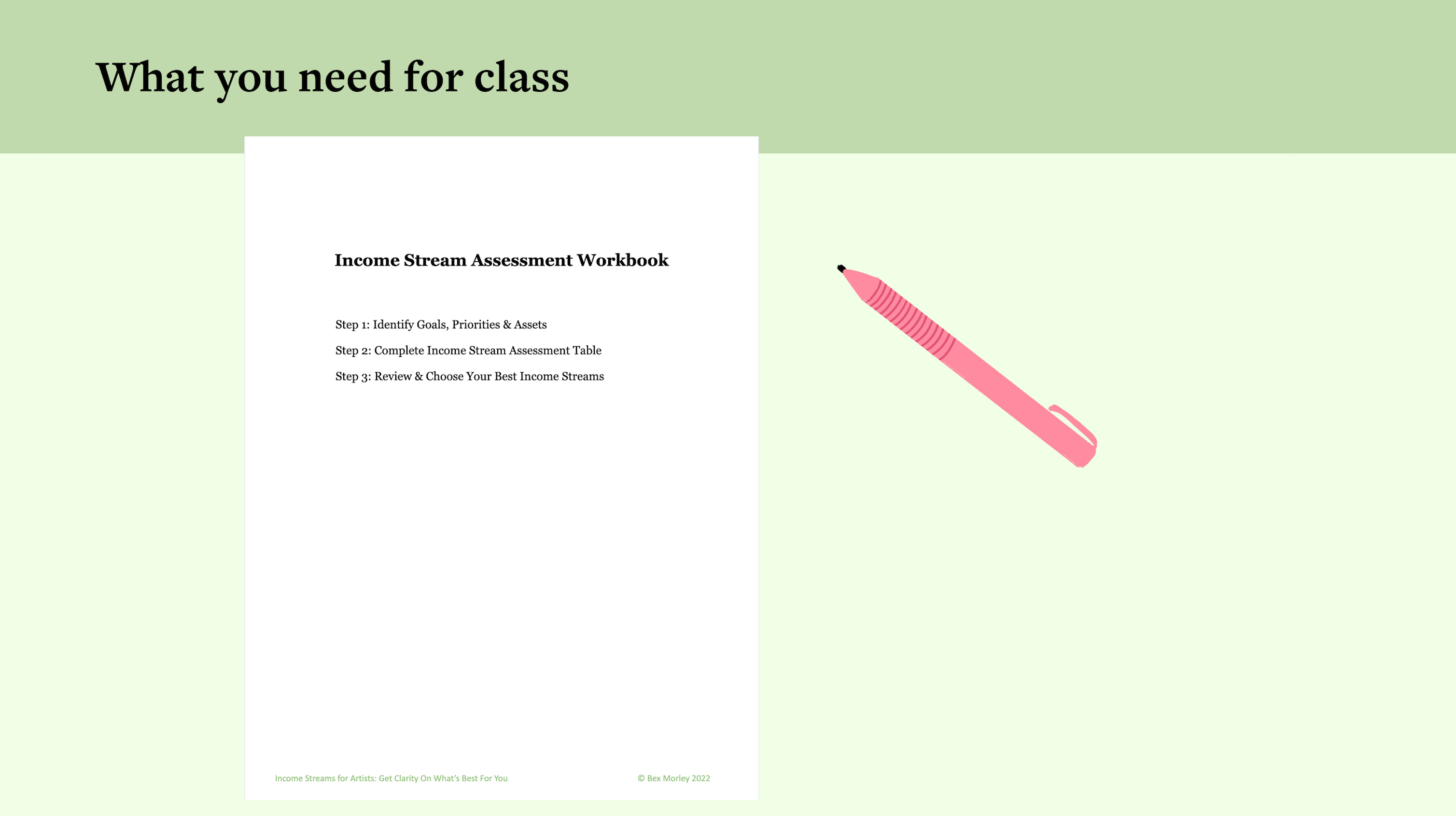
and all you need is a printout of the income stream assessment workbook and a pen. If you're ready to get clear on which income stream
opportunities are going to work best for you
and your business, I hope you'll join me in class. [MUSIC]
2. The Big Picture: [MUSIC] First I want to tell you a little bit about
your class project and why it's going to be a
good idea for you to do it. When we make decisions
in life and business, we consider the pros and cons, or in business more often
it's the benefits and the costs. This is a good thing. But when we're a freelancer, our lives and our businesses
are so intertwined. It's really difficult
to separate them. In fact, it's probably impossible
if you work from home. Rather than just considering the benefits and costs from
a business perspective, we need to consider everything. This is where a lot
of the traditional business planning lets us down. The other thing is that
when we're considering multiple income streams, we can't just consider
one in isolation. Well, it's the cumulative effect of doing that much work. How do they all fit together? Then how do they fit
together in your life? The only person who
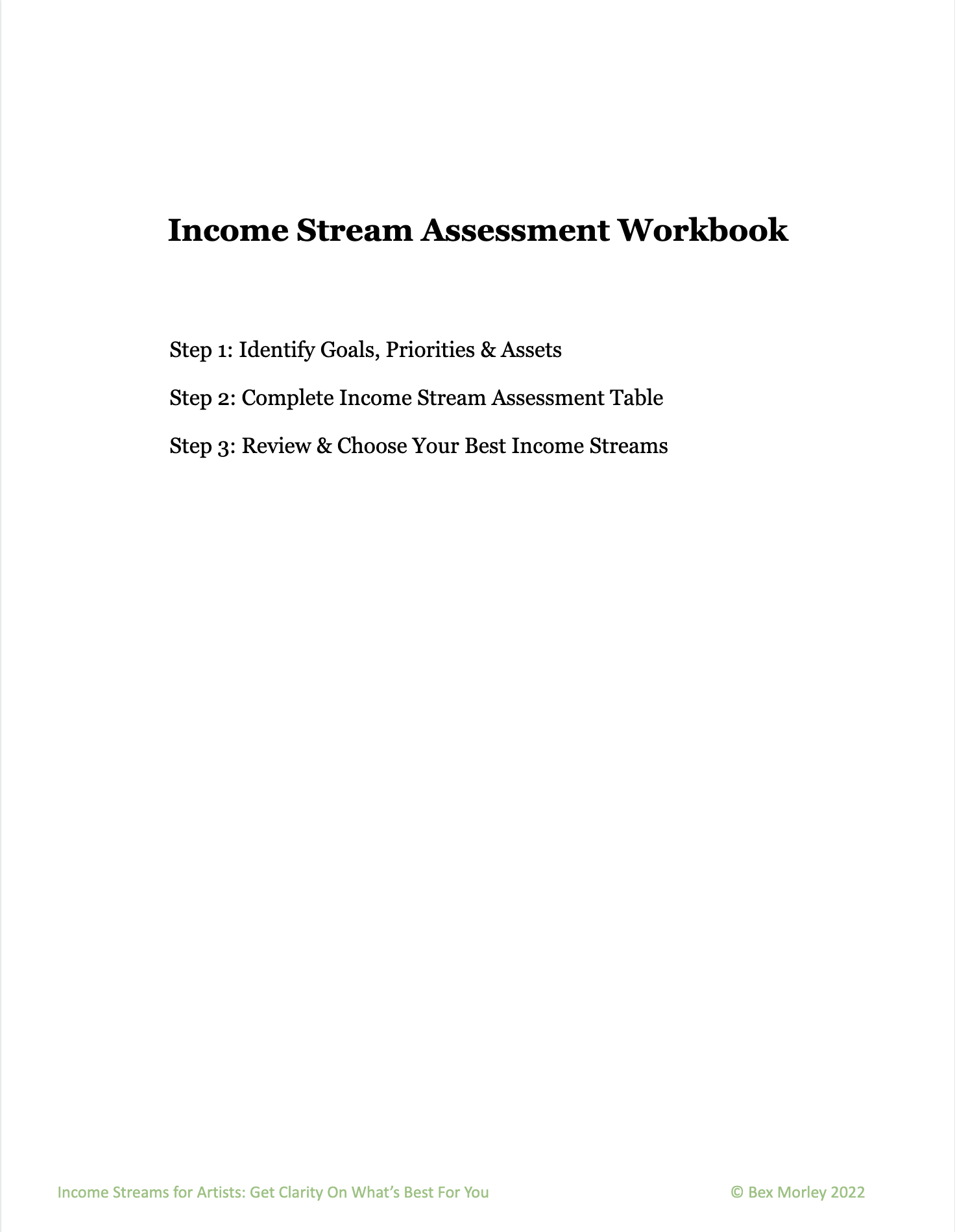
can do this is you. You need to complete the income stream
assessment workbook, which is broken down
into three simple steps. Step 1 is all about getting clear on your goals, priorities, and assets in life
and business so you can clearly see your
situation at a glance. Step 2 is where you'll fill out your income stream
assessment table with all those individual
income streams in one place to help you see the cumulative effect of multiple streams and how
they all fit together. Step 3 is where you review all your information
in steps 1 and 2 and analyze what's going
to work for you so that you can choose
the best income streams. I think at this
point, it's important to note that there
is no rule to say that you must have
multiple income streams or how many you should have. Before considering your options, let's look at the pros and cons of having multiple
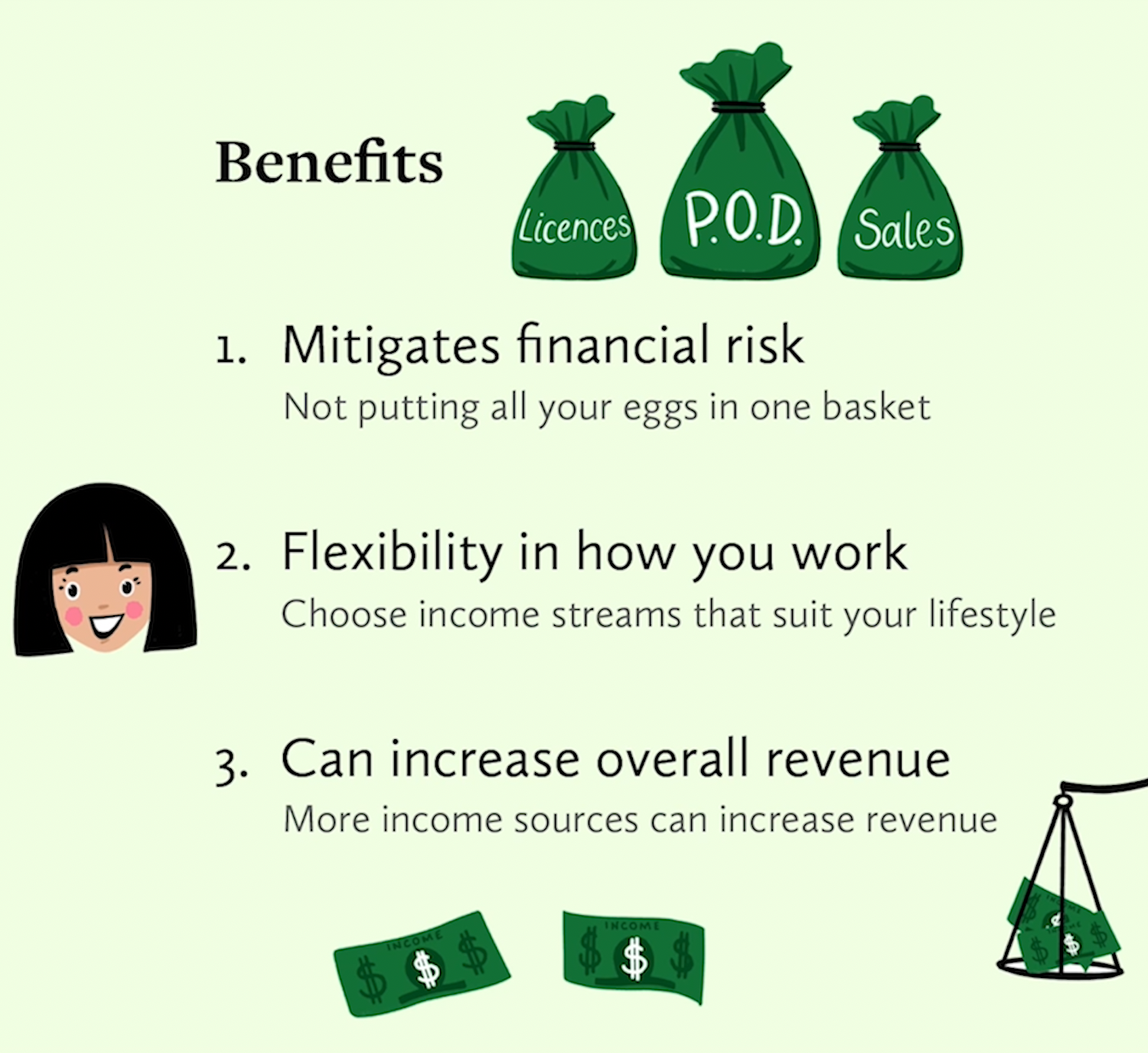
streams of income. The three main benefits are, number 1, mitigates
your financial risk. Because freelancers don't
have a guaranteed salary, we are at a greater risk of an income stream fluctuating or failing thanks to all sorts of factors which are
out of our control. If you've got multiple
streams of income, you're not putting all
your eggs in one basket. So if one income stream fails, you've got others
to fall back on. Number 2, flexibility
in how you work. Having different income streams allows you to work in
multiple different ways. You can choose things that fit your situation and provide you with any flexibility
you may need. Number 3, it can increase
your overall revenue. More sources of income can mean more money coming in a rule 3. However, there are
drawbacks as well. Number 1, there is no
one-size-fits-all solution. Whilst it makes sense to look around and see what's
working for other people, it might not necessarily
be a good fit for you. Everyone is different and everyone's situation
is different. Number 2, time and energy. All income streams require an investment of your time
and energy to maintain them, even the passive income. Number 3, it can decrease
your overall revenue. Adding too many income streams
will be counterproductive. It's all about balance. If you don't have
enough time and energy to nurture them all, those that you're not
paying attention to will suffer and you'll decrease
your overall income. Make sure to establish
one at a time and carefully consider the cost
of adding something new. The key takeaways
from this lesson is that you don't have to have
multiple income streams, but there are benefits
for doing so. There are also risks
and you've got to find that balance and
what works for you. In the next lesson, I'm
going to go over some of the most common income streams
for freelance artists.
3. Common Income Streams for Freelance Artists: [MUSIC] There are many ways that you can earn money as a freelance artist
and in this class, I'm going to go through some of the most common income streams. I'm not going to go into very
much detail over each one because there are other classes
that do that really well. I suggest that if you'd
like a list for reference, you take a screenshot
on the next slide. Here Here some of the common income streams
for freelance artists. Number 1, licensing
your artwork. You allow another business
to temporarily use your art with certain
terms and conditions, you retain the copyright. You can usually license the same artwork to other
companies at the same time, depending on the agreement, you can agree to be paid a flat fee for the license
or royalties on sales. Number 2, selling artwork. This is when you sell
your artwork and its entirety to another
company or individual, you will lose the right
to use your artwork again because they now
own the copyright. However, they will usually pay much more because of that. Payment will be a flat fee. Three, commissions
or freelance work. You're commissioned or hired to create specific artwork
for someone else, which can be a business
or a private individual. You agree on the terms
before starting work. It can be for a
full copyright or a licensing agreement
and payment can be a flat fee or royalties. Number 4, selling
your own products. There are so many
ways you can do this. You could sell products in
your own physical shop, an online shop, in galleries, markets, or wholesale to retailers. You can sell original
art, handmade products, manufactured products,
or digital downloads. Payments will usually
be a flat fee. Number 5, print on demand. You upload digital files
to a print on demand site. You can print your artwork on a variety of different products. They then sell, print,
and deliver for you once an order is received. You can also link these services
to your own online shop. So it looks like it's
coming directly from you. Either way, you get paid a
percentage of the sales. Number 6, digital stock sites. You upload digital files to a stock sites such as clip art, fonts, illustrations,
patterns, templates, etc. Customers buy a license to
use your work for a flat fee, and the price will depend on the type of license they buy. You get paid royalties
per license purchase. Number 7, subscriptions
and memberships. You can sell your own goods and services via a membership
site such as Patreon. You can provide your members
with anything you like, such as physical products, behind the scenes information,
digital downloads, videos, tutorials, educational
content, or services. Customers pay a regular
subscription fee depending on the membership
they've selected. Number 8, teaching or coaching. Use your skills and knowledge to help others reach their goals. Teaching can be done live, in-person or online via
pre-recorded classes, such as this one, or through digital downloads with
an e-book or a PDF. Coaching is always
live and adaptive, but can be one-on-one
or in groups. Payments can be flat fees,
royalties, or subscriptions. That's just a few of
the ways that you can earn money as an artist. There are loads of
variation within those categories that
I've just discussed. The common forms of
payment are flat fees, royalties, or subscriptions. Next, we're going
to talk about some of the types of income you can see and why that
makes a difference to you. [MUSIC]
4. Types of Income to Consider: [MUSIC] Now that we've gone over
all of those potential income streams for artists, we're going to look
at the types of income you can earn
from each one, and why that matters to you. There are two main types of income stream you've
probably heard of and that is active and
passive. Active income. This where you get paid for
the work that you do in direct proportion to the
amount and value of the work. For example, selling artwork, selling your own
products, teaching a live class and coaching. Some of the pros of
active income are, you get higher income
per transaction usually. You get paid immediately and you know the price at
time of the sale. Some of the cons are the
no work equals no pay. Another con is that once
it's sold is gone forever. In terms of your artwork, if you sell it outright, you can't use that again, and there's no
opportunity for scaling. Now we'll look at
passive income. This is when you get paid for the work you've
already done and you can be paid multiple times for the same piece of work. For example, licensing
artwork, print on-demand, digital stock sites, pre-recorded classes and
educational downloads. If you want to make more money, you have to sell or
license more times, but you don't need to do
the actual work again. The pros of this
are that you can take time off and
still get paid. You can get paid multiple times for the same piece of work. You can multiply
your income without extra work which
means it's scalable. The cons are, that you get a low income per
transaction usually, the pay can be delayed, such as in licensing when
you're waiting for royalties, and it can be riskier income, which can take a
long time to build. When it's in business,
scalable means that you can earn
multiple times more without doing
significantly more work or investing
significantly more money. You can see that most passive income opportunities
are scalable. However, scaling your
income can rarely be guaranteed and big
success is usually luck. But if you have a product on a print-on-demand site that
takes off in popularity, you can do very well from it. It's tempting to conclude
that passive income is better than active income because you can earn more from doing less. But in reality, this
is rarely the case. Now we're going to talk
about guaranteed income. This is usually active income. Guaranteed income means
that you definitely know you're going to get
paid before you start work. With jobs and salaries, you know you're
going to get paid. But freelancers rarely
have that luxury. When we create work
for our portfolios, we have no idea whether it'll
ever be sold or licensed, and sadly, most of it
probably won't be, especially at the
start of your career. However, if you get commissioned to create
a piece of artwork for a client or you take on a freelance contract
for particular project, the price is
negotiated upfront and you know you'll be paid
for the work that you do. The final type of income to
consider is recurring income. This is when you can reasonably predict regular
payments like a salary. For a freelancer, this is where memberships or
subscriptions come in. Many artists make good
money from memberships, but know that it
can take time to build your membership
base and it can be a lot of work because
if you're not regularly providing
value for your members, they will quickly
start canceling. On the plus side is one of the few forms of
active income that can also be scalable if you're
providing digital content, which is the same amount of work regardless of how many
subscribers you have. Here's our list
of income streams and you can see which
ones are active. We have a selling
artwork for a flat fee, commissions for a flat fee, selling your own products, memberships, and
teaching or coaching. Now look at which
ones are passive. Licensing artwork is passive, even if you get paid a
flat fee is considered passive because you can license that artwork
to someone else. Commissions and
freelance work can be passive if you get
royalty on your sales. Selling your own products can be passive if you sell
digital downloads, for example, it will
look after itself you don't have to do the
shipping and the packaging, so it can be passive. Print-on-demand is passive. Digital stock site is passive
and teaching or coaching can be passive if you're paid royalties on a
pre-recorded class. Guaranteed income. Not many options for
guaranteed income. But if you have
got a commission, then you know that
you're going to get paid for the work that you do. If you're doing some
coaching or teaching, you can make sure that you're
guaranteed that income. Finally, recurring
or scalable income. The recurring income really is the memberships which is also scalable if it's
digital content. Remember that all the passive income streams
here are scalable. This is the only
one that's active and potentially scalable. The other one that could
be recurring is if you get a regular teaching or coaching
gig that can be recurring. You can see that
different types of income stream are
worth considering, whether it's active or passive. You now know that passive income isn't as
passive as it sounds. There's a lot of work involved
upfront and it can take a very long time to grow that
into something substantial. It's also worth considering
whether you can fit in recurring income
or guaranteed income. Before you get overly excited about all
these income streams, I want to look quickly
at the creative brain. [MUSIC]
5. The Creative Brain: [MUSIC] As artists, we know that the creative brain
is a very wondrous thing. As with many wondrous things, there can be some pitfalls. One of the pitfalls of having a creative brain is boredom. Creative people often
get easily bored. Which can lead us
to look around for new and exciting opportunities
which are less boring, instead of toughing it out
on the things you've already started but are now less
appealing than they were before. This is when we're
most likely to suffer from shiny
object syndrome. This tendency can be very
detrimental to making real progress because building any income stream takes time, hard work, and patience. You're never going to love
every single aspect of your business because all
businesses have boring bits. It's very important to get
clear on why you're doing something which we'll be going
into in the next lesson, and don't give up too soon. Great imaginations. We have fabulous
imaginations as artists and we love dreaming up
exciting new scenarios. You can probably already see the enormous
potential of some of those income streams and maybe you're getting excited already. I actually hope you are,
because excitement is great. But in this world of inspirational
business memes which tell us that anything is possible and shoot
for the stars. There can be a lot of
nasty crashes which could have been avoided with good
old-fashioned reality checks. That's what we'll
be doing some of the work later of
assessing everything carefully before
making a decision on which income
streams to pursue. Finally, Comparison Trap. We see what other
people are doing and feel we ought to
be doing the same. I want you to think of other
people's income streams like other people's
pets on social media. You might see a photo of the most perfect
fluffy cat curled up asleep on a woman's
lap while she sips her tea and stares
out of the window, and you think, "I
need to fluffy cat, so I can have that life too." What there isn't a photo of is the cat vomiting on the
carpet at 03:00 AM, or the woman stepping in it
on her way to the bathroom. Maybe dealing with that
is why she's now so tired all she can do is
stare out of the window. The point is, Instagram
is not reality. Everyone is trying to present the best versions of themselves
so don't assume that someone else is financially successful or happy in
their work or better than you just because they have pretty pictures and a
large Instagram following. Many incredible
successful artists aren't even on Instagram, and what worked for someone
else might not work for you because your circumstances
are completely different. That's why we'll be looking
at your individual situation in the next lesson so you can make the right
decisions for you. You can see that whilst the creative brain
is a fabulous thing, we do have a tendency to see new opportunities through
rose-tinted glasses. I don't want to dampen
your enthusiasm, but I also don't want you to end up scattered and exhausted. In the next lesson, we're going to start our class project. If you haven't already
downloaded the workbook, now is the time, get it ready, and we're going to
start filling it out by looking at our goals, priorities, and assets. [MUSIC]
6. Step 1: Goals, Priorities & Assets: [MUSIC] In this lesson, we're going to start
on the class project. This is step one
in your workbook, your goals, priorities,
and assets. This is going to help us get
clear on what you have now, what you need, and
where you want to go? If you haven't already
printed it out, I suggest you do
that so that you can work on it as we go
through the lessons. Let's start with your goals. You're going to write
down your general business goals and some of your life goals in the long
term and in the mid term. Consider what you want from
your business financially, the amount of income, the type of income, and any major things
you might want from your life in the
next 5 - 10 years. The examples I've put down here are 20,000 in passive income, regular commercial clients, and time off to travel.
It's up to you. Just put down bullet points of the things you
think you might want to in 5 - 10 years. Now look at the mid term, break those down into
the 1 - 2 years. That could be $7K
in passive income, build a portfolio of artwork
and save money for travel. Make sure that your
mid-term goals reflect your long-term goals, but you can add other things too if they just
for the midterm. We don't need to go
into short-term goals at this stage because
we're looking at the big picture and
your short-term goals might change once you've
done this process. If you find defining
goals tricky, try asking yourself the reverse. What do you definitely not want? Which is often
easier to identify, then you can turn
that into a goal. If you don't want to fail, then your goal is to succeed. What does succeed mean to you financially and emotionally? It's up to you and don't
worry about it too much because goals can always
change over time. Your priorities in
life and business. This bit is usually
easier to complete than goals because most of us
know what's important to us. Just write down the first few
things that come to mind in each category for
your enjoyment. That means what do you love
to do in your business. If you love creating art and patterns and connecting
with others, write those things down. That just helps you not to
lose sight of what you enjoy. Financial security. How much do you
really need to earn? Not the goal, but the necessity. There is no shame in
not needing to earn anything if it's
zero, that's great. Relationships. Who
is important to you? For example, your spouse, your friends, your
family, your pets, they all take time and energy
so it's worth noting them down. What about your health? What do you need to stay
mentally and physically healthy? The examples I've put down
here are yoga, meditation, and fresh air so you write
down what's important to you. How about your soul? What do you connect with deeply
out in the world? So these isn't things
that are part of your own personal
or your work-life, this is other things. There's time in nature, having a strong
faith, worthy causes, music, it's so important to identify these things that
are important to you. Finally, your commitments. What are your
responsibilities to others? For example, you
might have a job or family commitments or you
might volunteer somewhere. Next, we look at your assets, record all the things that
you have available to you already that might help
you in your business. Your creative assets are all the things that you've
created and that you now own, so your art portfolio, your physical product,
and your websites. Not the things that
you have sold, but the things that you still
own that you've created. Next, we'll look at the skills, knowledge, and experience. What can you do well, what are you good at? Don't be humble, write
down what you're good at. Your art may be creating
patterns, maybe teaching, maybe you understand Photoshop, write all those
skills and knowledge down because it could
be useful later. Tools. What are the physical
things that you use? Could be an iPad Pro, Mac, office-based software,
all the things, the physical tools that you
have to use in your business. Finally, your resources. What other things can you use, do you have money to invest? What is your time and energy? What kind of thing do
you have available? If you only have a few hours in the evening write that down. If you haven't paused
the video already, take a moment to do that now and write down something
for each section. If you really can't think of
anything in the category, just leave it blank because it's not worth getting
stuck on this step. You just need a general idea of the big picture to keep in
mind as we move forwards. The key takeaway from this class is that you need to be
clear on your goals, priorities, and
assets before you make any major decisions
in your business. If you don't know
where you want to go, it doesn't much
matter what you do. In the next lesson,
we're going to get into our income stream
assessment table. This is the really juicy
bit of the project. [MUSIC]
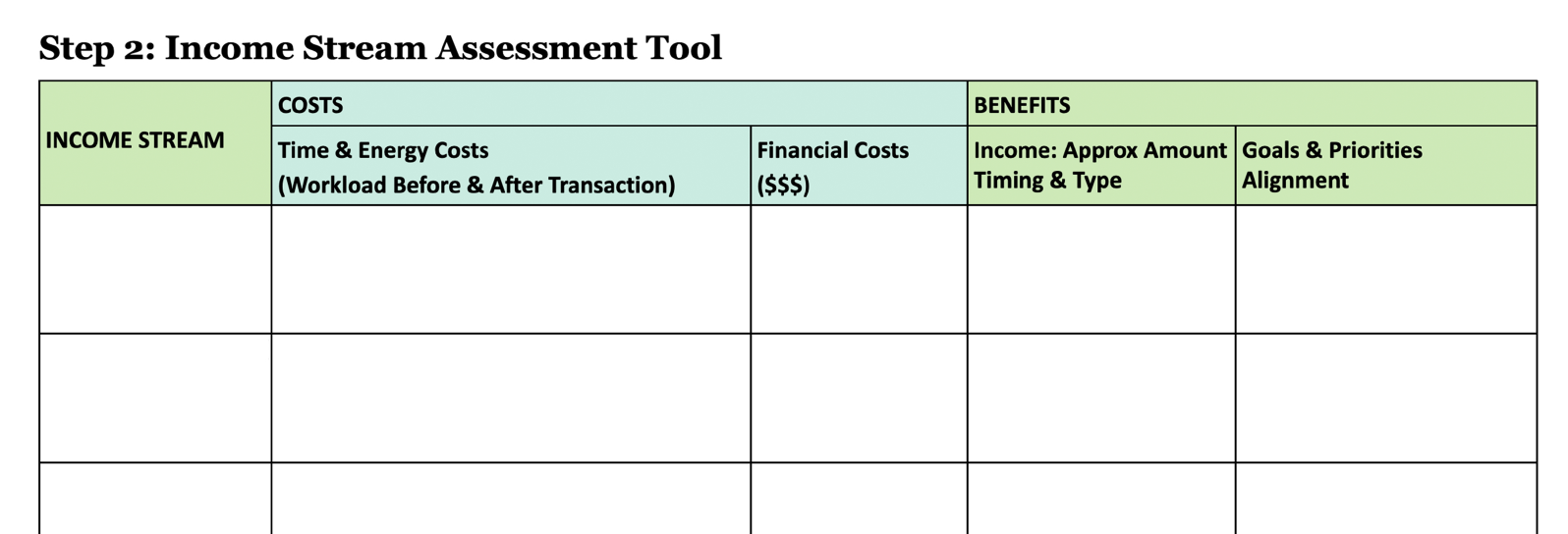
7. Step 2: Income Stream Assessment Table: In this lesson,
we're going to start step two of your workbook, the income stream
assessment table. We're going to fill it out with all the different income
streams that you've got currently and that
you're considering. You'll start to see how
everything fits together and what the cumulative effect is of doing all these
income streams. For me, this was a
real game changer. [MUSIC] Here's your income
stream assessment table. This table will help you do a basic cost-benefit analysis
of your income streams. A cost-benefit analysis is
a common business process used to determine
whether the benefits of doing something
outweigh the costs. It's like weighing up
the pros and cons. The difference here is
that you're not making one isolated decision
within a company, you are an individual who
needs to work out how your multiple income
streams all work together. By putting all of
them in one table, you can start to see
how everything adds up. Let's look at the headers. On the left-hand column,
you'll put your income stream. I suggest you start
with the ones that you already have and then add the ones that
you're considering. Then the blue section
are your costs, which in this case
is time and energy, or your workload and
your financial costs. Time, and energy, and money are your most precious resources as an individual business owner. Under the pink categories, you'll add the benefits, which is largely the income. But you also need to
consider goals and priorities that you identified
in the previous lesson. If you only focus on
the financial benefits of a particular income stream, it can be easy to lose sight of what we love about
being an artist, and what we want in our lives, and from our businesses
in the long term. I'll now go through
some examples with you. My first example is licensing
patterns to manufacturers. It's worth getting
quite specific in your income streams
at this point. Unlike the list that
I showed you earlier, which had very general
categories, this time, I would really like
you to write down the actual specific that
you're licensing patterns to manufacturers because
that will really help you work out exactly what
you need to be doing. The next column is your time and energy cost
or your workload. List all the time
consuming tasks you know are required for
this income stream. If you're not entirely
sure of the process yet, make your best guess. Don't bother with a
really tiny details. We're looking for an overview. Everyone's process may
be slightly different, so write down how you do
things or expect to do things. I've put down
research, draw motifs, pattern creation, presentation
sheet, uptight portfolio, Instagram posts, email
clients, and follow-up, negotiate contract, files to client, and update records. I've put a break here
between the things that come before and after
any transaction, sale, or licensing agreement. If you know the actual time
required in terms of hours, then it's great to
put that in too. Put as much of those
specific numbers that you can in as possible. Next is your financial costs. Here we're not putting in any of the running costs
of your business, for example, your website, your software, but more of the additional costs for this
particular income stream. Here, I've put agent fees. You might also have payment processing
fees depending on how you receive payments. Any of the specific
costs related to this income stream,
put it down here. Again, if you have
actual numbers, then please put those down
or a very close estimate. The next column, your benefits. The income is your
most obvious benefit, and you can put down the type, and the amount, and anything else that
you know about it. For licensing, it's
generally unknown. The timing of the payment
could be 12-24 months. If you're going to wait for a licensing deal
and you're going to get paid royalties for that, it often takes much
longer than you would expect to actually
see any money, but you could get
paid multiple times. The income type is passive and
it's technically scalable. Finally, your goals
and priorities. Check your list from the previous lesson and write
down all the benefits of this income stream in terms of supporting your goals
and priorities. The next example is selling
patterns to manufacturers. Immediately, you can see that
most of the workload for selling patterns is the same
as for licensing patterns. This is why most surface
pattern designers have multiple income streams
anyway, because the cost, and time, and energy
has already been made, to it's just a matter
of a different agreements at the end of it. The different comes from
the financial benefits of selling your artwork
compared to licensing it. Your income is likely
to be immediate, and the price should
be much higher because they're getting the
copyright to a work. You might only have
to wait one month for it and your income is active. If this is a commission,
it's also a guaranteed. You can see the
workload is the same, the type of income
makes the difference. The downside, of course, is
that once the sale is made, you cannot make any more
money from that design. Some manufacturers will
only buy designs outright, so it's worth considering. The next example is
print on demand. Rather than writing out all the different
workload tasks again, I've put use existing
artwork because it occurred to me that I don't
have to do it all again. I can use some of the
existing artwork if I've already done it
for the licensing and the selling
to manufacturers, I might need to edit it, and then upload it to the
print on-demand site. The benefits are, each income transaction
is likely to be low, you might only get
paid every two weeks, it's passive income,
and it is scalable. Private commissions. For
example, pet portraits. Here you can see that the
only work you need to do before sale is you
market your services. Then afterwards, you get to communicate with your
client, agree a contract, create artwork, and
voice your client and, send files or product
to the client. The financial costs might be the materials and postage if
you're sending an original. The benefits are a
medium to high income. The money should be immediate, it is active, and
it's guaranteed. Goals and priorities
could be things like you love
connecting with people, you love animals, and you want that financial security provided by the guaranteed income. Next example is selling
manufactured products online. Here you create the artwork, you format it for products, you do the ordering
and printing, you photograph it, listing, and you shop and marketing. After a sale, you have
packaging and shipping. Your immediate costs on
manufacturing costs, perhaps your sales platform, and your packaging and shipping. The upfront costs
are much higher. The income from this is medium depending on
what you're selling. The income is like to be
immediate once you've made a sale and it's active income. One-on-one coaching. Here you create an offer and
you market your services. Then only after
you've been paid, you book clients, and you offer the coaching. There are no upfront costs. The income you receive is low to medium, immediate, active, and guaranteed. Membership.
Digital content. This is just an
example of one of the many types of
membership you could offer. You need to create and send
out your content and value for members and you need
to market your services. The workload is continuous. That means you're
going to have to keep doing it every single month. You cannot set it and forget it. When it's a membership,
you need to be providing value on
a regular basis. The income is low
per transaction, but money is immediate
once you've been paid, and it's recurring and active. Although some of
these income streams, particularly the passive ones, the initial transaction or the per transaction
amount is low, these things, remember, are scalable so they
can add up over time. [MUSIC] If you haven't
paused the video yet, please do so now and fill out this table with all of the
income streams that you currently do and all of the
income streams that you're considering so that
you can really analyze which ones are
going to work best for you. If you don't know exactly how to fill in one of the
categories right now, make your best guess. Use actual numbers if you can. When you're fill in your income, you can use the income per
transaction or you can give a general number for the whole year if that's
what you're anticipating. It doesn't need to be
perfect in order to be useful so long as
you understand it, we're looking for
the overall picture. Before you move onto
the next lesson, I want you to go through every single income stream categories that you've just put down, and market as high,
medium, or low. Even if you don't
have precise numbers, this will help you
see at a glance whether it's a high workload, low-income, or vice versa. The key takeaway from this
class is that big decisions in your business need a cost
and benefits analysis. This helps you to determine what your best return
of investment is. That's the investment
of your time, energy, and money for each income
stream that you're considering. When we put this table together, you start to see how
everything fits together, and the cumulative
effect of that. I hope that's already starting
to bring you some clarity. The next step is to review all the information
that you've gathered so far and make your decision. [MUSIC]
8. Step 3: Review & Decide: [MUSIC] This is the final
part of the class project, Step 3: Review and Decide. We're going to review all
the information you've gathered and then
make your decision. By the end of this lesson, you're going to have clarity on the best income streams for you. Your next step is to answer the costs and benefits review. These are questions
to help you notice the important aspects of your
proposed income streams. Something I immediately
noticed when I completed this myself was why I didn't seem to have enough
time to do everything. The benefit of
putting everything in one table is that you can easily see how all the
different things add up. These questions are
fairly self-explanatory. Rather than go through everyone, I'm going to ask you to
look at them all now, pause the video and take some time to answer
them by yourself. [MUSIC] You now have all the information you need to make a well-considered
decision. But before you do
that, remember, it takes time and consistency to build
any income stream, so give it time. You can't build multiple
streams of income overnight. Establish one at a
time so that you know what's entailed before
adding something new. Similarly, before eliminating
an income stream, consider whether
you've really given it enough time and consistent
action to make it work. Don't move on and waste the work you've already
done just because you're bored or
uncomfortable with the next step you need to take. Is less work to tweak
something that you're doing, then start something new. At the same time, if it's time to let
it go, let it go. The second point I
want to make is that sometimes you just
have to try it out. It's common to be unsure whether something will work
out for you if you've never done it before and often there isn't one perfect answer. Make the best decision
that you can in the moment and test it out to see
if it works for you. If it doesn't, you
haven't failed, you just didn't get the
results you're expecting, and you now have more knowledge
about what works for you. Don't get too hung up on making the one perfect decision or
you might never get started. Start by considering which current income
streams that you will keep. Then once you've done that, how can you maximize those incomes or make
them more efficient? Then you're going
to look at which current income streams
you're going to eliminate and whether
there's anything you need to do to extract yourself. Which new income
streams will you add? When will you start?
Is there anything you need to do to get started? Which new income streams
might you add in the future? How will you make time for this? Remember, you want to
establish one at a time so that you know exactly how
much work is involved, and then you can make time
for other things maybe. But have a think about
how you might make time for that or whether
you're taking too much on. Pause the video and make
your decisions now. [MUSIC] Congratulations, you now know which are the
best income streams for you. Take a moment to appreciate how much hard work you've
done and feel that clarity. It's such a good feeling. I also want you to remember that each income stream is going
to take time to build. Don't rush off and start
too many too soon. Give it time and give it
that consistent work. I also want to
encourage you to keep this workbook into the future. This could form a
really important part of your business planning. Is going to be useful if
you keep updating it, then it'll still be relevant
and it will help you get some clarity as you go
forward in your business. Next, I'll give you
a few final thoughts on the income stream assessment, and I'm going to
give you some bonus questions that you can apply to all the other
smaller decisions that you have to make
in your business. [MUSIC]
9. Final Thoughts & Bonus: [MUSIC] This is our final lesson. I really hope that
the income stream assessment workbook
has given you some clarity and that you know now how you're going to go
forwards in your business. That income stream
assessment tool is also useful for other
business decisions. So even if you're considering
your marketing policy, it doesn't just have
to be income streams. You can do that
cost-benefit analysis. Not all the decisions we make in our business are majorly
impactful forever. Sometimes we just have an opportunity that
presents itself, such as a personal project
that we want to do or a class that comes up or
something that's being sold to us as a
good opportunity. In those situations, you don't necessarily want
to have a look at the big picture because
you just want to make a decision on this
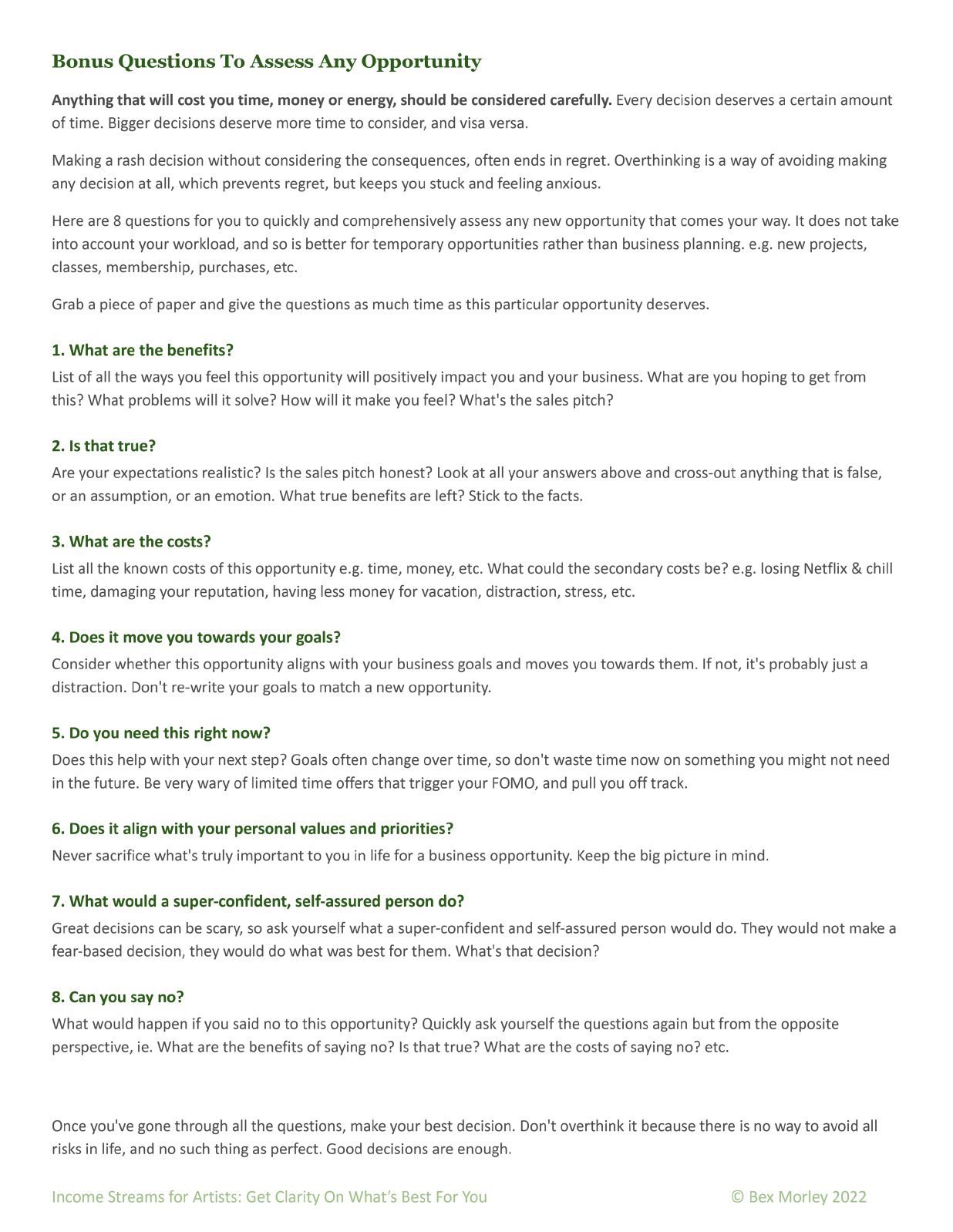
thing independently. When that sort occurs, I have this set of
questions that I've found really useful to help
me make those decisions. That's what I'm sharing with
you here in this bonus. This is a set of
questions that will help you make a decision for any opportunity
that presents itself in both
life and business. As you can see, the first
six questions focus on the cost-benefit analysis in a similar way that you just
reviewed your income streams. However, there are a
few key differences that I want to point out. Question 2, is that true? This is for when we're considering something
that is pitched to us as an opportunity or something that we're really excited
about in the moment. Are you making any
assumptions about this or are you just been
very emotional about it? What true benefits are left, and stick to the facts? This is particularly
useful when you're considering some of the
opportunities presented to you. There are lots of very dodgy sales pitches out
there and I want you to really assess whether their claims are
entirely true or not. If it seems too good to
be true, it probably is. The next question
I want to point out to you is Number 5, do I need this right now? Does this help with
your next step? Doing new things is
always uncomfortable, whereas planning and
learning feels safe. So be careful not to
procrastinate on the work you need to do now by over
planning for the future. If you don't do the
uncomfortable work you'll never get there anyway. So it's pointless. This usually comes off in the
form of classes. How many people have taken
a class because it might be useful one day and they never actually use
the information? Only learn what you
need for the next step. Question 7, what would a super confident, self-assured
person do? Some people are
chronic over-thinkers and hate making
decisions. No judgment. I've been that person too. What I noticed is that
decisive people don't always make the right decision and
they're okay with that. Let go off the perfectionism
and fear and know that an imperfect decision
won't destroy you or your business so long as
it was well-considered. Make the decision that feels like it will move you forward, not the one that
avoids any discomfort because that's what a
confident person would do. Finally, can you say no? What would happen if you
said no to this opportunity? By reversing the situation
and asking yourself, how would you feel about
saying no to the opportunity, you can go through the question
again with that premise. For example, what are the benefits of
saying no and so on? This often helps to
bring some clarity and identify any FOMO
based decisions. Thank you so much
for taking my class. I really hope it has
brought you some clarity on your income streams and how
they all work together. Please do share your workbooks
in the class gallery. Don't fall into the trap of
making your workbook pretty. I'm the biggest culprit of this. Maybe it's just me,
but we're artists. This is a business workbook. It can be as messy as you like. It doesn't have to be perfect. I would like you to share your messy unperfect
workbooks in the project gallery because
it's really inspiring for other people to see what you've been deciding and what
you've been doing. I know that there might be some sensitive
information in there. If there is, please just block that out
before you share it. I hope that you're excited
about your future and the clarity that you
now have over how you're going to proceed
with your income streams. [MUSIC]
 Bex Morley, Artist & Business Coach