Transcripts
1. Welcome! Start here: Hi and welcome. In this class, you learn how to
unlock creativity and generate original ideas
whenever you need them. This class is for
creators, professionals, and anyone who wants to
think more creatively, but often feel stuck unsure
where ideas come from. If you've struggled
to come up with ideas or wonder how
creative people do it, this class will
show you a clear, practical way to
approach creativity. Throughout the class, you'll
explore three key pillars, understanding what
creativity is, learning simple methods
to generate ideas, and finding inspiration
in everyday life. You'll practice idea
building exercise, learn how to connect different thoughts
through association, and build simple system for capturing and developing ideas. Recommend watching
video is noted because every lesson built
onto the previous one. If you guys have any questions, be sure to drop them in
the QN section below. Just make sure to check the existing question
first because there's a good chance that
question going to ask has already been
answered in detail. At some point, you'll be
asked to leave review. Please wait until
you had a chance to really experience
the material. Your honest feedback
helps improve the course, and better serve you
and feature students. Thanks, Gail for
joining this class. I'm genely excited to help
you learn creativity and to use some real projects where the personal or clients based. Let's jump into the first v.
2. What Is Creativity? Understanding How Creative Thinking Really Works: First of all, let's identify
what creativity is. Unless we do this step, we will not be able to
master it and prove it. We need to understand exactly
what we're dealing with. And it's actually not
as easy as you think. For example, if we Google
what creativity is, creativity is the ability
to generate, connect, and transform original ideas, knowledge or insights
into valuable, tangible or intangible products. That's not an easy definition. The problem is that we
can question a lot here. Like, what is an original idea? What is valuable? What is
tangible? What is intangible? I've spent a lot of
time looking and trying to identify
what creativity is. And if we simplify it to the simplest sentence
that we can think about, creativity is the ability to create something
because if we take root create creativity is
exactly the same thing. In whatever niche you are, you're able to create something, and so if you're able to create something, that's creativity. Obviously, we can stretch
the definition forever. But if we think
about creativity, we have a general
idea of what this is, like, the ability to
create something. So let's get into the next video and explore how and what can we
3. The Association Method: How to Generate Creative Ideas Faster: One of my favorite ways
to spark creativity or generate creativity is
playing game associations. You might have played
with your friends or you might have not played
it. It's very simple. I will tell you a word
and pay attention to the first thing that comes up
when you think about this. Try to visualize it. Something
will come up in your head. Most likely, you are not
going to have just like a black screen in your head with just that object or whatever
we will think about. What do you think
about? We'll have some sort of surrounding. Take a look at the surrounding that your brain will generate. And just pick one of the
things from surrounding. Like, for example,
a book for me, the book associates with pages because that's what
the book is made of. But then the pages
associate with trees because that's what
pages are made of. Trees associate with Earth, Earth associates with planet, plant associates with space, space associates with science, sciences lab, lab mice, mice is field, field is grass, grasses, horses, horses are
beaches, beaches are oceans, oceans are ships,
and you can just go on forever and explore way, that's my favorite way of coming up with any sort of ideas
or creativity, whatever. You can go like this forever. By the way, the way you
play this game with your friends is one person says one thing and the other
person associates something, and then the third person
does another association. So you just go like this, and it's interesting
because it's almost like random to start is
just to look around. Oftentimes, when I try to spark, just get that first ignition,
get the first spark. I literally look around
and try and just see like, Okay, I have a light here. I have glasses, eyes, table, water, tripods, wall, I
have a door, I have a room. I just look around, see what you have around, and it will really
help you start. So the first one is the
game of Associations. If you have any
questions, let me know. Other than that, let's
jump into the next video.
4. The Cross-Matching Technique: A Simple Exercise to Spark New Ideas: Now the second way to creativity
is a paper and a list. Well, you know how to generate a random combination of weird things by using
the game of Association. And now I just put together
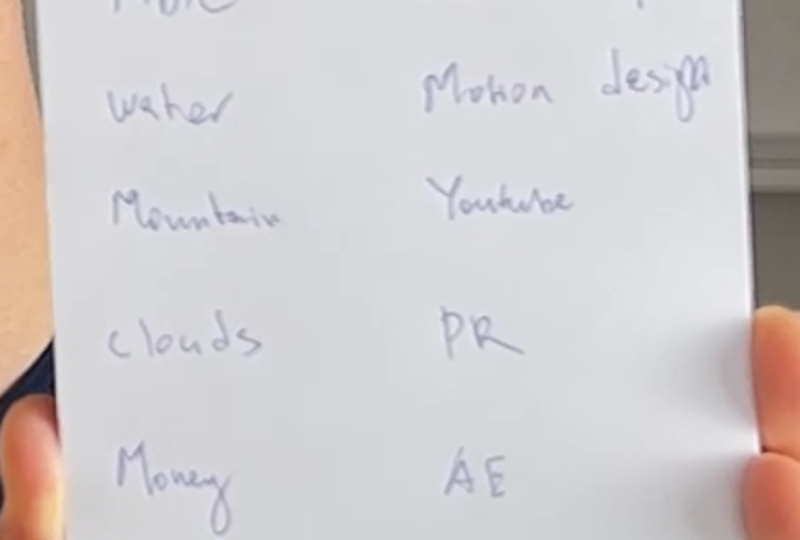
a very quick list, and on the left, I have just a number of
random stuff like table, water, mountain,
clouds, money, car. But on the right side, I have a list of
things that I have to connect with because
that's part of my job. So that is video editing,
motion graphics, YouTube, design, premier
pro after effects blender. So how do we connect
that do? Very simple. We just have to cross
it and overlap it. So for example, the first one table I create a video
about a table? Yes. Can I create motion
design about table? Yes. What about YouTube
video about the table? Yes. What about table in
Premiere Pro in the software? Sure. What about after
effect? Yeah, absolutely. That blender as well, yes. Then I see which
one works where. What are motion design?
Technically doable, but maybe not as good. What about YouTube?
Maybe not as good? And I just go through that list and see what's working
and what's not working. There are a couple of reasons
why this works really. First of all, it's paper. Like, it's physical. It's
a paper. It's a pen. You can use a pencil. It
doesn't matter at all. When you do something physical and not just in your head
or on your computer, it's a completely different
process to your brain. In the book, still
like an artist, I believe the author
also talks about it. So it's really, really powerful. I really recommend
you. Second, it already exists in real life. Like, you have some
stuff on the paper, and it's a lot easier to just
do it physically than to do it in your head or in your computer because whatever
you have in your head, put it in a piece of
paper, it becomes reality. When it becomes reality, it's a lot easier to get it moving than to just get it from
here or from your computer. On your computer, you're
not able to do like that. You cannot cross it. You
cannot kind of connect it, combine it, draw
something, put notes. You cannot do that
in the computer, but here it is creativity. Here's where it's sparks. So that's where the
part to use it. If you feel like you have
some ideas that you can find better use of the paper and
the pen, go ahead and use it. There's no limit. You just use
whatever options you have. So if you have any
questions, let me know. Other than that, let's
jump into the next video.
5. Questions and Time: How Your Brain Generates Ideas in the Background: The third way of creativity
is questions and time. I'm sure you had this
situation in life where you want to remember something
and you cannot remember. But then a couple of days
after just all of a sudden, it bumps into your head, and you're like, Oh, well, I've been thinking about that
a couple of days before, and now I know the answer. The same thing happens
with creativity. So if you put questions
in your head, you will get an answer
sometime in the future. You just have to wait
for it a little bit. Honestly, this technique is almost like cheating.
It's really good. The way I use it is throughout my everyday life during the
day, during the morning, before bed, I just ask myself some questions.
How can I do something? How can I make this reality? How can I make this
video possible? Like, what kind of ideas would be interesting for
some sort of audience? And then I just think
about those questions, and I think about
them sometimes, forget about them, but
then all of a sudden, then you know, it's
just out of nowhere. I just have an idea in mind, and these ideas are really good. And the good thing about them
is that they're original. You didn't just copy somebody,
but you came up with it. Of course it may not be
original in terms of that. Somebody already
came up with that. And that's not the
point, because there's almost nothing
that's new in this world. Almost everything that
exists in a world is some sort of well
forgotten past. Like, think about the new
movies like Batman Superman. That's movie from
70s, 80s and 90s. That's from the last century. So ask yourself questions. You might be looking
for something. Wait a little bit.
Don't rush it. Don't push it. If
you rush and push, it's not going to work. Have to give it time. Once you ask yourself a
question, give it some time, might be a couple of
days, might be a day, might be an hour, it might be a week, but give
yourself some time. You will get the answers.
Try this technique, and trust me, it will completely transform
your creativity. If you have any
questions, let me know. And that let's jump
into the next video.
6. Finding Inspiration: How to Train Your Mind to Notice Creative Ideas: The next super powerful
technique when it comes to creativity is inspiration. You can get inspired
by many things like books, movies, music, sunsets, countries,
YouTube, people, trees, nature,
mountains, and so on. I think a good indication of getting inspired by
something is getting a strong emotional reaction or sort of like a goose bumps. You might have a
different reaction. You get some sort of physical or mental reaction
to it in a good way. When you get inspired, I feel
like creativity just ten Xs and it's a lot easier
to come up with stuff. Oftentimes, I think about
what if I did that. If I was the character
of the movie and I did something
like this in real life, or I really like that, how
can I make this into reality? How can I make this into, like, let's say, YouTube video? Music really streamlines
a lot of things, and instead of it being
kind of like a bumpy road, we can create a smooth river that's going to
smooth the surface, it's just a lot easier
to do it this way. Anything new, which oftentimes is a little bit hard for people, but at the same time,
it's really powerful. Me and you, we don't like New. The reason is because something new usually meant
death in the past. But now new can
actually inspire you. So if you are really stuck
with your creativity, try something new, watch a new movie, listen
to a new song. I know it sounds like
it's not going to make a difference because
I was in your shoes. That's exactly what I thought. But then whenever I did, listen to a new song, watched
a new movie, you know, went on a different
walk or something, try something new in
whatever area you're thinking and it's going to completely transform your life. If you have any
questions, let me know. Let's jump into the next.
7. The Volume Strategy: How Generating More Ideas Leads to Better Ideas: Now let's talk about
the volume game. Oftentimes creative
people are really bad at business stuff and
business people are really bad at
creative stuff. So let's combine the
two worlds together. You already know how to
come up with creativity. Now, we need to take
the business side of things and make it
sustainable and practical. So when you think
of something new, when you try to
come up with ideas, when you try to mix
things together, you don't want to
limit yourself. You want to come up with as
many things as possible. Trust me, your brain will
limit it at some point. You might come up
with five, ten, 20 or 50 Ds in a row
literally in one sitting, you might have even a
problem writing it down, but then your brain will
stop. Don't limit your brain. Your brain will limit itself. What you want to do is write
as many ideas as possible, then take some time off and
come back to these ideas. In sometime in the
future, let's say, in an hour or in 24 hours, I like to give you 24
hours because after sleep, my brain just thinks
a lot better, and it almost like
resets because it's almost like I get a bias
if I do it the same day, but if I sleep on it,
things are better. And so I'd like to give
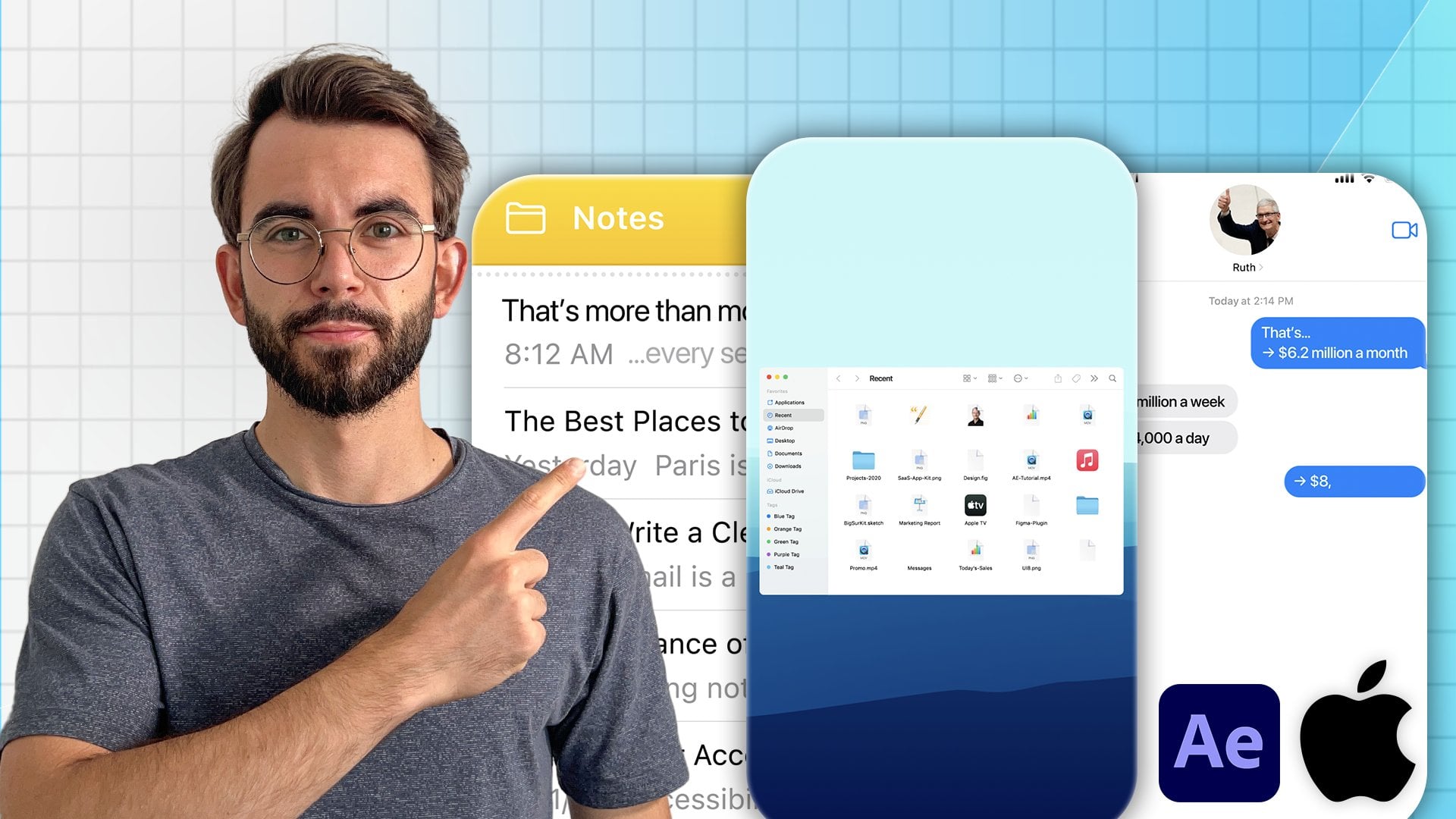
you a couple of examples. I keep my ideas in something
like Google Docs or, you know, Apple notes,
doesn't matter. So here are a couple of ideas. I had video ideas
from Google Calendar. This is literally
the ideas I put in Google Calendar. I
came up with that. So these are a couple of other video ideas that I
found in some other ways. This is for, like, one software. This is for another
software, another another. That's just a couple
of ideas from 2024 that I saved somehow. In 2023, I think I had even more ideas.
Yeah, there you go. This is literally just something
I came up from my head, L over 200 different ideas. The great thing
about it is that I'm able to just delete
if it's not good. But if I forget a good idea, I will not be able to just
easily remember that. So it's better to keep
as many as possible and then get rid of the
ones that you don't need. By the volume game, I mean, you want to come up with as many ideas and
stuff as possible. You want to make sure
you do it regularly. So just give yourself like ten, 15 minutes every day to come
up with different stuff. If you get a little
bit of pressure, sometimes it can be
a little bit bad, but it also can be
good depending on the kind of person you are
because if being limited by, let's say, time, you have
to do something in 1 hour. If that gives you
creativity, great. For some people, it
might give stress, and when you're stressed,
creativity doesn't work. But anyway, you want to come up with as many
ideas as possible, cut out the ones that you don't want. It's the
best way to do it. Don't limit yourself. Your
brain will limit itself. If it doesn't limit
yourself today, trust me, use that because
tomorrow it may not work. Like, this thing is interesting. And you can store ideas on your device, on
a piece of paper. I do prefer the device just
because it's easier to store that and you don't have to have physical stuff lying
around the physical mess. So I like to come up with something here or on
a piece of paper, put it on device, and then I have a lot of the
stuff on the devices. If you have any
questions, let me know. I think that let's jump
into the next video.
8. Last Step!: Congratulations.
You're nearly 100% done with creativity, mastery. There are just two
small steps you need to take. First, take action. As Kafucha said, a journey of 1,000 miles begins
with a single step. So if you empt ready, take your first step by coming
up with the first ideas. All the best information
in the world means nothing if you
don't act on it, and small steps lead
to massive outcomes. Lastly, if you found
involved in this program, I would really appreciate
it if you could take 60 seconds to leave
you honest review. I will immensely appreciate
this in feedback will massively help future students in deciding the best
program for them. Although this quiz is complete, your journey has just begun. I'm excited to see ideas online, so be sure to keep me and
fellow students posted. Remember, I'm here
for your success. So if there's
anything need, don't hesitate to reach out
in the QN section. And for choosing as instructor, wish me all the best I'm looking forward to seeing you
in future courses.
 Vladislav Sateev, Video Editor