Transcripts
1. Introduction: Welcome. Are you ready to captivate your audience and
have them embrace your ideas? Dive into the art of using story design to supercharge
your presentations. Picture yourself or your team gearing up for an
important proposal, a conference talk, or getting ready to present for
an RFP response. Now imagine having
a secret weapon for crafting presentations with
confidence and credibility, knowing you'll address your
audience's specific needs and connect on an
emotional level. You'll feel like a
presenting superhero. If you understand
storytelling is power, but aren't sure how to fully apply it, you're in
the right place. You'll master how to leverage story design components to give structure and flow to your
presentation as a whole, as well as we
relevant stories into your discussion to deeply
engage your audience. I'll give you a template and show you how to build
your presentation so that you can
match your prospects specific needs and craft clear, memorable messages
that resonate. By following this
simple process, you'll feel confident
communicating how you can help, and you'll inspire action. I'm Yvonne Lines, and
I've been helping some of North America's leading brands develop marketing
content for decades. Lately, I've been
focused on helping craft sales presentations using
elements of story design. It's yielded my clients
remarkable results. This method has helped a
major consulting firm here in Canada increase their win
rate by a staggering 30%. I've been asked to teach the story approach
countless times. Now I'm sharing
my expertise with you so that you can captivate
your audience as well. Later in this course, you'll
have a class project. You'll set the scene for
your story presentation using a downloadable
tool and my guidance. You'll be given direct feedback to make sure you're heading
in the right direction. Join me to harness the
power of story and make it easy for your
prospective client to say yes.
2. Audience Centricity: The most crucial
aspect of creating deep engagement is making your presentation
audience centric. It should be all about
them and their interests. Sorry to disappoint, but
your audience is going to be a little bit interested
in you and your background. Even then, only the parts
that are relevant to them. You need to get to know your perspective client
as best you can. To explain how important
this concept is, let's start with a little story. Picture yourself
with a sore knee. It's been hurting for a while, so you research a doctor in
your area who seems to be knowledgeable and go to
see her at her office. During your appointment,
the doctor tells you all about her background
and how qualified she is, what she specializes in, some of the other
work she's done, and walks you through all her qualifications that are framed and
hanging on her wall. She's got an overwhelming amount of experience to impress you. Finally, you tell her,
you've got a sore knee, so she writes you a prescription and sends you on your way. Let's call her
doctor traditional. Off you go, but you're thinking, doctor Traditional here
seems to know what she's doing and maybe I
should just go along with it. But I don't feel like she
really understands me. She didn't put the effort into
getting to know my issue. So how can I be sure she's giving me the best prescription? Maybe there's something
else I should be doing. So you decide to see what
another doctor has to say. You do some more research
to find someone else who also has a reasonable
amount of experience. This one we'll call
doctor Audience Centric. You walk into this
new doctor's office and she asks you about your
knee problem right away. You tell her about your pain, and she asks you about your
lifestyle and if you sit, stand or walk a lot. And she observes
your body position for all three of those things. She notices that you're a little off kilter when you walk, and she shows you
how to straighten your posture and
correct the imbalance. What she says to
you makes sense, even though she hasn't told you much about her background. Then she gives you the
same prescription as doctor Traditional did and
sends you on your way. For the sake of
this explanation, we'll ignore that you just
got two prescriptions. If you were to
continue with one of these doctors, who
would you choose? Doctor Traditional who bored you with an
overwhelming amount of information about
her background and her experience or doctor
Audience Centric, who geared the conversation
to be all about you and your needs and even give you some valuable information
right on the spot. I've obviously set
up this story to lead you to answer
doctor Audience Centric. At the starting point,
you had knee pain and she engaged with you and solved
your specific problem. It's easy to give her a yes. We'll do the same thing
for your presentation. You'll uncover the pain points of your perspective client, you'll engage them and solve
their specific problems, and then it will be easy
for them to give you a yes. Have you engaged on
that level? You story. It's innately human to
connect with stories, but not just any story. It needs to be relevant, meaning it has to be of
interest to your audience. I know the word story can
be overused and misused. People often refer to any
sort of narrative as a story. In this course, we're going
to use it in two ways. I'm sure you're familiar with story telling and how it can
captivate your audience. I'll show you how to weave many stories into
your presentation. First, though, I want to discuss what I refer
to as story design. We'll be using the components of great stories to give your presentation
structure and flow. We'll be mapping story elements onto your presentation
so that we can keep your audience captivated from beginning right
through to the end.
3. SP3 StoryComponents: In this lesson, we'll
look at the structure of a story and how it maps
onto a presentation. This structure will help your talk flow from
one idea to the next and stay relevant and
audience centric throughout. Your presentation should make it easy for your prospective
client to say yes. However, that means
that you have to do the hard work for them
to get them to that answer. You can't just flip through slides and read points
and information on a screen with your fingers
crossed hoping they'll figure out how what you're saying
maps to what they need. You need to show
them how you can help and make it easy enough for them to turn around and explain your solution to other decision
makers and influencers. Since you're in this course, I know you realize that
you need to stay ahead of your competition and
you're willing to do the work to bring your
skills to the next level. This story process may feel a little bit awkward at
first because it's new, but I promise you,
you can do it. If you've ever read a
child a bedtime story, then you can use story to sell. I'm sure you've read
children's stories, but if not, I highly
suggest you do. Even if it isn't a great story, you'll still have a good
bonding moment with that child. It will be memorable. As
humans, we can't help it. We're wired to
connect with stories. The same goes for using story with your prospective client. Even if you have a few bloopers, you'll still engage your
prospects so much more than the traditional
points on a slide method. Story will help you connect with your audience emotionally. People remember
how you make them feel and a few
messages. That's it. Let's look at a few
story components to help you connect and
get your passion across. We've already talked about being audience centric when we
discuss the doctor example. In that story, you were the relatable character
with a sore knee. Every story has a
beginning, middle, and end. It helps ideas flow
and most stories also include some
transformation that's tied to the moral of the story. I'll give you an example,
starting with audience centric. If the girl in this
picture is your audience, you're not going to tell her
the story of the exorcist. You'll choose something
more appropriate, such as one of AsopsT tales, the tortoise and the hare. Maybe you choose
this story because it has a message
she needs to hear, as in she's troubled about not being able to run as
fast as her sister, and this story will help
her see her own strengths. You might even adjust
your story to include her like naming the
tortoise after her, making her the relatable
character in her own story. Let's look at the
structure of that story. In the beginning, the
slow speed tortoise and the super speedy hare
are going to run a race. We all think that the rabbit
will move quickly and win. In the middle of the race,
the rabbit is so far ahead that she decides to stop for some carrots and a nap. Meanwhile, the turtle keeps moving at her slow
and steady pace. At the end, the rabbit
awakes and rejoins the race, but it's too late
for her to catch up, and so the turtle wins. There's the beginning,
middle, and end. Now, during that story,
there's a transformation. We all think that
the rabbit will win, but then we see that the
turtle is the champion. This transformation leads
to the moral of the story, slow and steady wins the race. Now let's see how
these components map onto a story
based presentation. You'll design your presentation using the same
structure of a story. I'll be giving you a tool in a later video to make
this easy for you, but here's a quick overview. Your presentation will
also be audience centric and have a relatable character.
That part's the same. You'll make it about
your prospective client and address their pain
points and needs. If you're pitching to
an existing client, you might call it
client centric. Your presentation will
have a beginning, middle, and end, but we'll call
that structure and flow. In the beginning,
you'll set the scene. The middle will demonstrate
how to go through a transformation and
the end will summarize. The transformation will contain
your three key messages, which are your client's
problems that you can solve. We'll use problem
solution pairings to suss that out
in a later video. Those pairings will lead to
the moral of your story, which we'll call
your main takeaway. Again, we'll talk
about that in a bit.
4. Know Your Audience: To better understand
your prospective client, build an inquisitive
relationship with them leading up
to your presentation. Ask questions to find the underlying causes of the
challenges they're having. Get to know them as
much as you can. I mean, without full on
stocking them, of course. However, I understand that sometimes you can't
call them directly. You may be going through
a broker or if it's a request for proposal,
RFP response, then you may only
have one opportunity to submit questions, or maybe your potential
client is just plain busy. You can still do some
online research. Ask for information through a partner or mutual
acquaintance, interview someone who
you know who is similar, such as they have a
similar role and in the same industry and may
face the same challenges. And just try picturing yourself
in that person's shoes. What might they need most? If you'll be
presenting to a group, think about who the
decision makers are and who are the influencers. What do they each need
to hear from you? Or what sort of topics
will appeal to them? Your audience's gender,
age range, job title, and geography are demographics
that are usually fairly simple to figure out
and could lead you to some generalizations
about who they are. Also, think about if they
are detail oriented, tech savvy, big picture C
suite types or numbers people. The more you know about them, the better you can customize
your presentation. Sometimes just a few distinct
words here and there can make a big difference in
helping them feel connected. It's also important to
look beyond demographics and figure out your
audience's psychographics, as in what are their needs
and their pain points. If you are in an RFP process, why are they inviting
proposals now at this moment? Perhaps they have
greater competition than they had in the past, or their market is changing or they've grown as a company. All these things can help shape your presentation to what
resonates with your audience. Also, what do they
stress over personally? Maybe they want to
leave a legacy or need easier streamline processes or more time away from
work for family, health, or fun activities. Really think hard about
their main concerns. Those are the challenges that
you'll be there to solve. When you know their
side of the situation, you'll be able to
better anticipate any tough questions
that may come up. Once you feel prepared
with your answers, confidence will pour out of you. When you feel you have
a good understanding of your audience and
their current situation, the next step is to
visualize a future for them. Where do they want to be? How can you help them get there? Think of it in terms
of moving from point A to point B with a call
to action in between. Where are they now? Where
do they want to be? What do you want them to
do to reach their vision? Here's an example using this presentation from my
audience, which is you? Point A, you've been
using traditional methods but have pressure on you to be stellar in an upcoming
presentation. Call to action, captivate your audience using story
based presentations. Point B, you want a deeply
engaging method that works well and will make it easy for your
prospect to say yes. I hope you're starting
to see how knowing your audience can set the
scene for your presentation. Your key messages will be
based on the knowledge you've gained about their
current situation and the vision for their future.
5. Story Structure and Template: Let's start with a
little about process to help you stay on target while you're developing
your presentation. So often I see people
using a backwards process. They start with a presentation that's already done for
a different audience, and they try to adapt it, retrofit it for their
current situation. Does that sound familiar? Maybe. It generally means
you end up with a bunch of slides that aren't very relevant and don't flow
well from one to another. I'm sure you have a
lot to juggle and it's easier to default to an approach that's
already known. But if you take the time to learn the process that
I'm about to show you, then you'll have a clear go to approach that promotes
custom messaging and works. We'll start from a
templated outline and build on it for
your specific audience. You'll be building
your presentation from the ground up for your audience's needs
rather than trying to adapt your information to
the current situation. I recognize that
you may be given a list of questions from
your potential client. If that's the case, you
can likely still use this process and weave in
your responses throughout. Sometimes you're given a full complete structure
that's very prescriptive. If that's the case, then
you'll need to adapt, but do your best to show the
benefit of your solutions. Now, having said
that, I'm about to share with you a
foundational tool. I admit it's not very
pretty to look at. It's just a bunch of gray boxes, so I've given it a
fun name instead. You ready? The super sexy story
template. Ding ding ding. I've adapted it
from a book called Beyond Bullet Points
by Cliff Atkinson. He didn't use such a fun name, but I think that's a
missed opportunity. The template is the same
one great storytellers use. It enables you to
get to the heart of why your presentation is
important for your prospect. And will make your
whole presentation flow like one big
story in itself. Plus, I'll show you
how and when to weave mini stories into your
presentation using this format. You can find this template as a downloadable PDF in
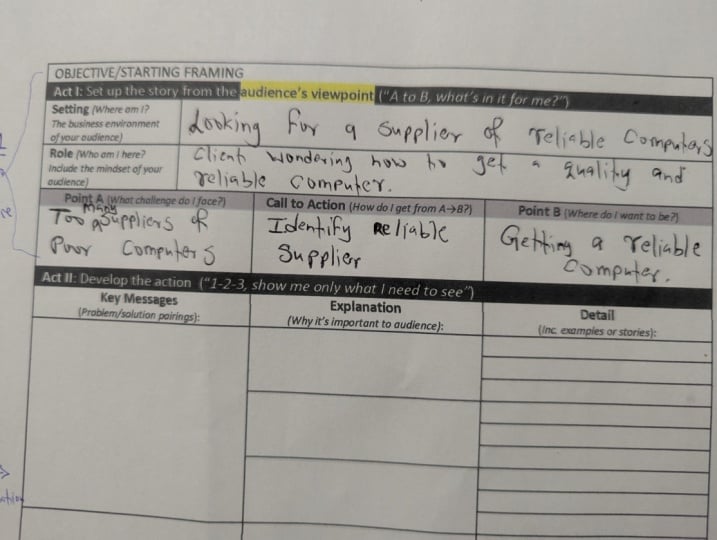
the resources section. You'll notice the template
is divided into three acts. It's like in the story
components we looked at. Act one is where
we set the scene. Here's where you get into the
mindset of your audience, where they are and
where they want to be. Point A to point B. When you nail this part,
you'll have the foundation you need to have your audience
hanging on your every word. Using this course as an example, my setting for you
is an online course to learn about engaging
presentations, and you're here because you need to impress an
important prospect. Point A, where you
are currently, you realize that
traditional decks aren't good enough anymore. Your competition is intense. What I want you to
do, the call to action is to deeply engage
your prospect by using story. Point B is where I help you visualize your future.
Make it an easy yes. This easy yes statement is a memorable sound bite so that it can also work for
my main takeaway. It was included in the title a couple of times throughout
this presentation, and it will come back at the
end. Here's another example. Picture yourself preparing for a finalist presentation
during an RFP response. Imagine you are a specialty training running shoe
designer trying to get your product to be sold by a discount department store. Once you know what's
important to your prospect, perhaps it's hitting
a target budget, you'll get a more clear sense of how to craft your messaging. In this case, your prospect's current running shoe
brand isn't selling well. That's the point A.
You want them to switch to a high demand
profitable brand. That's your call to action. For point B, since you know they need to hit
their target budget, running shoes that
fly off the shelf is a nice way to help them
visualize their future. It makes a memorable sound
bite for a main takeaway. I know it may look simple here, but take the time to
get this part right. Act one will inform your
entire presentation. Now it's your turn. Fill out Act one from your
prospects point of view. Download this template PDF, or you can make one
yourself with just boxes. Fill in the blanks with your presentation information
for your class project, take a screenshot
or snap a picture and upload it to the
class project area. I'll give you some feedback on your setup to make sure you've got strong first steps on
your journey to an easy yes. A quick note here,
do not include any company or client
names in your upload. They're useful for you
but also confidential. Let's take a quick look at the rest of the super
sexy story template. In Act two, we'll look at the transformation we want
your audience to go through. We'll have three key points. We'll call the three points
problem solution pairings and come back to this
topic in the next lesson. The resolution is
a quick summary of your three key messages, plus one main takeaway that you want to stick in the
minds of your audience. That main takeaway ties into your initial call to action
and point B from Act one. We'll come back to
this topic as well.
6. Key Messages: I mentioned that the info
you wrote in Act one, the setting section of the super sexy story template would inform your messaging. We're going to look at just
three messages because it's a good amount
for your audience to absorb without overwhelm, and it will still leave space for your passion
to come through. So you'll get across
both logic and emotion. There are many ways to
set up your messaging. After working hand in
hand with dozens of salespeople and keeping their
prospects at the forefront, here's the approach that
we found works best. We'll develop three
problem solution pairings. Think of your prospects top three pain points
that you can solve. Your messaging will be based on their needs and how
you can solve them. You've already gathered
information about your prospect. Now is your opportunity to respond with relevant
information. However, it's in this messaging section that
many people often go off course and only talk about themselves and
what they are selling. They forget why they are
there for the audience. Remember the work you did in Act one and let that
guide you here. Knowing and solving
your prospects problems is such an effective approach. I've had a client use
it and win business without even doing a
finalist presentation. I helped my client
use this process to write an executive summary
for a written submission, and their prospect said, We feel like you
understand us so well. We'd like to award
you our business and not continue with the
planned RFP process. Wow. Many salespeople look at
key messages as win themes, the three reasons why they
should win the project. If that's what you're
used to, great. So long as your win
themes line up with the top three problems your prospective
client needs to solve. If they don't line up,
they won't resonate during your presentation and you won't be able to connect at the
deep level that you want. Also, if your prospects main needs are not
something you offer, you'll need to think outside
the box to find a solution, such as partnering with someone
who has that experience. If you're a fan of thought
leader Simon Senec, you know that you
start with why. Essentially, you start with
the emotion and purpose before you get into how and what is the same for
sales presentations. While formulating three
key messages that speak directly to your
audience's needs, we'll have to strike
the perfect balance between providing enough
information for them to understand why you are the best solution for
them without creating overwhelm with detail about how you offer it and
what you're offering. Traditionally in sales, overwhelm
has been pretty common. People can talk about details before you even know
what they're selling. But there's a time and
place for details. Generally, your audience
will connect emotionally and buy into the idea before
they are ready for details. When you are deciding
how much information to put into your presentation, make sure your prospect is engaged and on board
with your ideas first. If they ask for more details, you'll know you are
connecting well. Here's an example from a car ad. Please look beyond
whether or not you like Elon Musk and
Tesla for now. The point here is to look
at the comparison of having an overwhelming amount
of information on a page to just having
a couple points. If you're the prospective buyer, your needs here are that the environment is
a concern for you, but you still want
high performance. That's the headline, zero
emission, zero compromise. It's only after you feel
like your needs are understood that you'll have
any interest in the details. LED lighting may be nice, but that's not what's going to convince you just
say yes to this car. Once you connect with
the key messages, then down the road, you may want to know about the two USB ports for media and power or the 60 40 folding rear seats with
894 liters of storage. But those details are only
going to create confusion and overwhelm if they're explained before the emotional
connection is made. This example represents many of the features
that differentiate traditional points on
a slide presentations and the story design structure
you're learning now. Here's an example from this deck that may feel more
common to you. This traditional slide
is not bad per se. In fact, I actually make slides like this
for clients often. I'm sure you've seen
plenty that are like this one or more crowded and overwhelming like
the previous car ad. Still, if you're presenting
in person or virtually, this slide contains
a lot to read. Want your audience
to listen to you, attach to your passion
for your offer, and connect with
you as a person. Here's the thing.
Human connections are always going to be
stronger than reading a slide. The slides should support you, help illustrate the
point you're making and guide you and your
audience through the flow, not be the presentation. If your audience is
trying to listen to what you're saying and read the
slide at the same time, they can easily be overwhelmed when what you want is for
them to feel understood. If you speak with them
as a conversation, you're more likely
to engage and get a better understanding of who they are and what they want. Remember the doctor's story from the beginning? Of
course, you do. It's a story and
stories are memorable. In that section, I
only used pictures. No words on the slide at all. Using pictures alone can be tricky because you need to
know what you're going to say. You can't default to reading
a slide if you get nervous. But if your upcoming
presentation is important, you'll take the time to
prepare for it and if you know your prospect well and are telling relevant story, you'll remember what to say. You may be wondering,
what if I need to send the presentation beforehand
or follow up with it, but there's no
words on the slide. It won't make sense
to the viewer. You can send it with
your speaking notes, or you can follow up
with a recording. Don't forget to ask first
if it's okay to record. And then also don't
forget to hit the record button or set
that up to be automatic.
7. Details to Reinforce Messages: Let's revisit act two of our
super sexy story template. On the left side
of the template, you'll put your three
problem solution pairings, your prospects needs that
you are able to solve. In the middle column, jot down a few benefits and why your solution will be
important to your client. Do this for each of the
three key messages. On the right hand side, you've got space for a few details, not an overwhelming amount, and you don't need to
fill in every box. But here is where
you can include a relevant story, an analogy, a case study, an example, some way to help your client
visualize a better feature. This template makes
your whole presentation feel like a story in itself, and the details in this section are where you weave
in smaller stories, mini stories to
explain your points. Let's look at an example of
how to craft this section. When we looked at Act one, we noted that the information
here would inform Act two. Using this course as an example, the transformation
I'm taking you through is to go from point A. Traditional decks
aren't good enough anymore to point B,
make it an easy. So my three key messages will support that
transformation. Here are my problem
solution pairings with a problem written from my
audience's point of view, that would be your
point of view. Problem one, my audience
gets distracted easily. Solution one be audience
centric. Problem two. It's hard to set up
a good presentation. Solution two, use
story structure. Problem three, I'm not sure
what information to include. Solution three, craft
three key messages and one main takeaway. These three solutions are the key messages that I want to get across to you
in this course. Next, let's zoom in on the first key message and
provide an explanation. In this case, my
points are to make the presentation all about your audience and their
needs less about you, your product or service. When I talked about that, I also said it was important to
know your audience well, and I told you the traditional
doctor story to help you understand what your
audience might be experiencing from
other presentations. As you know, timing
is important. In this example, I spent
a short amount of time on the first detail and a
few moments on the second. There's a box for
a third detail, but I didn't include one. If you don't have a lot of time, don't use too many details. Edit what you'll say
rather than trying to rush through it all and cram
in too much information. I've often seen people trying to talk really
fast to get it all in. That doesn't help your audience. Understand what
you're trying to say. Do the work to edit
down your ideas by deciding which details are a
priority for them to know. During your presentation,
you may have a lot of audience
questions, which is great. That means they are engaged, but you may find yourself
running out of time. Be prepared for
that situation by prioritizing your most
important details and knowing which
details you could drop. It's okay to drop details, but always keep your
three key messages. Okay. The second
explanation to support the solution is make it
about them, your audience. This detail is where
the second part of the doctor story came in,
doctor Audience centric. The third explanation point I've used is to solve your
audience's problems. The details here are to
match their problems with your solutions and how
that leads to an easy yes.
8. Weave in Mini Stories: To help bring your presentation
and your vision to life, we can weave in many
stories in the details. I'll throw in a quick
reminder here of the story components
that we looked at with the tortoise
and the hare. Your mini stories
should be audience centric and have a
relatable character. As in, make sure it's a relevant story that your
audience needs to hear. It will have a beginning,
middle, and an end. That is you set the scene
with a challenging situation, something happens, and
then there's an impact. To keep it a business story, it will have some
transformation and moral of the story that will
appeal to your audience. That's the whole point
of telling the story. You may find it's
not necessary to have all these elements
to get your point across, but as you're
forming your story, it's a really good
starting point. The doctor story I
used to describe audience centricity is a before or after sort
of comparison story. And there are lots
of other types of mini stories that can be used to engage your
audience as well. Here are a few ideas. A case study is a common type of story that can be woven
into your presentation. A great way to think
about the structure, the beginning, middle, and end, is to go with the
case challenge, the solution, and
then the impact. Make sure the challenge
part of your story is similar to your prospects
challenge to make it relatable. The solution would
be one similar to what you are offering
your current prospect, and the impact
should connect with the picture you're
painting for their future. Here's a quick example.
The challenge. XYZ company was spending so
much time on RFP responses. And if they didn't
win the business, it didn't feel worth the effort. They were winning about half, which is pretty good, but
they wanted to be excellent. The solution, XYZ company brought me in to work on
their presentations with their sales teams
and help them better engage their
prospects. The impact? Their prospects said yes, more often, In fact,
30% more often. And after a year, XYZ grew so much they were able to increase
their employee bonuses. Stats can tell an
excellent story, especially if you have numbers
people in your audience. Be sure to give
context to the stat, compare it to an industry
standard or show year over year growth or a story that
gives the stat some meaning. Don't expect your audience to know if the number
you're showing is good, bad, high or low without the
context that goes with it. Here's a very quick story
to give you an example. When my clients started using this story structure approach
in their presentations, their win rate went
from 50% to 80%. Recognize a couple of
the story components. The character is my client. Point A to point
B is 50% to 80%. A analogy is another way to tell a story and illustrate
your point like this one. I had a client whose sales team were great at hitting
singles and doubles, but they just weren't
getting the home runs they needed to win new business. We started using the
story design approach, and in no time, they were knocking their presentations
out of the park. Try to use an analogy that you know will be of interest
to your audience. They may or may not
be baseball fans. Client testimonials can also
be a great way to engage. Be sure they describe
the client's story. Rather than, this is amazing, paint a picture such as the story design approach works so well for
our presentation. Our prospect, now our client, actually gave us
applause at the end, and they even asked
about add on services. Beyond stories, switching to an engaging format can also help bring the
transformation to life. A demo or video, especially if you're
explaining something technical or like the shoe
example we've discussed, where your audience experiences your product or service
by trying on the shoes. Animating your slides could
also fall into this category. Not as a superfluous gimmick that distracts from
what you're saying, but as a tool to make your information
more understandable, such as bringing in
one element at a time. Here's another idea, a
guest speaker or a change in speakers or a video message
from someone important. If you choose to bring
in other presenters, be sure to practice together for flow timing and to come
across as a cohesive team. For other format ideas that engage well and are
also interactive, you could try a poll or quick survey with
a show of hands, ask questions or invite questions throughout
your presentation. You can even test your audience. Using this course as an example, do you know what my
main takeaway is? The answer. Make it easy for
your prospect to say yes, which leads us to
the next lesson.
9. Resolution and Main Takeaway: Now let's look at Act
three, the resolution. One of my clients told me
that their presentations usually have so much in them that they rarely
get to the end. I was like, What? I
couldn't believe it. The ending is the
most important part. I explained to them that people usually remember
the ending most, then the beginning,
then a bit in between. It's here at the end that you'll summarize your
key messages from Act two and revisit your call to action and main
takeaway from Act one. Driving it all Home
one final time. At this point, your audience
is likely already on board, but they may need to
turn around and convince somebody else who can
influence the decision. So your goal here is to leave your prospect with a few catchy words that
they'll remember. A sound bite. Step into your prospect
shoes and think of what you could say to a colleague or fellow
decision maker. We should choose this
person because blank. And then fill in the blank with something memorable that
you want them to say. For me, it would be
we should choose Yvonne's course because she'll
help us get an easy yes. For the shoe sales
example, it would be, we should choose this person because the shoes will
fly off our shelves. Often people end with, thank you, which is fine. I'm all for gratitude, but it's not as strong
as your ending could be. This is your opportunity
to actually put words in your prospects mouth
and inspire them to action. So end with something
they'll remember.
10. Map Structure to Slides: From here, the hardest part of planning what you're
going to say is done. Congratulations.
But you probably still want something visual
to support your messaging. Personally, I like to use
PowerPoint to create slides, but there are plenty
of good options. Just make sure whatever you
use is screen friendly, simple, and doesn't detract
from you, the speaker. You're there with your prospect
to connect personally, so you should always stand
out more than your slides. I have a graphic
design background, so I like to make
my slides myself. But you may want to hire someone or maybe you have
a resource where you work you can help yourself extra time if you are working with another
person's schedule. There are lots of
stock photo sites where you can purchase
great images, or you may want to use an AI tool to help you
create your slides. Here's how the template
we've been working on maps onto a slide deck. A simple way to think of it
is to have one slide for each template box and then
adjust where it makes sense. For example, what you
see here on the screen uses an opening section that sets the scene
in your intro, then completes Act one with
the audience's point A, their current situation,
you call to action, and the point B that you'll
help them visualize. Next, it moves to Act two with your three key messages
and explanations. Consider making each of
your three key messages a section start so it
stands out visually. You may also want
slides to match the details you want to
speak about and of course, act three, your resolution
and main takeaway. If your slides are mostly pictures without
overwhelming text, graphs, or numbers, then feel
free to add more slides. Your audience will
be able to absorb images quickly
without overwhelm. Here's how the
structure you just saw fits with the
slides in this course. It's slightly different here because it's an e course
that you can work your way through rather than
a sales presentation that your audience needs
to absorb all at once. But the principles are the same. We've got a cover, the intro agenda about what
we'll be discussing. Point A, traditional
presentations no longer work, a
call to action, and point B, mentioned becoming a presenting superhero by using story design
to get an easy yes. My first key message is about
being audience centric, explaining with
the doctor stories and solving your prospects
issues for an easy yes. My second key message is
about story components, where I compared reading
a child's bedtime story, broke down the tortoise
and hair fable, and then introduced the
super sexy story template to use as a foundational tool. Then my third key message, talked about problem
solution pairings, explained how to avoid
overwhelm and gave ideas for many stories that can be woven into the details. I'm wrapping up
with this summary, and will bring back my
soundbite of Make it an easy.
11. Helpful Resources: Before wrapping up, I want to leave you with a
couple of resources. Beyond BuletPoints
by Cliff Atkinson is the book that I adapted the super sexy story
template from anything by Nancy Duarte and her
company is highly recommended. They've published several books, send newsletters regularly, and often host
podcasts and webinars. Kudos to you, you've made it
to the end of this course. Congratulations. I would
love to hear from you. Please ask questions or send me your feedback
here on this site. Or you can always reach me at Yvonne dot line at
smartlife dot TID TIPS. If you need extra
help or want to take your presenting skills or your team skills
to the next level, contact me for
coaching workshops or how to carry a theme through
your entire presentation, making your whole
discussion feel like one captivating
story and making it even easier for your
prospect to say yes.
 Yvonne Lines, Sales Presentation Specialist