Transcripts
1. Intro: Welcome to my course, how
to think and be successful, cultivating a growth mindset. My name is Colin Stuker. I'm an entrepreneur, CEO, father podcaster
content creator, and I'm obsessed with the first principles of just
about everything, especially of success
and the mindset, how you think and how that translates to abundance
in the real world. There goes my It's fascinating how everything in your life starts in your mind. Every action you take, every failure, every success, everything you do say
is first a thought, is an electrical
signal in your brain that comes from who knows where? It just shows up, and then we
get something in real life, and then we think
about it later, how that was good,
bad, whatever, and then we adjust and
we learn, and we adapt. That's a very fascinating
process to me. And there are some first
principles that we can learn from people that have
done this for hundreds, potentially thousands
of years as humans throughout our history. Have been able to use
their mental energy, their thoughts and
translate that into real tangible results. We're going to
cover how to think, how to not think as well. A lot of times what you need is you need to
improve by removing. So we're going to
focus on removing negative thought patterns and limiting beliefs
and replacing that, creating space for thoughts that are going to help
you get what you want. I hope you get a lot
out of this course, but more importantly, I
hope you take action. I hope you start
thinking differently. And I hope you manifest
the abundance in your life that you want
and that you deserve.
2. The Growth Mindset: The growth mindset. It is the foundational
mindset of everything. If you want to be successful, I would even say
if you want to be happy, healthy, and stress free, you kind of have to have
a growth mindset because a fixed mindset leads
to negativity and to, I would say, destruction
of your mental well being. The growth mindset is the most important
thing for creating success and happiness
in your life. I do truly believe that. Hree quotes here, and then
I'm going to get into talking about what the verse
fixed mindset is. So you can start
thinking about it and start recognizing it
in your own life. You're not going to watch
this video and then wake up tomorrow with the
growth mindset. It doesn't work that way. But you can start recognizing
your thought patterns, and you can start culling
the fixed mindset and the limiting beliefs
and the things that you might be doing
and not even aware of it. You have to first shine
a spotlight on it, become aware of it. And then you can
start changing it, it's going to be
a process, okay? So we've got the
first quote here. There's no such thing as
failure only results. Now, this is a little
bit more specific into the action realm and thinking about doing things
and what failure success is. But it's very succinct
and very powerful. If you actually
think about this. And if you understand
this concept, if you understand the principles of taking action and failing, succeeding, just doing anything, it will help you remove a lot of the limiting fixed mindset
beliefs because you have a healthy understanding
of what success actually is and what taking
action actually is, okay? There's no such
thing as failure. Like, there's no such thing as failure because every
single thing that you do that didn't succeed
or that you call failure actually gave you data, Edison said, I figured
out 1,000 ways, a light bulb doesn't
work, and that's how I figured out the one
way it did, it does. When you fail, you know, even that words kind of bad. It should be just learning when you tried something and
it didn't work out. You have information that you can use about what doesn't work. And what does is that leads
you to better action. This is the success loop. The feedback from action
leads to better action, and then on and on on till eventually you succeed the
way you want to succeed. Without taking action, You cannot be successful.
You cannot get result. And without learning what
the wrong actions are, you can't figure out what
the right actions are. I think a lot of people
think this idea of success should be just planning a bunch, doing the thing, and then
everything works out perfect. Doesn't work that
way. No problem can withstand the assault
of sustained thinking. This quote speaks
to the importance of consistency, sticking to it. And the reality that if you
actually keep going and you keep trying and you doggedly pursue something, you
will figure it out. You will either figure out that your whole approach is wrong, you need to try something else. You will figure out that it's not worth the time and effort, so you do something
else, so you quit, saving your time and energy and stress or you'll figure out that the first five ideas you had about this thing
are the first five methods. They were wrong. But
then method six works, or method 1409 was wrong or not really the right key
to this lock and 50. Try 50 got it done. It's not that I'm so smart. It's just that I stay
with problems longer. Albert Einstein. Einstein Daly, daydreamed
and was living in his head, to eventually figure
out E equals MC squared and the
speed of light and relativity and all
things that he figured out that
was revolutionary. He just thought about it for
years and years and years. And most of what he did in his mind were just like
thought experiments. He would just in his mind, like, if this then that, or what if this was true?
What would that mean? And he just followed these
logic patterns in his mind, and he stayed with
that problem that most physicists and scientists just weren't trying to
really think about or solve, and he stayed with it for
years until he figured it out. What things in your life have
you stayed with for years? All right, let's get into the
growth first fixed mindset. We got this cool chart here that we can go
through real quick. And it's from this website mindset health.com. There's
a link right there. Growth mindset believes that intelligence and talent
can be improved, and it's not just
intelligent and talent. Growth mindset believes that
anything can be improved, and that if you don't have
a result that you want, it's because you haven't
figured out how to get it or you haven't put in the
work necessary to get it. So this leads to embracing flaws and mistakes as
opportunities for growth, accepting setbacks as part
of the learning process, and feeling empowered
to reach goals, right? Empowerment is very important because you have to
believe that you have the agency to accomplish what you want to accomplish
or try to accomplish. If you feel like someone else has the agency
or that you're just the victim or just going
to get lucky or not lucky, then how can you actually
control the outcome? You can't. And
what it does is it removes all motivation
to do anything. Fixed mindset believes that talent and intelligence
are fixed. You say things
like, I'm just not good at math. That's
what I used to say. I said that all throughout
high school and middle school, and I never did good
at math. Imagine that. And then I got into
business and started working with spreadsheets
and formulas, and I'm like, Damn. I'm actually pretty
good at math. Fixed mindset leads to
hiding flaws and mistakes, feeling ashamed about failures, which is literally opposite of how you should
think about it. You should embrace
failures because that's learning and because
you took action, you should be happy about
that, giving up easily, and being unmotivated to
strive for or achieve goals. Developed IQ, seize intelligence as something you can
develop over time. So this is the growth mindset. Fixed is seize intelligence
and talent as fixed. If you think it's
fixed, you don't try. Obvious. Motivation. Growth
mindset willingly embraces challenges and risks
possible failure. That's part of the course. But with the growth mindset,
you actually embrace it. Fixed mindset avoids challenges to prevent the possibility of failure because it wrongly
assumes that failure is bad. Growth mindset is beliefs effort and practice can
lead to mastery. And that's the process. That's why they say it's about the journey out destination. It's part of the fun. Fixed mindset believes
that talent is innate, so effort and practice
aren't important, right? It's very much about
all I'm either good at it or I'm not or I'll get
it or I don't and whatever. Growth mindset acceptance, Cease failure as temporary
setbacks and persist in the achievement of goals because growth mindset knows that it's about the
effort you put in. Fixed mindset gives
up easily and views temporary setbacks
as permanent failures. Inspiration. Growth mindset sees other people's success as
source of inspiration. Now, personally I've
always felt this way. I've never been jealous
of people. I've always been Wow, that's amazing. I want to do that. I want to
learn from you or tell me what's your secret,
right? That's amazing. See other people's success as a threat of a source or gels. As a threat of a
source successes as a threat of a source or gels. I don't know if that's written the right way.
Finally, feedback. Growth mindset views feedback as an opportunity to grow and applies
constructive criticism, fix mindset, view feedback
as a personal attack, and ignores
constructive criticism because again, it's
about the ego. Okay. So this is the foundational
mindset for success. I'm going to spend
a little bit time here on this and
talk about it a lot. And I already do
talk about it a lot. I've done multiple
podcasts on this, multiple videos. It's
so freaking important. It's one of those
things that's hard to just teach or understand. You really need
to in my opinion, I believe that you need to first focus on getting rid
of limiting beliefs, getting rid of fixed
mindset and stop all that toxic internal dialogue that's holding you
back and replace it with positive affirmation
based dialogue, or at least go neutral. Right? If you can get rid of the
negative nancy in your mind, you at least have
the opportunity to do things and you're not really spending a bunch of time trying to analyze it, you
just get out there and do it. And then to take it to
the next step further, you start building growth
mindset based affirmations, and you start training your
internal mind that if you put the work in and you embrace the work and the struggle
and hard things, you're going to get result. And the more you do that,
the better you get at it. And then, over time, after a
year or two of doing this, you're a completely
different person. You manufacture
success in your life. If you want something, the
only question in your mind is, is it worth the effort,
time, and expense to get it. And then if you decide it
is, then you go get it. And you don't have any delusions about it being easy or whatever. And in fact, in a lot of cases, the growth mindset has a very healthy rationality to success and to what it takes. Like, for me, now
later in my life, 36, I've been doing this
entrepreneur thinging for years. I You know, I used to when I was younger,
just jump into things. Now I'm very, very careful about what I take on because I
know how hard things are, how expensive they are,
how long they take. I used to just, you know, wrongfully assume
that I could get it fast or I could do
this or do whatever. And you know, it was
good to have that kind of young ignorance bliss
mentality for a while. It definitely got me
into some things. I definitely costs a
lot of money though, and a lot of pain and suffering,
and I've learned a lot. And so now I'm way more
way more measured. But that's a result
of experience, and it all still falls within the realm
of the growth mindset. So like I said, you're not going to wake
up tomorrow with this. But if you start on a
daily basis catching yourself when you're
telling yourself these bad ideas about you not
being good enough or worthy or they're just this and
you're not or their privilege, and you're not or you're
a victim or whatever. When you catch those really bad internal
dialogues and you stop them, then you can create this empty space for
positive dialogue, or at least for a empty space that will allow you
to just do things, take action, get it done, right? Yeah, I want to go on on
about this so important. But I guess we'll have to spend some more time on that
in later episodes, courses, videos, wherever you happen to be
hearing or seeing this. So make sure, though. I would say the single
call to action is to make sure that you start
catching those fixed beliefs. And they also might be
coming from other people. Don't let anybody tell you
you can't do something, you're not this or
you're not that. In fact, before I
let you go, it's actually kind of
weird and ironic. It's like, if I asked you, how did you learn how to walk? You would say, Well, I
was like a young child, and I was like, bumbling around, and I scraped my leg
quite a few times, and I probably bopped my head
a few times as two sons do. And you would almost think that that question
is kind of stupid. So then, why do you or anyone ever assume that
anything you've never done, you're supposed to
just be good at. How does anybody
achieve anything? Like, how do you become a
billionaire from self made? Amazon, you know, Jeff Bezos, are they born out of the
womb doing these things? Or do they go and they do and they try and they
learn and they fail, and they make mistakes,
and they have successes, and they go through the process? Think about that
question. And how probably certain things in your life that you
have fixed mindset around are completely
dismantled by just a very simple
logic statement of one plus one equals two. If I want to get something
I've never done, I have to go after
it, I have to learn, I have to grow, and
I have to adapt. Just like if I want to
play piano or whatever. I think we have
this idea that you have these virtuosos that
are born out of the womb, being able to play
piano perfectly. Even those kids, those
prodigies have to start hitting the keys and learning
and listening to the sounds and experiencing
cause and effect.
3. The Obstacle Is The Way: Book. Great book. Most of the books
are pretty good. By Ryan Holday. He actually lives
just outside Austin. I saw him in a coffee shop once. My buddy went up to him. I didn't. Okay. The
obstacle is the way. Now, this is based
on stoic philosophy, which has been which
is huge for my life, for working through
trauma and my life loss, but also for business
and how to think about the invariable
inevitable problems that come up and all the different things
you have to deal with. And most of it is just you having to wrap your
head around it, have to come to terms with it. This is true in everything.
Every struggle in our life, it's about how we
think about it. We can either make
this thing ten times worse and obsess over
it and feel bad for yourself and be the
victim or we can use it as fuel to learn
to grow and to adapt. All right. So there's no
good or bad without us. There was only perception. I don't know if
that's right without us. Is that the right quote? There is the event itself, and the story we tell
ourselves about what it means. I guess that could be right. Within us? I don't know. There is no good
or bad within us. No, that probably isn't right. There is no good or bad without us. There's only perception. So yeah, good or bad
is just a opinion, an opinion. This
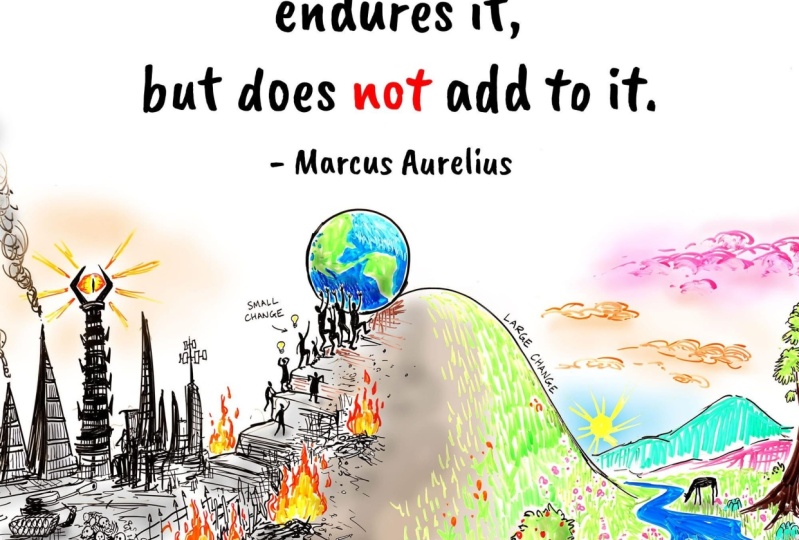
is a better quote. Marcus Salus. Choose not to be harmed and you
won't feel harmed. Don't feel harmed and
you haven't been. So simple Son so powerful. This is something that
takes potentially years to really
internalize and be able to think this way and
be able to act this way as your gut response, right? We can intuitively
understand that we shouldn't obsess
over these things or feel bad for
ourselves or whatever. But our primal brain takes over. And only through lots
and lots and lots of effort and training and experience dealing
with these things. Do you get to that point where
you can just quickly maybe suppress those
negative emotions or those primal responses and
then move to a place of logic. And when you use logic, you can remove so much of the dangerous emotions that well up that causes problems and that generally throw
fuel to the fire rather than try to dissipate or
throw sand on the fire. We tend to fuel
and grow problems, by the way we respond to them. And this beautiful quote
here by Ryals is just saying that if you decide to not
be harmed, then you're not. Nothing anybody says to you can harm you unless
you allow them to. It's just your opinion of something they did or
said to you, right? Okay. With growth minds that you start approaching
problems differently. Maybe we should make
a little bit bigger. When you start thinking of the things in your
life, the obstacles, and you really almost develop
this desire for them. Like they become a guidepost
that you're going in the right direction or that you have this obvious next
thing you need to do. Like, this is a big
obstacle in my way. This is a big struggle.
But if I get through this, I'm going to be better off. I'm going to be closer
to where I want to be. Generally, the bigger the
thing is in front of you, the bigger this struggle
or the obstacle, The bigger the reward
on the other side. It's kind of like
risk to reward. The bigger the risk, usually the bigger the reward,
they're exactly correlate. So the big thing in your life, whatever that big fear is or that big struggle
or obscle thing that's in your way, right? The bigger it is, the more
likely it is to be the key, the gate, the door to exactly
where you want to go. Okay. So you start viewing the things in your life
as the very things you should go towards
and work through, right? So the growth mindset, you start approaching
problems differently. You start viewing
these big things as almost a magnet,
you're attracted to them. You're like, Oh, wow, I need to deal with this. I
need to resolve this. I need to work through this,
rather than what most people do is they just try to
avoid their problems. And the more you
avoid your problems, the more you develop
the habit of avoiding your problems, that's
not what you want to do. The more you move towards the things that are hard and that are big and
that are in your way. The closer you're getting
to your actual goals and fulfillment and happiness
and wisdom and learning. This is one of
those dualities of life that's just inescapable. The big problems in your
life are the very things that are going to bring
the big rewards results. The big aha moments epiphanies steps forward, the big leaps. And every day that you
ignore them or try to go around them or try to
somehow short change them. Anytime you try to shortchange doing the work that you
know you need to do. Well, the bigger those
problems swell, and actually, the more scary they become, and the further away from them and your goals
behind them, you get. Think about this.
Most people give up after one or two
tries or something. They say one thing
to one person, or they try one iteration, or they write one business plan, go to one investor or they
ask one person their opinion, and they get shut down by, like, one thing,
maybe two things. Get some of my coffee
here cause early. Cold Bla of ice, dash
a cream. That's it. What about 50 tries or 100? Like, When was the last time or the only time I'm not even suggesting I've even done this. Most of us live in a world where we don't actually
have to try 50 times, we probably can try three
to ten and get it done. But 50 times tried something, and maybe a sport or some
kind of physical activity. We'll make more sense here with this because, you know, like, if you're surfing, you're
literally going to get up 50 times and probably
fall, you know? When you were walking
when you were a toddler, as my newborn is Rowan, who's about nine months now, he literally gets up, stands up. He's not at the walking pace, but he falls over all the time. Sometimes he falls over
backwards and rolls around. Usually, he doesn't
hit his head, and he laughs, sometimes cries. Maybe the last time you
actually tried something doggedly until you got it
right was actually walking. Now, think about how our modern comfort world and
our addiction to comfort in this world keeps us away from doing that
necessary work, that hard work. That if you think about
it, pretty scary. The older we get the more
comfortable we become. When was the last time you tried something over and
over and over again. And you were telling yourself that, I'm just
going to get this done. I don't care how long it takes. I'm single mindedly focused
on getting this done. The reality is
there's nothing in your life right now that you couldn't figure out if
you kept going until you did. Until you figured it out. There's nothing in
your life right now. I promise you that
that if you kept going, you wouldn't get there. Let me say that simply anything and everything in your
life that you want. If you keep going, you will figure out
a way to get there. But do you have the
mental resilience in the fortitude
and the mindset, the growth mindset that
is needed to show up day and day out effort after
effort after effort. That's the hard part.
I recommend for this to get the obstacles
away, read that. Some other books
are really good, goes the enemy,
things like that. I usually listen to these
or read these on audible. Great stuff, and that's going
to be it for this lesson.
4. The Success Loop: Action over knowledge. Most
of us one way or another. Even some people
that go to college, they do this because they don't want to get
out there and they just want to avoid
doing the work or asking for a job or whatever. We think one more course or podcast or video
or one more bit of information or secret that
we don't have is what we need to finally just start doing things
and figuring it out. We want to feel like we know how to do something
before we even do it, which is completely ridiculous if you actually think about it. How do you know how
to do anything? If you haven't done it yet? How do you learn how to get good at something if you
haven't done it yet? It's very strange
kind of A fallacy. It's almost an apost syndrome that has infected our culture
because we see people on TV that are well spoken that look like they have
all these things going on. They have everything
figured out. They say the right things, and we think we have to be like those people or that somehow
they're born perfect, so we have to do all this
work ahead of time to figure it out to look and
be as perfect as possible. Cont be further from the truth. Analysis by paralysis or analysis by avoidance or
analysis for avoidance. The idea that you need
just one more book course or podcast to get the
secret information. This is just avoidance
of doing the work. Here's a good way to
think about this. I'm going to get a sip of coffee If I told you exactly how I did what I did or how Steve
Jobs did what he did, would you be able to follow those same paths and
achieve success? Would you be able to
do what Jobs did? If you knew every
single thing he did. If you knew every
habit, every routine, everything he said in a meeting. If you just replicated
that verbatim, would you have the same success? Now, if you think about that, It may not be obvious, actually. Some people might actually think that they could
do the same thing. Now, of course, if you
were at the same place as him and literally
lived his exact life, and you have the same
opportunities, you know, like, yeah, I guess
you would have been Steve Jobs if you did
exactly what Steve Jobs did. But maybe you would have
looked differently. Maybe your voice
tone wouldn't have inspired as much or been as good at doing the
apple presentations. Like there's just literally
billions or trillions of happenstances and reasons
and this and that of which that even if you did live at the same time and did every
single thing that Jobs did, talk to every single
same person, whatever, you would still not get
the same results as him. So this idea that
you're going to read some book or course
or listen to somebody, and they're going to kind of
show you the path so that you never have to fumble.
You never have to learn. You never have to try. You
never have to be afraid. You never have to do any
of those hard things is a fundamental lack
of understanding of what actually success
is, what life is. Life is learning. Success is learning.
Failure is learning. The only way you actually
lose the game is if you stop playing, as long
as you keep going, and as long as you learn
and try and learn and try, you follow the success loop, which I'm going to get
to in the next slide, then you can create
your own success. And you don't need information
from someone else. And in a lot of instances, information can
actually hold you back. You're going to
develop bad ideas about how maybe you should talk to people the way jobs did. But guess what? Jobs was jobs at a time and had the certain power and cache he did to
get away with that? If you just start
going out into the let's say the business
world and start berating people and wearing
turtle necks and doing things that jobs did because you think you want
to be like jobs, you're probably
gonna feel dismally. People are going to
kind of laugh at you. There's so much
context, like I said, so many of these billions of interactions and circumstances
to which you know, jobs maybe could have
been a jerk at times. He was also very charismatic and motivating and got out
of the way a lot of times, too, if he actually
read his biography. So the answer to this
question is, absolutely not. You could not do what I've done. I cannot do what
you have done or going to do and
vice versa. Okay. So even if you take the
biggest ideas of humanity, you'd have to go
out into the wild and get feedback
from the universe, because maybe those ideas, the way you're implementing
them are not the right time, not the right place,
not the right people. There are these
subtle differences. Like I said, trillions of circumstances that you have to go into different
environments, different people,
different timings, different dollar amounts. Everything is
different. You have to go into that environment. And you could try things, like you can experiment with things and see what
works and what doesn't. And then more you do that,
the better you get, right? This is fundamentally why though no amount of information can
prepare you for success. It can actually it can prepare you for how to
become successful. Like if you take
certain actions, you focus on the basics
and you learn how to deal with people in psychology and the basics of
marketing or whatever, and then you get into the
trenches and then you do things and you act and
you learn and you grow. That's why I spent so
much time focusing on the first principles,
like growth, mindset, how you think about things like just the first principles
of everything, even health, life, whatever. But it still doesn't shield you from doing
hard things and learning, which is hard, which is painful, which can hurt the ego. I call it the success loop. The only way to be successful
is the success loop. Action leads to learning, which leads to better action, which eventually over
time, the more you do that leads to success.
I say that again. You do something,
you try something, you perform an experiment, and that's really
what success is. You're being a scientist, you're experimenting until you
figure out what works. And then you get some
feedback from people, things, the market,
whatever, customers. And then you take that
information and you take more actions now that you have more information to
take better actions on, and then that better action
leads to more information. Maybe it's information
that makes your stuff better, so you
move up a little bit. Maybe it makes you have to move laterally this way or that way, and then you take
actions, right? And you're just kind
of doing this like zigzagging, sometimes
you're going this way. Maybe sometimes you're
coming backwards, if you're just not paying attention to what the
data is telling you, or you're being too
stubborn or you're being too afraid, and
you're avoiding things. And then over time, you're
just kind of zigzagging, going around like that,
and then over time, you have that upward traject,
just like the stock market. If you look at any stock ticker over 30 years, the companies
are going like this. They're going up,
down, up, down, and the better ones
are generally over a long enough time period
going like this, right? What you don't want to
do is kind of like going like this or worse, like this. The success sloop is
action, learning, action, learning, action,
learning action learning forever. And then
you have success. Okay.
5. The 1% Rule and Compounding: We've got a very important
concept here, the 1% rule. You can find this article
over on james clear.com. Highly recommend it's book,
it's website, everything. So the winner take all effects, the 1% rule. Talk
about this real quick. Now, I'm not going to go into the whole Pareto principle right now. You can read up on that. Again, Google this article
and find the link. But he was basically
Italian economist that found that
most of the peas in his garden were produced by a small majority
of the pea pods. And he thought that
was interesting. That's nature. I'm not doing anything. It's just
doing its own thing. So where else might
this be the case? And he was actually studying the wealth of nations at the
time. He was an economist. And he found that there was this similar power
law of the 80 20. Or sometimes even as
much as 9055 or 9091. It's a power law distribution. And he started noticing it, I believe it was about 20% of the rich in Italy
owned 80% of the land, and then it kind of found
its way into other ideas. So this 1% rule, though, let's find it in here. It's about small differences
in performance can lead to very unequal distributions
repeated over time. When you get things
like compound interest, where Einsteint is the most amazing thing
in the universe, and it's how Warren
Buffet build his wealth, it's a little bit stacked at a time over and over
and over again, that then builds
on top of itself, and it grows exponentially. And then the growth you get
grows exponentially, right? So if you actually ever look
at a compounding calculator, it's very fascinating
what happens after ten to 20 years where the little bit you save
starts snowballing, and then what you save
on top of what you save on top of B
you save on Top Bot builds bills bills
bills exponentially until you get this
explosive growth. Buffett, for example, made most of his wealth after
you, I think it was 65. Okay. So he was a
millionaire, you know, as young as 20 where he might have had a
few million bucks, and then he maybe had tens
of millions or hundreds. I think he might
have had something around 100 million or more
by the time he was like 65, but then past 65 is when
he accumulated billions. So the 1% rule states that
the majority over the time, the majority of the results in a given field will accumulate
to the people teams and organizations that maintain a 1% advantage over
the alternatives. You don't need to
be twice as good. You just need to be
slightly better. And even if you're
not thinking about this from a competitive
perspective and just about improving yourself and where you were and
where you want to go, if you're improving
on a daily basis, 1% of time a little
bit at a time. Over the course of
a year, you know, that's 365 days of small
incremental improvements, and then over two years and three years and
five years, right? And then you compound
and compound a compound. And then when you get
better from getting better, your 1% improvements
actually get bigger. It's actually
pretty fascinating. Early on, you might make small improvements
here and there and they are 1% of a small hole. Then as you get better, more advanced, more
intelligent, more effective, your 1% improvements
actually end up becoming bigger in proportion
to your old improvements. By getting 1%
better than before, even in the future,
after you've been getting 1% better for a year, your 1% improvements
on date 399, 1% is actually way
bigger than the 1% you had on day ten or day 20
or day 50, et cetera, right? It's a very, very
fascinating concept. And when you really
dive into understanding exponential growth in
numbers and things like compound interest
and compound effort, it's actually pretty hard
for a human brain to comprehend because
they're just outside of our ability to really
comprehend and the scales are just so beyond what humans have evolved
to understand. But the key principle is every single day,
1% improvement, a small tiny micro improvement, do one little 80 bitty
extra thing to become wiser, healthier,
better, smarter. And over the course of one, two, five, ten years, and
then your whole life, where you are now and
where you will end up will be you know, light years away.
6. Consistency is the thing: We're coming to the end.
Let's talk about consistency. You've heard it 1,000 times. You've you know, people talk about it,
there's quotes about it. All the self help
guru preach it. But what is consistency
and how do you build it if you're struggling
with it, you know? Like, this is not an easy thing. I can read you all these quotes here and I'm going to read
you some of these quotes. And I'm going to talk about
it to the best of my ability. But I struggle with this because I don't really
know what the answer is. Like, everybody has to figure
out it for themselves. You have to figure out
what works for you. How can you become consistent? And they say things like find your passion and
find your purpose, and those are basically, wellsprings of motivation, which then lead to consistency. But what if you struggle
with finding that? I mean, this is
not an easy thing. This is going to be
the hardest thing you're going to have to
do in your entire life. The hardest thing
to do it as adult is to figure out How do you
want to spend your time, which is very much about how much of the work you're
going to do in your life, which is the bulk of your life. What is that going to be? What are you going to
be working towards? Is it going to just
be for a paycheck so you can then spend that
money on something else? Or is your work going
to be your passion? Are you going to be fortunate
enough to figure that out some combination of the spectrum, like, where
are you going to fall? And this is not an easy thing. I'm going to read
a few quotes here, and the more I talk about this, the more I realize
like I literally have no idea what to offer you. Maybe that itself is the
best thing I can do, other than you got
to figure it out. You got to try a lot of things. You have to figure out what you're trying
to accomplish in life. For me, personally,
losing my father, having struggle in my life, having loss and pain and a lot of the different
things I've gone through has always created in me this drive and an appreciation for time and how
little of it there is. And so I'm always thinking about how am
I spending my time? How am I spending my
time? I've always been willing to give up
pursuing opportunities or money if I thought that
time wasn't you know, being used well, or if I was
working for somebody else, I'm basically allergic to
working for someone else. I have to work for
myself. So everything I do has to be for me
when it comes to work. And I figured that out long ago. So that is an example of my life where I at least have an internal dialogue
of how I think about time, and it does motivate
me inspire me. And it's a double
edged sword because some days where I
should be relaxing, spending time with the family. I'm next thing. I'm thinking about what
I should be doing. I'm feeling anxious
if I'm not working. I definitely battle
with all those type entrepreneurial
side effects that come with you know, they're the other
side of the coin. Like one side of the coin is you get stuff done,
and, you know, you seemingly have never ending spring of motivation and
energy and whatever. But the other side is it's
hard to turn that off, and it's hard to enjoy life. It's hard to embrace the journey rather than the destination. Like I'm saying, This
isn't easy, okay? I can barely even think or talk about it. This is hard stuff. It's hard stuff. And
I'd be doing disservice to you if I didn't give you
straight honest real role. This is the hardest thing. It is figuring out
what purpose is, what your mission is, how to connect that to what
you're doing daily. I also have always been afraid of basically being
a slave to a job. Early on, I recognized that. So I've always been in this, I need to
build my own thing. I need to make a lot of money
to pay for my lifestyle. That's always been
a goal I've had. And, you know, it's
financial freedom. It's having a certain amount
of money and income and assets so that I can
live on my own terms, and I'm getting closer and closer to that
on a daily basis. And then I got to figure out what I actually
do with my time. I create a t time for myself, and I got to do
something with it. So again, that's a whole another problem you have to figure out, but it's definitely
a better problem to have than not even knowing where you want to go or whatever in the
first place, right? That's definitely
the problem you want to work through and get to
better, bigger problems. Okay? So success isn't always about greatness.
It's about consistency. Consistent hard work leads to success, greatness will come. Trust is built with consistency. Let's see any good ones in here. Consistency of
performance is essential, you don't have to be exceptional every week, but as a minimum, you need to be at
a level that even on a bad day, you get
points on the board, and that very much
echoes the 1% rule. If you're getting better, just at least a little bit
every single day, you're at least getting
points on the board. You're at least moving forward. Luis, I've learned
from experience that if you work harder
at it and apply more energy and time to
it and more consistency, you get a better result
comes from the work. With consistency and
reps and routine, you're going to achieve your goals and get
where you want to be. When you look at people
who are successful, you'll find that they
aren't the people who are motivated but have consistency
in their motivation. Okay. Yeah. So the quotes
here are all over the place. Consistency is a tough one. You have to figure
it out. And when you can figure out what that
purpose is that mission, that motivation, what
are you working towards? You write those
goals down daily, you recite them in the mirror, you positively visualize and use positive affirmations
to yourself. You talk to yourself
positive self talking, and do all these
things, and over time, it becomes your
identity, who you are. And then of what I
think Phase two, you'll struggle with is figuring out how to
spend that time, that energy, that focus. Because you'll have so
many opportunities and so many things you could
do, so many distractions. And the hardest
thing is deciding, which is Latin for cut off. That's the word decide.
It means the cut off. So when you actually decide
on some thing or some things, few things, you are
cutting off others. So that's a level two problem that you have to work through. And then when you
get that done and you create financial freedom, then you have to
figure out what you do with your time, how are
you going to spend it? Are you going to read
every single day. You're going to
play video games? Are you going to send
a beach somewhere? All that can get very
boring and very fast. Trust me. You got
to figure that out. But that's a good problem
you want to have. That's really the
goal you should get to is I have all the time. I don't have to really work
for money if I don't want to. Maybe I want to do a little bit. Maybe I don't. That's a
good problem to have. Okay.
7. Big Goals, Tiny Goals: Mm. Finally, we have the importance of tiny goals, tiny steps, micro habits. You have big goals, hopefully. You have a very clear vision
of those goals, right? That's goal setting
one one, be very, very hyper specific about
the number about where you're going to be what you're going to achieve, who's
going to be around you? Who's the person you're going to be. Be crystal clear about that. Write that down. Now,
most of us can do that. It's a fun thought experiment. And in ten years,
we're going to have a pretty clear vision
of who we want to become and what
we want to have. But what about Tomorrow. What are you going to do
when you wake up tomorrow? What are you
actually going to do to get you one step closer
to that ten year goal? What are you going
to do in five years? What's every year from now to ten years from
now going to look like? How much money you're
going to have? What do you have accomplished? What are the obvious
stepping stones to get there? I ask
some examples here. Imagine you had a
goal of making ten, $10 million after ten years, you can break that down
into a daily number. So it comes to about $273 a day for ten
years that you need to reach. That's about $8,200 a month. Now, the way these
things work is, you're not going to start
today with that kind of money. It's more likely going to
come after a few years, and then it's going to
grow and grow and grow, and then some days you'll
probably be making $500,000 a day get even more so, and you get a lot of
that compound growth that early on is nothing, and then later on really is mushrooming into a short
period of time, right? But you would still be averaging over ten years, $273 a day. Now, if you're to do that
through business, right? That's one way. If you do that through a
salary, that's one way. If you're going to do it
through whatever I don't know, whatever other possible ways there are to make $1 million. You got to map out to the
best of your ability, brain dump, things you can
do linear steps, right? Let's just say you're
going to do it for a job. You want to get a job
that's making 100 year, and you want to stow
away as much of that as possible so you can
then have $1 million. In fact, maybe 100 K is not the best example. Well,
I guess we have one 20. Now, because you
have taxes and you might net like 80, then you
have the living expenses, which could be like
30 to 50,000 a year, and then you might only have 20 to 30,000 left over every year. And then after ten years, it's really only one quarter
million dollars. That's actually the sad part about having a salary
is it's really, really hard to get
wealthy with a salary. But if you're buying
assets along the way and they're appreciating, there's
definitely ways to do it. So maybe that's not
a good example. But let's just say your goal
is to make $100,000 a year. Like, you just
want to make that, you want a job that does that, and you want to do a remote job. Like, map out what that is. Then figure out
what a timeline is. Within six months, you want
to have that job, okay? So what's some action step? Like, what can you
do on a daily basis? Well, step one is, like, build a really solid CV or
something or I don't know, like a video, do
something creative, CVs are kind of
boring, to be honest. Do something that's going
to get the attention of an employer of a prospective company
you want to work for. Maybe reach out to that person, send them a book,
send them a letter, create a short video and make it creative and
engaging and whatever, you know, offer to interview
somebody and interview them. But really, it's a way for
you to showcase your skills, offer to work for free as
an intern for 30 days, and then just make them
promise that they'll sit down with you for an hour a week to teach you something
or whatever. There's just so many
creative things you can do if you think outside the box and you do things that
other people aren't doing. Take that kind of
creative energy. Map it out into a
plausible step by step, build the things,
test the things. The things that work
and get result. You know, do more of that. Things that don't work or
you get straight nose, maybe file a way to try on someone else or
at another time, doesn't necessarily mean that
it's a Dud proud effort, but at least means
that it's not working right now for
whoever's working on, maybe try on ten
people instead of one, or ten businesses
instead of one. So you want to map out
the theme here is, you want to map out as
many of these tiny steps as possible that then
lead to a larger goal. And you're not going to
know the exact path, obviously, but there's going to be definitely
some milestones, either in dollar amounts
or in job secured or in funding secured or whatever to which you could then
get to $1 million. And if you were going
to do a business, for example, you know, one milestone is hitting $10,000 a month
in profit, right? That's $120,000 a
year in profit. And then it's very likely
your business is growing. So, let's say you build
in five to 8% growth. That's actually the
low end. So maybe like 10% to 20%, actually. And then you can kind of map
that on a spreadsheet what a plausible step by step day by day month by month action plan is to go from starting
your business, getting your first
customer, getting your first $10,000 a month profit to getting your first potentially $100,000
a month profit, and then finally making
your first million. And then finally having $1 million in extra cash
in the bank, right? Each one of these
can be mapped out. Spreadsheet, and
you can build in realistic percentages and models and use it as a guide post. You're not going to
follow that plan and execute perfectly. It's just not the
way reality works. But at least you have a map, like a vague idea of
where you're going. And then you can adjust along the way and you can move
things up and down, move them ahead, move them
back, et cetera, right? So you have to figure out
what you want to achieve, then map out as many
realistic micro steps and many goals as possible
that'll get you there. And then you constantly adjust these goals as you go and
you update timelines. The more time you spend
thinking about it, tracking and writing
down your goals, the more likely you will actually get there, right?
That's super massive. You may not get to
exactly what you planned. You probably won't, but
you'll least end up somewhere else that's going
to be pretty awesome too. The reality is most people don't clarify or write down
their goals at all. That's the sad truth. And that's why most
people don't reach them. Most people don't
actually get there. As Seneca said, if you don't know the port,
no wind is favorable, he's using the ship analogy, if you get in a ship,
you have a destination, you sail to that destination. If you get in a ship and you don't know
where you're going, and the wind just
bounces around. Well, you never have a good wind because you're never
going in any direction. You're going in every direction and no direction
at the same time. If you don't have a goal, you're not going to end
up at that goal. And if you don't
have a goal, you don't even know where
you're going to end up. You might end up
somewhere completely you didn't have in
mind or that you don't want to be or that
someone else had plan that is not
really what you want, and that's just not that's
not where you want to be. You don't want to go through
life with regrets and you don't want to go through life
looking back and been like, Wow, if I would have
just had an idea, I could have maybe steered the ship in a different direction, and instead I'm here now and
I've wasted time and money, and I'm never getting it back, hopefully that would be a wake up call to then move
forward because it's never too late if
you're alive, right? But avoid that at all
costs by creating a plan, creating some goals,
creating some micro goals. And then every single day,
I mean, every single day, looking at that list, iterating, jotting down ideas, like,
whatever. I use notion. I keep my stuff in
here, I love this app, every single day,
review your goals, add to them, maybe
subtract them, maybe just timelines, and just
get them into your brain.
 Colin Stuckert, Entrepreneur, Podcaster, Writer