Transcripts
1. Introduction: Hello, welcome to my Udemy course. Thank you for choosing me as part of your journey. And in this course we are going to learn some basic music knowledge. And by the end of this course, you will be able to learn how to read some tags and recognize some of the symbol in text as well. And if you're wondering, why do you need music theory? One big thing is music theory explains why things are the way they are. So if you always wonder why this is S4, Why do you present this way and call it a C chord? And why? This is C chord as well, then you have come to the right place. If you don't know anything about guitar yet, you still don't have basic skills on detail. I do recommend you to check out my other courses, which I've talked about some basic skill that you might need to know. Even you don't have any basic skills on guitar yet, you can still listen to an end goal to the next coins. Because this is a music theory based course and how to retype all be talking allied hour trying to make it fun for you guys, but I'll be talking a lot, that's for sure. So do get your popcorn and verity, click on the next video.
2. Basic music knowledge: Now, before we get everything started, let's talk a little bit about facie music knowledge. Let's start with the first one. So this is how music works. It goes from a to G, and then it goes back to a. So a, B, C, D, E, F, G. And then you go back to there is no H, there is no element OP. And that is the exact reason why you've never heard of p minor chord or L major? I I even feel so wrong for saying that L minor chord, but no, My, So that's one thing that you have to know. Nodes from a, B, C, D, E, F, G. And then it goes back to a second thing that you have no, as a lot of students have this misconception, like when it comes to note, it only exists on instruments, but that's not the case. So what do I mean this that if today you slam the door or today you start an entry, anything that emits a sound, you can attach a note to it. If you want to attach to a certain of sound you have, you must have this skill core. Perfect pitch. Like people, people like Charlie pools and Jacob Collier has it. But personally I don't, I wish I do, but I don't have perfect pitch. That is the reason why I cannot attention to anything that's happening around me. So what I'm saying is that whatever the happens around you, that has a sound, then it has a node. Is just that. Are you capable of identifying the note? Do you have perfect pitch? That's another story. So when it comes to sound, and it doesn't only exist in music and Schumann's, it happens all around this. Anything that makes us out hasn't know it. And next out what differentiate a song from just a normal nor a sum as consists of beats, freedom nodes call it singing a lot of the elements and combine them together. What's this? That is what makes the song. But if today you only slam a door, you wouldn't say that's a sum because yes, it has a sound, but there's no rhythm. There is no B, there is no any other musical elements to it. So in order to make a song, you need, you need freedom. You need instruments in the notes you need, cause maybe you need a singer as well. And that is all you need for the basic, really basic music knowledge. And if you're ready, click on next video and we will talk a little bit about octet.
3. Octave: Now, before moving on, let's just talk a little bit about Octave. Why does octave? And the simplest way I can explain without using any jargon, octave is basically DO RE MI visor Laredo, that's one octave. What are deaf includes DO RE, MI, FA, SO LA Latino. And there's a lot of octave depends on how high you instrument can go. So to put this into a real life example, I'm going to show you a during facility don't start from C to a highest, see? So Octave usually starts from a lower noise to a high-end k. Now let's start from S0. So I started from this scene to this day are both C. And in the next lecture you're going to learn all the names of this fingerboard and everything. But for now let's just learn about octave first. So the first of the cell like this, That's no gray Paso or C, D, and E. So I'm going for one lower C to needle C. Now let's go from middle C to our highest. So this is, I'm going to start from this. So, So again, this is C, a, C. So I started from middle C to our highest. So the whole thing we call it DEF. So again, I'll start from the first lowest, C on guitar, bluesy on guitar. That's one octave and another uplift. So now our stack from an OSC to the highest see, Lois see on guitar. So this lowest city on guitar. That's the first octave from C. And now arm's going from this C to a highest. Now that's the second octave. And you can start wherever you want. It's just that for the example just now I started from C, and C is the most common way to start reading. Even in piano. They usually start things from C. So that's what an octave. You're going from lower to middle node and then from medulla to a higher note. And the thing is they have to consist of DO, RE, MI, FA, SO LA County. So consists of eight notes. That's what makes them octave. You start from C and C start from S0 and ends if it wouldn't count an octave. And this issue is a very, just something that I have for x that, you know, is it wouldn't order your plane that much, To be honest, it is something that I have to explain. So if you're ready, click on Chapter Two. How See you there?
4. How to read guitar tab: Hello guys, welcome back. Now let's learn how to recap. I will include a picture here, which is some deviant roles. I won't take the credit is lobby on rows as arrange by Manto music, as you can see at the top right corner. And I actually have my laptop here. I will refer to this angle because even though you see the picture, I can't see it. So I aren't public laptop through referred to it. But before we happen to play levy on rows, let's extend a little bit about how to read the tag. So first of all, the TAP has six strings, just like guitar. The top string is the first green. Second string is here, touching it here, festering. Second string, that string 4, 5, 6. Just like how it's on the tab. So on the top, the top string is the festering. So the top stream indicating here, and the bottom string indicating here. And the numbers on top of it as frets. And we will try to play the first line later on. And if you're wondering, what are those long, long thing, long lines at the bottom. Those are actually bins, which we will touch on and the next few chapters. But for knowledge is focused on how to read tap. Okay. So under first-line, our played one type. So our referred to my laptop over here in our clean a first-line for you guys. So you guys can, you know, lists have listened. So this one is actually quite easy. It's not that complicated. Let's focus on the number here. So if you see first line, it has a number on top, again, the number indicating the florets. So if you see the first note is first stream that fret. So what you have to do is you have to press on first dream the front. And usually when you press that fret, you use that finger. You never use them to press anything. So 12 tree four. So if you see number three, then you have to use this finger to press. So on the third fret you use your ring finger to press. And the next is two. So use a middle finger. And the next note is 00 means open string. It means you don't have to press anything. And it's a 0 falls and the fish green, then you just play the first string. That's about it. And then the next note is that fret second string. So under second Shri, you have to press that frame, 1, 2, 3. Remember if you attended my previous courses when you press, you have depressed close to the fret, not over it, not on top of it, but just very, very close. So secondary. And then again, second stream, open street. And then fostering that Fred. And then forestry second frame. So unlike music notes, which is kinda hard to decipher, but for tax, they're much easier is just numbers. And I would do a postcard down. So you guys can pause this video for a while. Now in concert with first-line for you guys to practice. Pause con, down in 321. Welcome back. Now let's talk about the second line. The second line is about the same. It's just that there is a number five there. So again, it means the number five falls on the first string. So you have to do is on the fifth string. Fifth fret with your pinky. Okay? Don't really, your index goes down here unless you intend to play something lower. But if you intend to go back to the first decision, I suggest is to use your pinky to press fret 5, 1, 2, 3, 4, 5. So you press here. So again, if you see number 3, try to use this finger. If you see number to use middle finger. But if you look at second line, that bar, you can see this is a little bit hard. So instead of doing this, it doesn't sound as nice. It doesn't sound continuous. So what I would suggest you guys to do is use other thing that you press it. Although I say if you say if you see frontier, you have these middle finger, if it's the first one, you have to use finger. One. In this case, you can use other finger. Use any fingered. That's most convenient to you. But do remember if you're not play anything that complicated. First fret is for first finger, middle finger is for second fret. That Fred is for that finger. If you're just playing the simple stuff, like a first-line for a second. I think there are I suggest you guys to do it this way. Ring finger, index finger, middle. And then at honoring. So you have to really know your preference. You have to really know which way is most convenient way for you to press stuff properly in order to know, you know, the finger policemen and everything. And to be honest, finger placement is very important for a SUS plane, just like in the example that I did just now, if you didn't use to correct fingering, it doesn't. Some SIT sounds, muted. Sounds very muted and stop all the time. So that's not a good way. So make sure you're fingering its proper. So the sunken sounds continuous. And again, I'll do a POS calm down so you guys can practice a second length for a little bit. Postcard down and treat too. Hi. I hope you got it right. And as for the rest, I will go through it because if you've already got it, We'll move on to the next. If you don't, I do suggest you to replay this video again just to get it right. But I believe tap is not that hard. It's quite simple, like I say, is just number. So you can try to play some other songs. So chin up online, I do suggest you guys to start with a very simple song, like lullaby, like Jingle bell, lie, Mary Had a Little Lamb. Start with very simple songs as if you need more practice. But if you're ready, let's move on to the next lecture.
5. Recognise notes on guitar: Welcome back. Now let's learn a little bit about nodes. I'm not sure if you guys have seen this before. This is a chart for guitar. So every single place that you point there is to it. Every single one on everything Fred, every single string there is to it. And with the open Shri, this is e, B, G, D. I would say the most important part is bunch screen. And you must be wondering why do you need notes for what do you, what do you need names for everything. In the lecture you understand why? Because everything that we play on guitar, he starts from nodes. Everything we are playing. It is not. So if you don't understand note, you wouldn't understand why caught are the way they are. So you must understand note first, then understand caught, because caught is basically made from multiple nodes. So we are going to learn from notes, perhaps the most important one that you have to remember again, and this 63 y. So if you look at this chart as quite overwhelming, right? There's a lot of forbid, there's lot of strokes and flat that you don't know yet. If you actually just remember this extreme, you can count all this stuff. So technically you don't even have to memorize them because you can count them. And now I'm going to teach you guys how to count. It's very easy actually. So you just have to remember all the 63, all the open string. First. Again, first string is the second string is the string is G. Fostering is that she is in six units. Once you remember all six of the string, then you can start to cut. For example, the festering is E. Fostering first fret would be F. It goes with the alphabet. So a, B, C, D, E, F goes down like this. But if you look at this chart, there are shops in Flint symbol in between some notes write K, Schutt and flip our explain more about what is shops in Flint on the next lecture. But for now, just know that e and b does not have sharp. And I'm talking about every single EM, not just guitar. It applies. Invite your place. Channel implies in everything E and B does not have a sharp. So basically what it means is if this tree is E and after ie there's no sharp, so you don't reserve a place for shop. That's it is white, this is at shredder ways. First stream, first fret is f after F sharp, so you have to reserve the second fret for F sharp. But if they don't have sharp again, E naught, B naught, don't have sharp. So only when you mentioned E and B. Then after eNB row have to say a sharp. But any alphabet, either the EMV, You have to say a sharp. For example, this is then festering first fret f, because after E there's no sharp, so straightaway you going to have after F is F sharp, so you reserve second fret for F sharp. This is extra of the F sharp, G, G sharp. Remember after GIGO vector a. But in this case, g has G-sharp. So you have mentioned G-sharp first, after G-sharp than a, after a, a sharp, B. And after B, there is no sharp. So you should always say C. You don't have to reserve a place for B-sharp after C, C sharp, D after D. And then it just goes like this. Everything go off of. You have mentioned ABCDEFG after GU, go back to a. And except for E and B, you don't have to mention sharp off the width. Every single alphabet you have to live. You have to reserve a space for sharp and flat. So let's start with fostering d. This is d. So after D, You have to reserve a space for D-sharp. This is the space for D-sharp. And then after D-sharp is e. So this is after E, no sharp. So should a way F, F, F sharp reserve space for F sharp, then you go to G. I hope you guys grabs the concept because there are two ways to really memorize this course. The first one, you can count them, how I teach you just now. But if you still prefer to memorize them, you can memorize them like this. Just remember that goes with alphabet. So after E is F, G, a is BC. And it just go on and on like this. After a to G, G goes back to a for piano where everything laid out nicely like this. The black keys are for shuts and flat and the white keys out for the whole tone. So there are so much easier to see because they're literally color-coded. Before guitar is a little bit harder. You have to recognize what doesn't have sharp, which is E and B. Other than that, you have to add a sharp after you say it. So I hope you guys graphs the concept. And if you're ready, let's move to the next lecture. We'll explain a little bit about what is sharp and flat.
6. Sharp and Flat (♯ &♭): Now let's talk a little bit about sharps and flats. First of all, sharp symbols would like this. It looks like a hashtag. And this means semitone, higher and flat sign look like this. It looks like a B with a higher belly. If that makes sense. It means semitone, low. We're, what is the mean, right? Semitone is half tone, and a whole tone is from DOT to re. If this is doe and this is SRE, then you've jumped a whole tone. Sharps and flats exists in between. So this is again, this is doe and this is Ray. Shrubs and fled exist here in between. So if I say this is D and this is C, notes, C-sharp would be here, and D-sharp would be here. Semitone. He took half a step higher. But if I say C-sharp, it means here and defer it means here also. Because fled as semitone. Lower, you take a half-step down, whereas shot you take a half-step up. But if you want to jump a whole tone, you jump straight to here. And let's put it into a more real life example. This is C. And then this is C-sharp, because each fret represent semi-tone. It's frets. Again, it represents semi tone. So if we jump, if you've pressed and you keep us fret and you go to here, it means you've jumped a whole tone. You've jumped from C to D. That's a whole tone. But if it did not jump the whole time, you start from S0 and you go to the second fret. That is C sharp, because you took a half-step up. C-sharp after C sharp. D. D sharp again is over here. But if you want to know where is D flat prestige and took a half-step down. So basically what I meet this as C-sharp, the is basically that same thing. It pretty much depends on how you like to call it. Do you like to call it C sharp note or do you like to call it D flat? Both are valid. Okay. And now addressed the EMBA situation. They do not have sharp. So this is again, because they don't have sharp. That is the reason why you jumped straight to F. And then F sharp, and then G. G sharp, a, a sharp, B. B. This a half shot. That's why you say the next one is C. You don't say the next one as B-sharp. But B-flat is over here. And again, flat is taking a half-step down. Sharp is taking a half-step up. So they exist in between a whole tone. The exits in between the sweet spot over here. And we've shots and plan your music and sound different because half a tone matters. Okay? That is why shutter exists. It makes your music much more, much one different, in a way it makes it much more exciting. Shazam flight can express your feelings more thoroughly. So, yeah, that is what shots and flat means. Shell a little bit of the remission. Shop means semitone higher. You took a half-step up. Flat means semitone lower, take a half-step down. But if you jumping, jumping from DOT to re, That's a whole tone. You take a one whole step instead of hub. So every single shots and fled are referring to the middle between the middle spot in-between each NADH. And very different from candle. If you see this is how piano looks like. The black keys are shut and play the white keys on a whole tone. And it's so much easier for us for beginner to see because they are color-coded. There's black and white for guitar, everything looks the same. So you really have to recognize where is sharps and flats flood and what does it mean? So if you digest it, you can move on to the next chapter. But if you still cannot digest, I suggest you to look at this a little bit longer to understand how it works and try to memorize. Memorizing, not as very important, so you don't take too long to place skill or understand how notes it's working for you. But if you're ready, let's move on to the next lecture.
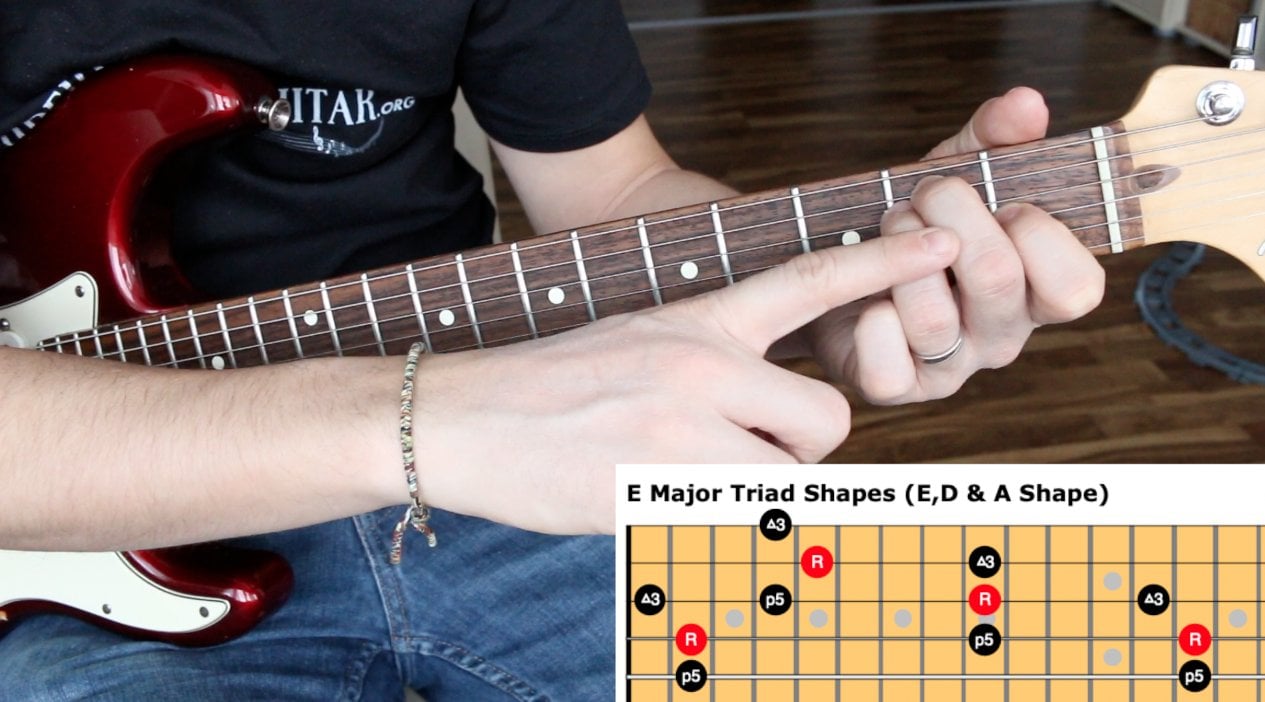
7. What are chords?: Now we've talked about notes. Now let's move on to carts. What our core words, quote, is, a combinations of notes, like I mentioned in a previous lecture. If you're playing just one string, That's a note. But if you play a lot of sheet together, that's a CT. CT is the combinations of not. So that is why most of the time when you press it caught, you have to press more than one string. Because you have to play a large string at once, which makes a quote. And quote is not, it doesn't comes in a random way. Every card has a formula. And for, for example, C major, the formula is 1, 25. And but I feel like this is more of advanced knowledge. So I would have mentioned it too much. I don't want to overwhelm you guys again. So in the future I will put out some funds causes for music Curie as well, but not as touch on the basic stuff. So like I mentioned, just now, called me doesn't form in the randomly. It forms in a very specific way with a specific formula. Thing on cots is more about what you are pressing. What are you pressing instead of how you pressing it? So again, use C chord. C Corp formula is C, E and G 1235. What it basically means is when you press C naught, G naught, and E note and you play them all at once. Mix the C chord. So if you have for any memorize the chart, seconds cubed plus friend is C, fostering second friends, E, fifth street, that Fred is C. And when you're strong, you're strumming a sequence. Because this is C, E, G, open string g, and this is C. So we are pressing to see one, m1 g. So when you shrunk, That's a C Corps. So what that basically means is it doesn't how, it doesn't matter how you're pressing it out, you're pressing it this way, or you're pressing it this way. As long as you are pressing CEG and play them altogether. That's as he called it, that it doesn't matter how you are pressing, pressing it with this finger pattern, or you're pressing it with this thing competitive. No matter how you press it as low as you're pressing CEG notes and you play those triangles together. That is 64, that is a C chord. And nobody can tell you you're wrong. So the lot of time may still have my more at one student. They press the quote like this, and they prefer to press C collect this because it sounds more ONE. And either student will look at them and be like, that's not see Coit. Know it is a C chord is just that. It's a different way of pressing. Because again, if you're pressing SQL as c naught, E naught and g naught, and then play them together. That's a C chord. And each port has written that basically means the first alphabet in all courts. For example, this is C major. So the base must be C, must be C. And that is the exact reason why we press where you place the court yeah. For plugged the base of the fishery because C is C is the base. So whenever you try to play a base, you have to start from here. Instead of playing the six based, clustering based you have who played the fishing. That is the reason why is because this c is the root. That's why use plot from here. So again, put it in other contexts. For example, when you play a minor court, for example, you have to play the base of the fishery because fifth string, the name is eight. And you cannot play either string because other string is not part of the a minor family. Only the fifth string is. And some of the student who asked, why can't I play the bass a here? On the string? Technically you can, but where we say or the base we're referring to the base, the lower loops over here is the base tree. So the basics of guitar are fostering that string and the sixth string. So when you want to play a bass, use it. You usually social base from fostering fifth string or sixth string. You don't go down under, such for your base because those are melody strings, those are not bass strings. So again, let's use a miner for example. If this is a minor, the word, the first alphabet, a, it means they're there as the base. So you have to play a as the base. When you press E minor chord. You cannot play the 63 or the fourth string as the base. Because again, this a minor, the a over here is telling you that the base is a and that is the reason why you have to play a as the base of a minute when you're plugging. I hope you guys understand. I know is kind of a lot to digest. If you still don't understand, please do replay or do some research. But if you do, Let's move on to the next video.
8. Chords quality: Next up quotes Wiley. What is quart quality? The quantity basically means major, minor, dominant seven. Or what else? Major seven, minor seven. All this are caught quality with the same root node and different quality that can sound really, really, really different. Let me show you guys an example. So C would be the remnant of the code. And let's try C major focus. And this is C major. Now let's try the next quality, C minor. This is C minor. Can you hear the difference with the same, just different quality? Now let's try C major 7. With different quality. The vibe is very, very different. That is exactly what qualities are four. And again, to form this quality, there is a specific formula to follow. There is a formula to everything that you've learned. They don't form in the very random way. They form in a very specific way. Now let's try g. This is what G-Major sounds like. And this is what she minor sounds like. If And though with the same rootNode, but different quality. Again, it can sound really, really, really different. So it really based on what the author light. For example, Billie Eilish. She likes to do some that have major seven. Major seven is this white? It has a very Andrew coming down from the sky. Vite. Her song use a lot of major seventh, whereas Pop art is like dwelling. Like Taylor Swift, they use a lot of major. So it really depends on what you want people to feel. That's when you choose your quality waste. And even with major seven chord, it doesn't need a whole zone would be C major seven, G major seven images. Everything, not everything is major seven. It doesn't work like that. So every single goal. So in one song, maybe they start with C major 7. And then we'll move on to mind-map. It wouldn't be, I've never seen a song with just major 7 quality. Now for the usually mixed it up to make it more interesting. That's all about cots quality. I just wanted to introduce to you guys was what are some of the most common quality that you will not? The most common quality that you will see in pop song is major minor, major 77. And to put the whole thing in context, again, this is C major. This is see my name. And this is C7. And this is C major 7. Every thing has a different fight to it. Even with the same. There is very, very different. And that is all I want to teach you guys about quality. I just want to introduce you. What are some of the most common quality to you guys? When you're ready, we can move on to the next chapter and I'll see you there.
9. Beat?: Hello, welcome back. We're finally done with those music. Basic knowledge, yada, yada. Let's get some action going on. In this lecture, we are going to learn the concept of feet. And I will use the Sunday lunches know lobby and rose as an example. I teach you guys. But first of all, let's understand what is beads. Again, in the very basic simple terms without any jargons. The other thing that you kept your tolls and clip your hands with when you're listening to a sum. So when you listen to songs, sometimes it's very natural. It just comes to you and just start clicking your hand, clapping your food. That's, you are actually clapping to the B. Those are B. And for most of the pops on out there, one bar is four beats, so you're usually count 12341234 on the red case, you do count 123. But I do understand that it's hard to count the beat every single time you play. But there is a tool that's hue to help you. It's called metronome. Instead of preaching. And looks like this. And it just click, click, click, click, click that you can choose to BPM, which is beat per minute. How many bit is it permitted? And then you can start playing it on your phone. There's an app for it, and there's a physical metronome as well. And they actually come for you. So you don't have to keep doing 12341234 to make sure you're on the right track. So if you feel like you're not so sure with beat, I do suggest you to download a metronome app on your phone just to listen to it, how it feels like. But if you're ready, let's move on to the next lecture. We will clap some sung and feel the beat going through.
10. Clap along: Welcome back. This lecture we are going to click to a song, but now let's start with a very simple song first, like I mentioned, we should start with lullaby. So I've chosen on Ginko Bao. Now let's try to club to it. I mean, on it. To key. Make sure you're doing it with childish. Make sure you're doing that. One is the four names. And that is actually all. If you copyright, if you've got the right, then let's move on to something a little bit harder. So I'll give you guys a 30 second head start. So make sure you start clapping before the 30-second end. So right after the 30-second, our reveal, the answer which I will, you know, cleft along to it. And if you've been clapping, let's see. If we move, clamp on the right feet together. 30 seconds. That's from now. In fact, his name was neither of these is if you did you get it right. So what had been said, if you've been clapping faster than me, if you're not clipping at the same time, just know when I start clipping means the bead is kind of wrong, but let us not be upset if you get it wrong. Law. Let's try one more song before we move on to the next chapter, just to get the beat right, you know, make sure you are precise. Next son. So again, for the next time, I will give you guys a 30 second head start. After there is again, our stat clapping. And if you guys are on the same club with me, then you're doing it, right? And for this one, I will count 1, 2, 3, 4 as well. Just so you guys know where's the first beat and where it's less beef. Let's get it started. Same system. So that gives us insight. She is stacked clapping, signs for the part. Did you get it right? Okay. So if you've got it right, Let's move on to the next chapter. But all are of all of the trees on that we clap along just now he didn't get any way I would suggest to you to open your metronome. Listened to the metronome just played the four over four. Now, I will see you in the next chapter.
11. Recognise beats in guitar tab: Welcome back. In this lecture, we are going to learn how to recognize some of the most common beads symbol. For classical music. They always looking at peak like this. But for people who play tag, we're looking at bits that's like this. Look familiar. Yes, we have seen this in love your books. All the lines at the bottom. Those are and our passive voice over to do the thing. And they will explain it to you. Hello guys, welcome back, voiceover, Meet, taking over. So in this section I will actually touch on classical notes as well because sometimes when taps, when they write tax rate, they include classic go beat and they exclude like the normal tab B. So our touch on both as well. And if you're ready, let's get it started in 321. So let's start with the most easiest one, which is one beat. And one beat literally looks very normal. It just look like a long line. That is one beat. At any classical. They like this. Black inside with the leg. I call this a lag. Okay, Now let's move on to two beats, two bits as shorter line. That's to be in classical. They are empty inside. These are beads, but it helps if you look at them as two pizzas or $2, it does help a lot. Trust me, which you will appreciate that in the next lecture. Now let's look at three beats. So Tribute is a short line with a dot, That's tree. And in class the goal notes, they are empty inside with a dot. That is tree. Next up, we have four beats in tech 4-bit, absolutely nothing. So if they wrote nothing at the bottom, that thing would be considered as for B. But for a classical notes, they are like this. No lakes, just one circle or oval. That's more accurate. And moving on to use a little bit more complicated, Let's talk about the half beads. So the first half beats looks like this in temp music. This is what half beats looks like. It's an L shaped thingy. I call this part of tilde. Okay, just like cat was the tail. This one is half B. Again, you can think of it as 50 percent or half of a pizza. And in classical loons, they look like this dark insight with the late until that would be heartbeats. Next step, we have something that looks like this. Something that looks like the bar, or I don't know, a window. This is half B. And have been combined together. Actually, they don't want it to look too messy. So the combined this tail instead. So it is half beat for the guy on the left and half did for the guy on the right. So if you look at them as a unit, there will be one beat. But if you want to look at them separately, they will be half beat and half B, O key. And for classical works the same, they look like this. With the combined till. The same theory applies. They just apply this tail together to make them look a little bit more organized, a less messy. Moving on to a long line with the dot. That is one bit and half. Again, you can look at this as one pizza and a half or $1.5. It helps. So in classical music notes, they look like this, like insight. With a dot that is one beat and a half. It does really help if you look at them as like a currency, which I will explain later, because there's a way to cheat if you look at them as currency. For this part, please do memorize because it is quite important. So let me repeat long thing as one beat, short. As two, short one with the dot, that's tree. Nothing. If it's empty, then it is 4-bit. For the one that looks like L, that is half B. And if they have a combined tail, is half B for the guy on the left, half for the guy on the right. If you look at them as a unique, it will be 1 p. Okay? Last one, we have long thing with a dot that is one beat and a half. Actually there is a lot more as well. There's like this devalues quad on, but we will not touch on that today because that's not so often. These are the most frequent beat that you will see. Okay? So if you're already less tried to do accounting practice, I will see you in a short while. Hello guys, welcome back. So let's do a little bit of content practice. This guy is the bottom line, so let's not confuse it first, I already down a byline. And let's start with the top, how to count. So when you're counting, you can actually do this. When we count. Let's think of a first circle, okay? So when we count, we, first of all, I have to look at how many B is it in a bar? So this, post this for over here. They are telling you there's four beats per bar. So why a new coun? You have to do it like this? You have to separate each circle into two pieces so you can come to more accurately. So what we do is we do one, end two n, three n, and the last one for n. Sorry, that's supposed to be for n. Okay? And when we say n, The symbol for end as a plus, okay? So again, when you can't, you have to do 1234 and, or you can basically look at them as 50, 50%, 50%, 50% cent and so on. If you can't really think of as beat, you can look at them as 50 Cent. So each alpha, but no matter is 1 or n, they represent half B, or they represent half of a pizza, or they represent 50 percent. Remember, every thing that you have mentioned represents half B, each one. So when you mentioned APK stuff over here, 1234, and they are called their total up to four beats. Okay? Now let's start with the first one. This guy, it's long. So this guy, the value would be one. This guy is short. So the value is to, like I teach you and mentioned just now. So this guy with the tail, with the tail over here, a combined two. But now let's just look at the left guy here. First. This guy is half-baked or 50 cent. And the guy over here on the right is also half bit as well. So when you write the B, you have to consider. You have to start from one. No matter what happened, you have to start from one. So this one is one beats, so you have to write one. And because again, one thing that you have mentioned is have been visiting, you've mentioned is half B. So if you write half beat, half beat, one beat, so it matches the value over here. Okay? So make sure that you are right. You just have to do some Matt. Next stop. This guy is to B or $2, the value is two. So you have to continue calling thing. You are done with one end. So don't look at this guy anymore. This guy is $2. So how many $0.50? You have to put it on under here. So you have to put 50, 50%, 50%, 50% percent. You have to put $0.450 in order to make the touring it. So 23 and belongs to this guy. Okay, next up, I'll explain it. In B instead of currency. This guy is half-breed. Okay? And remember everything that you mentioned as half b. Now that you've done with tree and foreign, you're left with, sorry, Now that you've done with two entry and we're left with 4. And so again, each thing that you've mentioned equivalent to half B. So if this guy is half, all you have to do is mentioned this guy is half. And if this guy is half bit as well, you just have to write. And so let me revise. 1 n belongs to this guy, to entry and belongs to this guy because the value is 2 $2 basically. Now for belongs to, sorry, now for belongs to this guy and n belongs to this guy over here. And then next bar, line after line, it means a restart. You have to start with one again. Now let's do some revision. A short guy with the dot that is tricky. The value is tree, or you can think of this as tributes eyes or $2. And another guy, this guy as long. So the value is one tree pizzas. So you have to write one Peter, two PTAs and tripeptides for this guy. So what you have to do is 123 and so it matches the value. Everything that you say equivalent to half-baked, remember, and there's six things here. And that sums up to Sri. Moving on, this guy, the value is one. So you are done with tree pizzas. You are left with one pizza over here, which is for n. And after four n is a restart again. So you will see a bar line. I hope you guys understand, but if you guys don't please do click on love your rows. In next lecture, I will explain it with a real life example and tell device and teach you guys how to count there. I will see you there.
12. Count with me!: So now we're looking at a real life example. Again, this fall, this tab is arranged by motto music, I will take the credit, lovey on rows, the one with pledges. Now. Now let's put it in the more real life example, shall we? So the first one, a long guy with a dot. The value is 1.5. Remember, long guy with diet that's 1.5. See 1.5. Now, shot the tail, tail, tail, tail. That basically means 0.5.55.5 big and have been as well. Now, this one is just like the one we see at the first part. 10.5.555 half, half bit. Fail. This is the same, 10.5.555 half half. So whatever answer you right here would be the same as this one. Now, next up, we have, this is exactly the same as this one as well. The last two to shot to the guy. Okay, I hope you guys remember. These guys is to be, because shorter the value is two. Now, let's start counting, shall we? So 1.5 kind of refers to 1.5 pizza or wiring it. And 50 percent, usually if I use them as money, student will understand a little bit more. So from now on I will mention them as like money. So 1.5 pizza, how many $0.50 make? 1.5, which is $1.50. Free. 57 makes $1.50. So what you have to do is you have the right tree stuff down here. So whenever we start, we have to start with 12. That's just the way it is. Okay? After every single byline is a restart. If you see the lines over here, everything above the line means a restart. Let's move on to the next one. For this one, it would be because after one end to it is n. So no matter what happens, you have to count 1234 and you cannot just come 1234, okay, for beginner, do count like 1234. And instead of 1234, it has to start with one and followed by n. And then a next number, 2 followed by N. Okay? Now let's move. This guy over here is half as well. So after one end to end, it would be three. Because remember of the two is three. And after tree you have to follow by n as well. So this guy is and because this one is a half feet, that is the reason why you only put one thing down here. Again half bit because to 50 cent, so if it's 50 percent, you only put wine coin over here. Whereas if it's one ring, get FFTs and you have to put three coins because each coin equivalent to 50 Cent. I hope you guys understand. I'm not sure if I should explain them money because my past experience been telling me if I explained it in money, people who understand a little bit more. Okay, so Let's move on. This guy right now. So these guys have been as well. So after three n, Now as for after four, it would be, and as well. Let me put this guy over here. It would be N. So again, if you want to look at it as a coin, every single thing that you've mentioned, 12 for n represent one coin, which is 50 Cent. Okay? So if you look at it as money, it would be much more easier. Now because these guys are the same. I'm just going to jump straight to this one because they have the same beads. For this one. The value is two. So they are telling you this is $2. So what you have to do is think, how many 50 send ME up $2. So if it didn't match, right, it would be four coins. So you have to write 123. Each alphabet represent a coin, okay? So after 12 and it will be 34. Because again, $2 equivalent to $0.450. Now we see a byline over here. This is a byline. It means a restarts. So whatever you count from here, you have to start with one. And this four is basically telling you you only come until four and there wouldn't be 50, and there would be six, and there wouldn't be seven. And the vice versa, you don't stop at tree as well. They're telling you for, so you must count to four. But somehow, if you made a mistake, you only count on to tree. Or you sometime thing that there is the fifth beat, then it means you made some mistakes. I hope you guys understand what I'm talking about. So anything that you understand or you don't fistula me know, you can inbox me and he tied. Now, let's move on to count and play at the same time. Since we already know all this, we are ready to count and play. I will see you in the next lecture. Bye bye.
13. Class Project-Let's combine everything: Welcome back. It is time to combine everything that will vary, all the basic music knowledge and the P. For now, I will look at my laptop over here to refer to you, love your Aunt Rose 10. Just like we've learned just now, we can actually transferred this thing that we've seen, this number into a node. For example, fostering that Fred, do you remember what that is? Is G. And fifth string, second fret, that is F sharp and string and the string. Then if you still not sure about lids, you can go back. But the good thing about TAP is you don't really have to know anything about nodes. So our cow and play at the same time. Just so you guys get a sense of how he's supposed to do it. So the first note is one bit and a half. So you remember 12224. That's how you supposed to play it. And again, when you combine everything, okay. It means a lot of things that's happening is supposed to play, is supposed to count, supposed to stop. A lot of things is happening. So it can be very over one at start. So that is how you supposed to play and count at the same time. But again, if you realize just now I'm kinda of breath, I have to keep talking. So again, metronome is there to help. They can count for you so you don't have to come. But a common mistake that students make when they count and play at the same time is that they stop. Let me show you a bad example. What do I mean by a star? 12112? They stop in between br because they needed some time to digest, they needed some time to prepare for the next bar. Just please be aware what you supposed to do. Try to make them continuous. And one go and do it at one go. Let's do a pulse countdown, and I'll put this first line with the counting. So you guys can practice and count at the same time. Pause con down in 321. Welcome back. For the second line, I will put accountings at the bottom. You guys supposed to play income the same time without referring to the company. That's how are you supposed to do it. But if you write the content and the bottom is kinda like cheating. I understand that if you guys need some time to digest the beads and stuff, so do make sure that you're really familiar with the beat. So you can just see it and count and play at the same time without writing anything at the bottom. That would be the most ideal way. I'll put a second line, one type, and it will be your turn. And 23412341 and x2 and fun and that's how you supposed to do it. But later on, after the postcard down, you guys can play a little bit slowly. I do adductor little bit fastest now it's just me. But if you're a beginner, I do recommend you guys to start slope like this. 12, then four. And then four. Because as slow as you want. But make sure when you first start, don't do it too fast. Just start slow. So I will do a postcard down right now. So make sure you guys pause this video and practice the second line while counting. This time, there won't be a tipped at the bottom. Pascal down in 321. Welcome back. And actually that is all for combining everything, combining the notes that you've learned, combining how to meet tab and combining the deeds to get them. That's all. But I do suggest you guys to, you know, learn more songs that from lullaby. That would be amazing.
14. FAQ: Back to the last chapter. As you can see, I've put my guitar down because I'm here to answer questions. So I'm going to look at my laptop here. I'm going to refer to my laptop here. And I'm getting these questions for W W dot dummies.com. So they have article about 10 frequently asked questions about music theory. So let me answer some of them. Question, if I can already play some music without knowing music theory Y for the learning. Again, if you're curious, baby, if you're just a very curious person in nature, you would wonder why things are the way they are. Why do you press this court a certain way? And what do you call this as C code and call that a minor chord. There's a formula to it like I mentioned. So to be honest, in these contexts, because I'm a teacher myself, I have seen a lot of teachers that please keep that fairly well. Of them better than me to do improvise vision and haul them. Without any theory. All they know is the beat and some of the nodes. They have no idea why see other when they are, they don't know anything about those formula. So if you're wondering if you can play instrument well, we don't know any music theory. That question would be yes or no. You have no some of the music theory, but you don't have to muster it. You don't have to be a master of music theory to become a great musician. But again, it does help look at people like Jacob Collier. I admire hints. So wedge, He's like music theory textbooks. She knows so much and that's the reason why he can get Grammys at such this young age. Because he knows lot. He's very curious in nature. He always wonder why things are the way they are. It does help to improve his playing skills. And as you can tell Jacob Collier, he sutural instruments a lot. So if you know a lot of music theory, it does help with that. It does help with you switching around instruments without putting too much time on it. So if today you don't know anything about music theory and you try to switch to piano. You're basically said starting from square one. But if you do already know a little bit of a music theory, I would say like 50 percent of the music theory and you start to play piano, you wouldn't be as hard as other people. You wouldn't be starting from square one. Next question. The next question. Why is so much music theory centered on the piano keyboard? Because piano is the most easiest way to understand music theory, like I've mentioned in a previous lecture as well. Piano, basically a color-coded. There's black, there's white. You can see clearly at everything is laid out so nicely for you. One key after another, before guitar is not the same thing. It is basically a whole other world compared to piano. Piano, everything layout basically. Before guitar, they don't, there's the same C, same ie, the sounds literally the same on guitar. Let me show you guys. So what different from the term PLOS for guitar? They don't lay out nicely for you. Kelo is like us from C and then D and E and then F and then G. But for good guy doesn't work that way. And another big difference about piano, guitar is piano only have one same note in the whole panel. So what I mean is if you play this he on Kindle, you only can find that C at that particular place. But for guitar, you can find C here. And you can find see here. And they literally sound the same. So let me do a comparison for you guys. The first opens shrink, and the second string, fifth fret, sounds literally the same. I'm bucking two strings over here. The sounds literally the same. And you can find the same E at another place to. So this place is the string 12, 11, 10, 9, Fred. So there's one particular note that sounds the same at a lot of place. So that is the reason why when it comes to music theory, a lot of people we use piano and as an example, which is a big advantage, be this advantage for people who wants to learn guitar. But we are here to help each other, right? So, yeah, next up. Is there a quick and easy way to learn to read music? Yes, there is. I'm actually a classical guitarist, but I fall in love with acoustic guitar and Tatas playing pop song, you know, on the way. But technically I'm classical guitarist. There is simple way to memorize all of the nodes, But I think what it's referring here as the classical looks like this. As for tabs, I don't think you need to memorize because they're just numbers. Again. Last question. Why is music theory important? Music theory is important because again, it helps you understand why things are the way they are. Once you understand music theory, it's really easy for you to switch around in treatments. So o, a lot of people will say, Oh Mike are useful ton that you can play guitar, you can play piano and play drums and you can leave. But the truth is adult, I couldn't muster all of the instrument. I've muster as music theory. That is because dashes, that's the power of music theory. I wouldn't say their theory, they are literally facts. There are like This formula that works everywhere. So just that you met problem. If you know the formula to your mats problem, it's not hard for you to solve the equation. So the same goes for music. Once you know the formula, it is not hard for you to get the answer and played correctly. But in this lecture, in this course, I've barely touched on the formula because again, I don't want to overwhelm you guys if you guys haven't even get the idea of the nodes yet. So if you guys do Qin two or more, do let me know and inbox me please. I'm really happy. Every time I see a message popping from you guys, I'm really, really happy. So if you guys do one molar, we're above music theory more in depth, please do. Let me know.
 Nola
Nola