Transcripts
1. Welcome & The Overwhelm Trap: Welcome to from
inspired to creating. How to turn creative
overwhelm into focused art. This class is for you if
you recognize this feeling. You are surrounded
by inspiration. Everywhere you look, there is a technique you want to try, a trend you want to explore, a challenge you want to join, a style you want to develop. Your saved folders are full. Your sketchbooks have
half started experiments. Your Notes app has 17
ideas you haven't touched. And somehow, despite all of that richness, all
of that input, all of that genuine
love for making things, you sit down to create
and you do nothing. Not because you're lazy, not because you don't care, but because there is
simply too much and your brain doesn't know
where to point itself first. That is creative overwhelm, and it is one of the
most common and least talked about reasons
artists stop making work. I'm Ricardo, and I have been there more times
than I can count. I am someone who finds inspiration in
everything in nature, in galleries, while doom
scrolling in books, in the color of a coffee
cup on a rainy morning. The world is endlessly
interesting to me, and for a long time, that
was exactly the problem. By the end of this class, you will have three things
a clear understanding of why creative overwhelm happens and why it is
not a character flaw. A simple personal tool called the creative focus
filter that helps you decide what to act on
and what to let pass. A first creative mark, something real and
started, not just planned. This class is practical. Pause the videos,
work alongside me, and by the end, you will have
something in your hands, not just in your head. Let's start by understanding
why inspiration, the very thing that's
supposed to fuel us so often stops us cold.
2. Why Inspiration Becomes Paralysis: This lessons looks at why
inspiration becomes paralysis. Before we can fix
creative overwhelm, we need to understand what's actually happening when it hits. Here is the thing
about inspiration. Your brain treats every
genuinely exciting idea as a potential priority. When you see a beautiful Lino print technique
on Instagram, your brain lights up.
This could be the thing. When you read a trend report about botanical illustration, your brain lights up again. This could also be the thing. When an art challenge lands in your feed with a
compelling theme, your brain says and this. Every single one of
those moments is real. The excitement is genuine, the pull is genuine. But your brain cannot hold
20 priorities at once. When everything feels
equally urgent and exciting, it responds the way any
overwhelmed system responds. It freezes, decision
fatigue sets in, and the path of least resistance becomes not choosing at all. This is not weakness. This is neuroscience. There is a concept called
the paradox of choice. The more options we have, the harder it becomes
to choose and the less satisfied we feel with
whatever we do choose. Artists who love and seek out inspiration are
especially vulnerable to this because our entire practice depends on remaining open
and receptive to the world. That openness is a strength, but without a filter,
it becomes a flood. There is also something
else at play. When we consume
inspiration, saving a post, watching a technique video, bookmarking a color palette, our brain gets a small
dopamine reward. It feels like progress. It feels a little like
creating, but it isn't. Over time, if consuming inspiration consistently
replaces making, your creative confidence
quietly erodes. You start to feel
like someone who appreciates art rather
than someone who makes it. I want to give you one
reframe before we move on. Inspiration is not the enemy. Unfiltered inspiration is. The goal of this class is not to make you less
open to the world. It is to give you
a personal system for deciding which inspirations deserve your creative
energy right now and which ones
deserve to wait. Because not every
beautiful thing you see needs to
become a project. Some things can
simply be beautiful, some can go into a
future ideas folder, and a small chosen few, the ones that align
with where you actually are and where
you actually want to go, those are the ones you act on. Let me show you how to tell the difference in
the next lesson.
3. Your Creative Focus Filter: Now, let us look at your
creative focus filter. The creative focus filter
is a simple one page tool. You will build yours as we
go through this lesson. So have a piece of paper
or a notebook open or a notes document if you
prefer to work digitally. It has three parts. Part one, your creative anchor. Your creative anchor is
the core of what you make, not what you want
to make one day, not what you think
you should be making, not what's performing well
on someone else's Instagram, what you actually make in your
actual practice right now. This might be a subject, botanical illustration, character design,
abstract landscapes. It might be a medium watercolor, digital, pen and ink. It might be a feeling, quiet and contemplative work, bold and energetic work, intricate and detailed work. For most artists, it is some
combination of all three. Pause here. Write the answer to this question at
the top of your page. When I make work that
feels most like mine, it looks and feels like. Don't overthink it. Write the first honest
answer that comes. You can refine it later. Part two, your current season. Your creative anchor
tells you what you make. Your current season tells you where you are right
now in your practice, because that changes
and it matters enormously for deciding
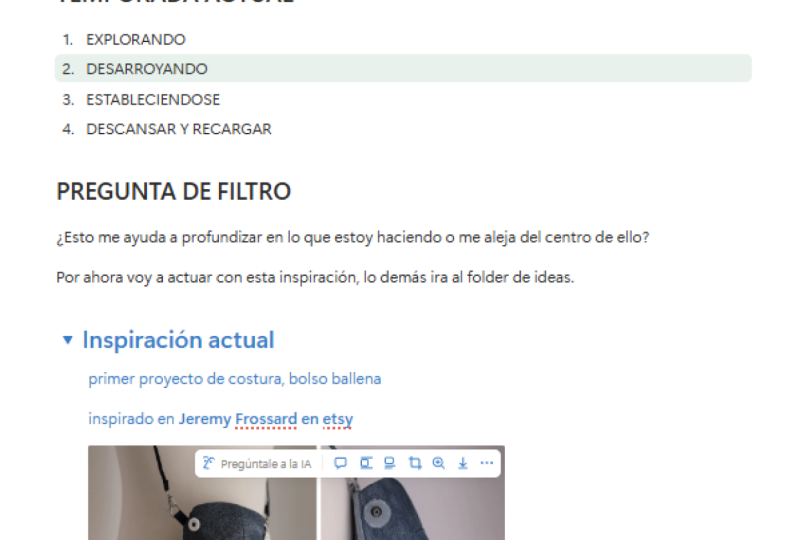
what inspiration to act on. There are four creative seasons. See which one you're
in right now. Exploring, you are
trying things, experimenting, not sure yet
what direction to take. Lots of unfinished
pieces, lots of variety. This is a valid and
important season. Developing, you have a general direction and
you're deepening it, building a body of work,
getting more consistent, starting to recognize
your visual voice. Establishing, you have a
clear style and practice. You're building an audience, taking on clients
or selling work. Consistency matters more than
experimentation right now. Resting and refilling. You're between seasons burnt out or deliberately
stepping back to replenish. Input matters more
than output here. Pause here, write your
current season on your page. This matters because
the inspiration that serves you completely
depends on where you are. If you're in the
developing season and you keep chasing exploring
season inspiration, new techniques,
wild experiments, totally different subjects, you will never build the
depth your season needs. Part three, your
filter question. Now you have your
anchor and your season. You have a filter
question you can apply to every piece of
inspiration you encounter. The question is,
does this move me deeper into what I'm building or does it
pull me sideways? Deeper means it relates to your current subject,
medium or feeling. It challenges you
within your lane. It adds to what you're
already growing. Sideways means it's exciting, but it belongs to a
different practice, a different season, a
different artist's journey, not yours, at least
not right now. Sideways inspiration goes
into a future Ideas folder, a physical notebook,
a saved folder, a notion page, whatever
works for you. It is not ignored. It is held for later.
This is important. You are not closing doors. You are choosing which door
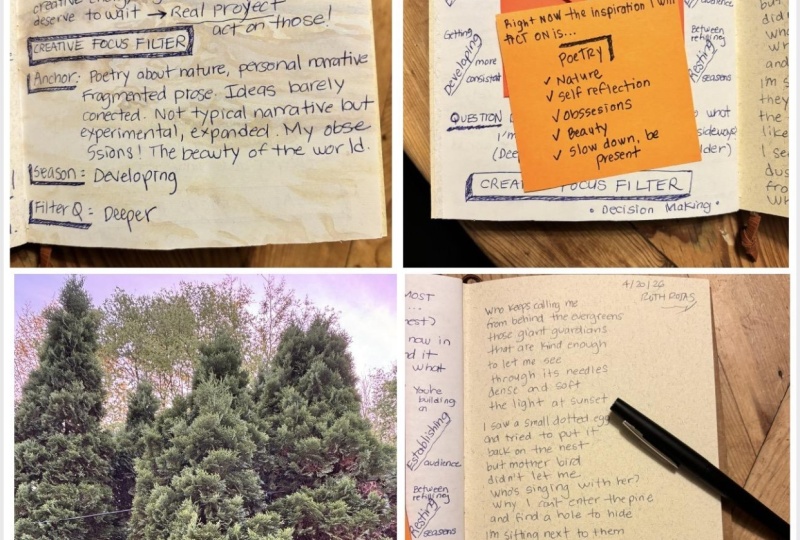
to walk through today. Pause here at the bottom
of your page, right. Right now, the
inspiration I will act on is everything else goes to
my future ideas folder. That sentence,
simple as it looks, is your creative focus filter. It is a decision made
in advance so you don't have to make it fresh every time you sit down to work.
4. From Filter to First Mark: You have your filter.
Now let's use it right now in this lesson from
filter to first mark. Because the biggest trap after any planning exercise is
returning to consumption mode, watching another class,
reading another article, saving another post, telling yourself you'll start
when you feel more ready. Readiness is not a feeling
that arrives before you start. It is a feeling that
arrives because you started. You
already know this. So here is your task
for this lesson, and it takes 10 minutes. Look at the last sentence you wrote in your creative
focus filter. Right now, the inspiration
I will act on is open your sketchbook or
your working document and make one mark that
belongs to that thing. Not a finished piece, not a polished study, one mark, one color swatch, one rough compositional sketch, one written sentence describing the piece you want to make, one reference image
gathered and placed on a page with a handwritten note about what draws you to it. The mark doesn't
have to be good. It doesn't have to
go anywhere today. It just has to be real, a physical trace of you choosing your focus
over the noise. I want to talk for a moment
about what this first mark actually does because it's
more powerful than it looks. When you make a mark in the direction of
your chosen focus, you are doing two
things at once. You are creating momentum, the single most
important ingredient in a consistent
creative practice, and you are sending
your brain a signal. This is the one
we're working on. Over time, that
signal gets stronger. The filter gets easier to use, the overwhelm gets quieter, not because there is less
inspiration in the world, but because you have built
a practice of choosing. The artists you admire
who seem to have a clear, consistent, recognizable
body of work. They are not less
inspired than you. They are not less tempted by every beautiful technique
and trending subject. They have just
built this muscle, the muscle of choosing
depth over breadth for now. You are building it, too. You
just made the first mark.
5. Your Class Project: Hi. Your class project for this class is
beautifully simple. Upload two things to
the project gallery. One, a photo of your completed
Creative Focus Filter, your anchor, your season, and your filter sentence. It can be handwritten
on a scrap of paper or typed in
a notes document. It doesn't need to be beautiful. It needs to be honest. Two, your first mark, a photo of the sketch, the
swatch, the rough study, the written
description, whatever your first 10 minutes of
focused creative work produced, it doesn't need to be finished. It just needs to
exist. That's it. Those two things together are the whole point
of this class, a decision made and
a beginning begun. When you share in
the project gallery, I would love to know what
season are you in right now and what is the one inspiration
you've chosen to act on? Write it in your
project description. Because something
important happens when you say it out loud, even to a screen, it
becomes more real, more committed, more yours. Before I let you go, I
want to say one more thing about creative overwhelm because I think it
needs to be said. If you have been living with that frozen feeling for a while, the sense of being surrounded by inspiration and
producing nothing, please be kind to
yourself about it. It is not evidence
that you are not a real artist or not disciplined enough or
not serious enough. It is evidence that you are
genuinely alive to the world, genuinely moved by beauty
and craft and ideas. That is the best
possible raw material for an artistic practice. You just needed a filter. Now you have one.
Use it every season, revisit it when the
overwhelm comes back, and it will, because
that's the nature of a creative life lived
with open eyes. Each time come back
to your anchor, name your season, ask
your filter question, and make your first mark. I'm Ricarda. I am so glad
you were here for this one. Please check out my
profile for more courses. Click Follow to receive updates whenever a new one is
launched. Thank you.
 Ricarda, 20+ yrs Music Pro: Branding & Creativity