Transcripts
1. Introduction: Are you in constant conflict between creating and earning, contributing and consuming, basically just trying to
survive under capitalism? Well, welcome, friend.
You're in the right place. I'm Tamara Jensen, an artist,
strategist, educator, and lifelong student of what it means to build
things differently. As a very reluctant
participant in capitalism, I've built, scaled, and
sold my own businesses, and I teach people
how to do the same. If you've taken any
of my other classes, you know I do things
a little differently. I'm all about leading
with purpose, modeling care, and
creating safe, inclusive and fair
environments where we can all create and
thrive in community. Revolutionary, right? Well, for many of us,
especially creatives, women and people
whose communities have been excluded from
traditional systems, money can be a
complicated topic. We've inherited economic
models that were built on extraction,
inequality and burnout. We've been told
that success means constant growth, endless hustle, competition, that our value as humans is tied to our productivity
and our bank accounts. But as I've learned
over the years, it's not all doom and gloom. There are ways to not only
survive in this system as a creative who's
building something with purpose, but to thrive. So we're here today to
reframe something big, money, to get clarity on how we can create value without
compromising our values and how we can make an individual and collective impact with the
resources we have. This class is for artists, creative entrepreneurs,
solopreneurs, and purpose driven
founders of all kinds who want to build financial
systems that feel empowered, equitable, and sustainable
while still paying the bills. It's for anyone who wants
to make a living from their work without
compromising their values, people who believe that business can be both conscious
and profitable, both growth minded and giving. Above all, it's for anyone
who wants to set themselves up financially to make an
impact, doing what they love. Maybe you're just starting out and want clarity
on your pricing. Maybe you've been running
your business for years and want to realign
it with your values. Wherever you are
on your journey, this class will
help you reconnect your financial decisions
to what matters most. So over the next few videos, we'll learn how to reframe
our relationship with money from fear or avoidance
to confidence and care. We'll identify our
enough number, the amount that allows
us to get out of survival mode and live
and create sustainably. We'll map out our
income streams that honor our energy and
our communities. And we'll design a
conscious money map, a simple visual guide to keep our finances aligned
with our ethics and well being while creating mutual benefit for ourselves
and our community. By the end of the class,
you'll walk away with a clear personal framework for managing your finances in
a way that supports you, uplifts others, and ultimately generates limitless
value and impact. So instead of thinking of
money as a scoreboard, I invite you to think of
it as a flow of energy. It moves through
you, your business, your collaborators,
and your community. And you have the
power to direct it with intention. Let's dive in.
2. Class Orientation: Before we jump into things, take a minute and hop into
the class discussion to share a single word that described your current
relationship with money. Maybe it's healing, conflicted,
hopeful or terrified. I don't blame you. There's
no wrong answer here. This is all about sharing
and unlearning together and learning how to create with clarity, courage, and care. Okay, before we build anything, we need to redefine
what value means. In a capitalist system, value is measured by profit. Traditional business model
frameworks center the value of an idea on whether or
not it might be profitable. Of course, we want
our business or our creative practice to earn enough to sustain itself
and hopefully grow, but I think we can
do much better. In a feminist and decolonial business model,
value is relational. It's measured by
care, reciprocity, and well being, and that doesn't mean you're
not earning money. So what does this look
like in practice? Well, it could be paying
yourself and others fairly without undercutting
or overcharging. In my restaurant, we were a certified living
wage employer, and we eliminated
the tipping model. It was non negotiable to me that every person
in the business was treated and compensated
as professionals and humans. It could also look like
choosing sustainable materials, even if it means slower growth. In fact, research shows
that businesses with sustainable production
processes are more than twice as likely to survive
than conventional ones. And the sustainable
materials market is projected to grow from about 330 billion today to over 1 trillion
in the next decade. That means that choosing
better materials, even if it means slower growth, isn't just a moral choice.
It's a strategic one. So a conscious business
model could look like pricing that reflects
both access and abundance. Sliding scale pricing, pay
what you choose, tickets, pay it forward models and co ops where
profits are shared. They're all examples
of creating value and distributing it in a way
that supports community. It's about circulating wealth
instead of hoarding it. So I'll challenge
you to think of your current creative
practice or business. Maybe you offer
workshops where you could offer sliding
scale pricing so that those with ample
resources can make it easier for others
to participate. Or maybe you could
find a sponsor that aligns with your
values to help cover costs. Maybe you're an artist,
and you could form a collective sharing
studio space, materials, marketing costs, all benefiting from the added
visibility opportunities and customers that come with the combined
energy of the group. So before we move on, take
a minute and jot down a few ideas of how
your revenue model might embrace these
unconventional ideas. There are some examples
in the class description if you're looking
for inspiration. There's no single
best answer for this. As we start to build
our money maps, we can refine which
models work best to build our resources and increase our
capacity to keep creating. Join me in the next
video where we'll set our financial intentions and get a grasp on our goals.
See you there.
3. Exercise: Set Financial Intentions & Find Your "Enough" Number: Okay, don't be scared, but we're at the
part of the class where we have to do some math. So take a deep breath, shake off the k of capitalism and trust that we're
in this together. For this exercise, grab a
sheet of paper, your journal, use the template that's
in the class description, whatever you prefer
to work with. We're going to start to build our conscious money
maps together. They're a living creative
snapshot of how money, care, and impact flow
through our work. You don't need to be good
at math or design for this. Think of it like sketching a self portrait
of your business, and instead of eyes and hands, you're visualizing energy,
purpose, and resources. Okay, let's get started. We're going to begin by
setting our intentions. At the top of your page, write three sentences
that describe how you want money to feel in
your life and business. Let yourself visualize
how it would feel to have ample resources to
practice your craft, build your business with
ease and make an impact. If I imagine how I want money
to feel in my business, I might say, money moves through my business with
integrity and ease. I'm not interested in a business that's built on extraction or relies on paying
people poverty wages so that I can pay my bills. But I also don't want it to be a struggle, hence the ease. Next, I might write, I
earn enough to rest, share, and create without
urgency. Let's be real. We all need to take
a break sometime, and living from paycheck
to paycheck without the ability to take a proper
break isn't good for anyone. We need restorative rest in order to create
and provide value, and we need to account
for that in our finances. Lastly, I might say, every dollar reflects
my values of care, transparency,
and sustainability. I don't just want
the cash to flow. I want it to come because
people support what I'm creating and they align with
how I'm creating value. So take a deep breath, pause this video, and write freely. You can
always edit later. How do you want money to feel in your life
and your business? These intentions will become the compass for the
rest of your map. Okay. Now, we need to inject a little dose of reality
into our money maps. We have bills to pay,
student loan debt and ourselves to care for. So in this next step, you'll add up your real monthly needs. The total number
in this exercise will include three
areas of your finances, your personal needs,
your business needs, and your care needs. And your personal needs, list things like your
rent or mortgage, groceries, transportation,
utilities, healthcare. Pause if you need a moment
to think through this list. I know it's a lot. Next,
list your business needs, materials, software,
web hosting, packaging, marketing,
wages, insurance. Again, I know the list is
endless and probably scary, but we can't get clarity
without confronting reality. So pause the video for a second, if you need to write
out that list. Lastly, write out
your care needs. What? What's this magical
accounting category? We'll get to that in a moment. For now, list your care
needs like therapy, vacations with the
family, savings, time off, anything that
supports your well being. Now add up your personal
business and care totals. This is your enough number. It's your sustenance school. Now, this shouldn't be an
arbitrary fantasy salary, but it also shouldn't be what
keeps you in survival mode. You want to write
down the number that allows you to
live and create well. That's why we included
your care needs. If your total is, say, $4,800, just round it up
to 5,000 for simplicity. So this is your monthly target. It's the amount that lets you thrive without exploiting
yourself or others. You factored in the necessities in your personal
and business needs, but also included a
realistic estimate on what it costs to
experience being cared for. And that's where we find support and capacity to keep creating. Okay, so we've thought about how we want money to
feel in our lives, and we've done some math to get clarity on what we
need to thrive. Now we're going to
find that money. In the next step, we're
going to think about how money enters our ecosystem,
our income streams. In this part of the map, I'm challenging you to
think creatively. Maybe you're a chef with a passion for throwing
pottery on your days off. Why not host seasonal dinners where you sell limited
edition plateware? Are you a visual artist
who's comfortable in your practice and has lots
of experience to share? Consider teaching workshops
at a fun local venue. Do you have an engaged
online following? Consider a subscription model on Patron Substack or
hey, Skillshare. The reality is, it's rare
and even irresponsible these days for any business to have a single income stream. As a creative and as
someone who's driven by purpose and the desire
to provide real value, you're in the best possible
position to dare I say, capitalize on this reality. In my case, I sell
original artwork. I deliver workshops and one on one coaching
and mentoring, and I teach on Skillshare. I've also provided fractional
and project based services that are funded by grants. I've listed some
possible income streams in the class discussion
for you to consider. So pause this video, list
the ways you currently earn money and any new ways you'd like to experiment with. I've toyed with the
idea of launching a Substack, so I'll
add that here. Okay, now we want to
estimate how much each of these income streams realistically
contribute each month. When you've done some
quick napkin math on these income streams, ask yourself, does this add
up to my enough number? Now, if it falls
short, don't panic. The whole point of this
map is to help us notice the gaps and get excited
about the opportunities. So trust the process. Okay,
that's enough math for now. Next, we'll get
to the map making part where we'll visualize
how our finances support our needs and our
impact and see how the energy flows to create a healthy
financial ecosystem. Join me there.
4. Exercise: Build Your Conscious Money Map: He Okay. No more math, I promise. We are ready to start making
our conscious money maps. There are personalized
frameworks for managing our finances in a way that gives us clarity
and direction. So the goal here is to visualize how our
purpose, resources, and impact intersect, and where we might want to pay
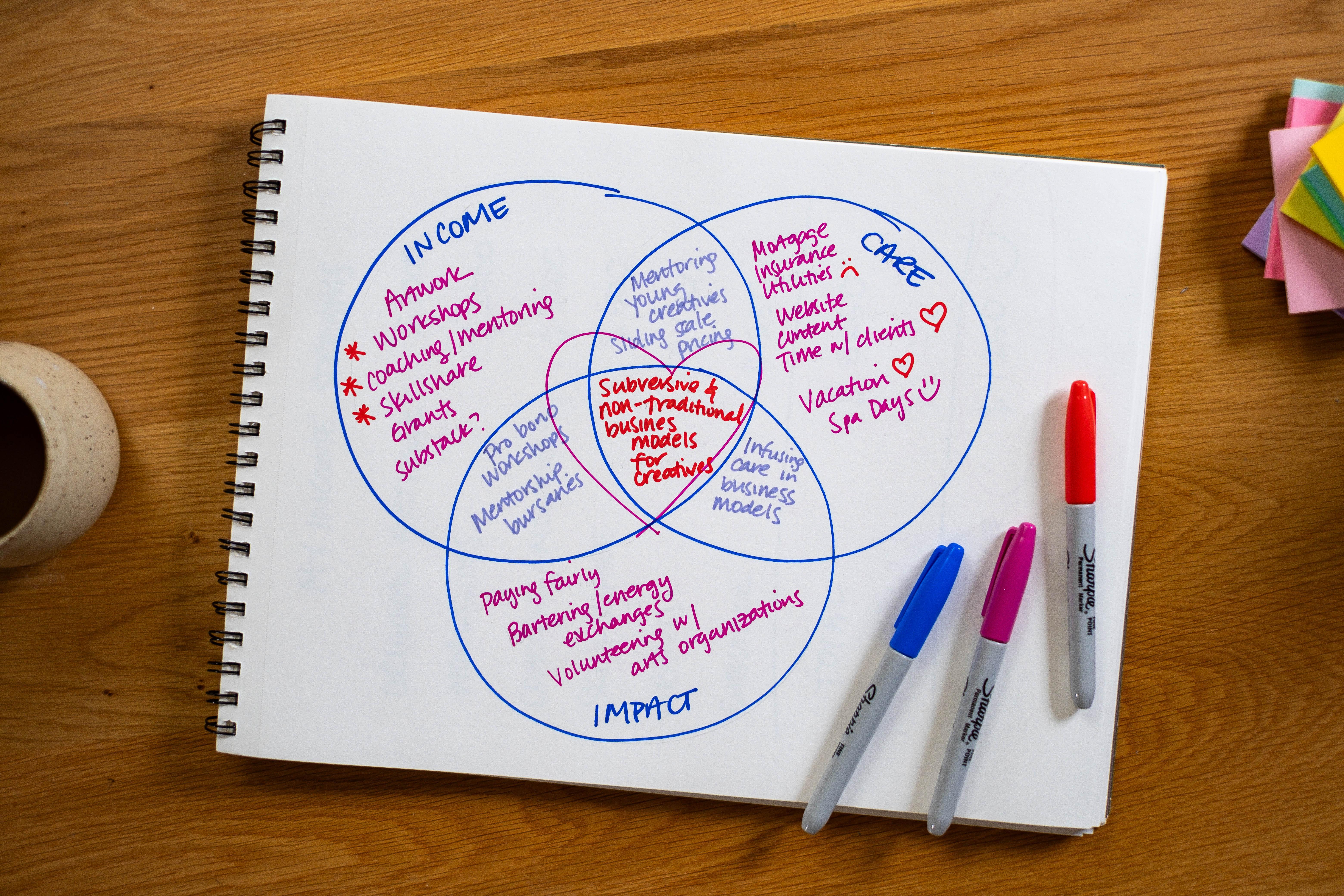
a little more attention. So on your page, draw three large overlapping
circles like Ben diagram. You'll label them income,
care, and impact. Let's walk through each circle. So first, income.
In this circle, write everything that
brings money in. Go back to your list of current and curious
income streams from the previous exercise. So this might
include things like product sales,
services, commissions, teaching, speaking,
or mentoring, grants, residencies, or
other sources of funding. Maybe passive income, like print on demand or
affiliate sales. Write down each source. Next, we want to identify
where abundance already flows easily and where new streams
might want to emerge. So you can highlight doodle, underline, whatever
makes sense to you. Just indicate which income
source or sources feel the most steady and which ones are maybe a bit
more experimental. Okay, next, our Care circle. In our money maps, we're replacing the word
expenses with care because every cost or expense should care for
someone or something. So go back to your
previous exercise and write down the items you include in your personal business and care
costs, your expenses. So this could be
materials and tools, rent or studio fees, software or subscriptions,
professional services. But don't forget rest, time off, self care, continuing education, whatever that looks like. Once you have your care
items written down, identify which
items nurture you, your collaborators
or your craft. Again, highlight,
doodle, underline, whatever makes sense to you. Now, if there's a care item that doesn't nurture any
of these things, ask whether it can be reduced,
replaced, or released. It's certainly not always easy or comfortable to
think about cutting back. Try to think
creatively on how you might reduce or eliminate
some costs here. I'm in a group chat with some friends that we
call Lady Money party, and we challenge
ourselves to switch providers for things
like our cell phones, car insurance, and even where we shop for
necessities if we found ourselves defaulting to a
more expensive supermarket because it was more convenient. With some simple changes or
negotiations with providers, you might be surprised
where you can reduce costs, freeing up resources
for the things that make us feel more
supported and cared for. Okay, so what about this area where income and care overlap? This intersection is all about sustainability
and well being. It represents the work, systems, and habits that generate revenue and genuinely
support your well being. So what belongs here? This could be fair
pricing models that reflect your value
and your capacity. Projects or clients that are financially rewarding
and emotionally healthy. Income streams that
don't cause burnout, so passive income or seasonal offerings that allow
you to rest in between. It could be investment
in tools or education that make your
work easier or more joyful, could be healthy
financial boundaries, saying no to work that drains
you, even if it pays well. In filling out this area, look at the areas you
highlighted in each of the other two circles
and ask yourself, Where does earning money feel good for my body and my mind? Or which sources of income actively contribute
to my well being? Pause this video if you need a few minutes to think through
this part of the exercise. Okay, now we're on to impact. It's why we're all here, right? Sure, we all need money to exist in society, and
we have bills to pay. But we're all driven by
something bigger than ourselves, and we want to make sure
our financial realities make it possible
to make an impact. So in our third circle, impact, this is where we're
going to track how our money moves outward, how we participate
in reciprocity and play a meaningful
role in our communities. I want you to notice that
this is a circle of verbs. It's actions you're
taking or will take to align your
finances with your impact. So you might include actions like paying fair wages to staff, assistants or collaborators or donating a percentage of
profits to a local cause. Maybe bartering or gifting
work within your community. I personally barter
all the time. It could be using eco
friendly packaging or suppliers or mentoring someone
for free once a month. Remember, this isn't about giving all your resources away. We still need to
meet our own needs, but we want to think
beyond ourselves here. As an added bonus, thinking about others is a
great way to get out of our own heads if
we're ruminating about stressful
things like finances. So, ask yourself when
my business thrives, who else thrives with me? Whatever you feel like to
identify the actions that are most accessible or
impactful to you now. And those are maybe
a stretch goal for when you're in even
better position to give. I'm so excited to see the actions you come up with
in your impact circles. It will be no doubt inspiring
to everyone else here, and collectively,
we can all expand our repertoire to make
an even larger impact. Okay, so what about
the area that overlaps between
income and impact? This intersection is all
about purposeful growth. It's where you make money while
creating positive change. It's a sweet spot where
your business goals and your social or environmental
or community values align. So in this area, you might list aspects of your
business that are tied to social enterprise or mission driven products
that you're creating. Maybe it's creative commissions that raise awareness
or support a cause. It could be consulting, teaching or speaking engagements
that empower others, could be choosing
ethical clients or collaborations that
mirror your values. It could be transparent pricing
that redistributes power, like sliding scales
or forward options. When you're filling out
this overlap, ask yourself, how can I generate
income in a way that expands justice,
not inequality? Or which of my offers have ripple effects beyond
my own success? Pause the video if you want
to take a few minutes here. Now, if we look at the overlap
between care and impact, this intersection is all about collective care
and regeneration. It's about tending
to the well being of others while also
nurturing yourself. How you sustain the
community that sustains you. In this area, you can write
down the actions you're committed to that make an
impact on you and others, like paying
collaborators fairly and promptly or mentoring others
without self sacrifice. It could be sourcing materials locally or ethically to support small ecosystems or building accessibility into your
offerings like using captions, flexible pricing or trauma informed facilitation
for your workshops. Any practices that
replenish mutual aid, time banking, bartering, that's what you want
to focus on here. So to fill this
out, ask yourself how do my care practices
extend outward? Who else benefits when I
take good care of myself? So how do these circles connect? What goes in the middle of
our conscious money maps? This is the beating heart of your ecosystem where purpose, sustainability, and
prosperity coexist. It's about wholeness,
integrity, and flow. In this center area, you want to include things
like your most aligned offers, the ones that support
you financially, sustain you emotionally, and
create meaningful change. The creative work that feels
like it's your true calling, it's profitable and principled. You can include the systems
that circulate abundance. You earn, you rest,
you give back, and that energy returns to you. So ask yourself what gives me the feeling of
enough sufficiency, satisfaction and
shared prosperity? Or which practices, projects or choices belong right at
the center of my world? Pause this video if you want to take a few minutes to
think through this. Now let's take a step back
and look at our money maps. Our income feeds our care costs. Our care costs sustain us so that we can keep
creating and earning. Our impact sends energy
back into the world, which, and here's the magic, eventually circles
back as trust, reputation, collaboration, opportunities we haven't
even imagined yet. In this way, your
conscious money map is a living ecosystem,
not a static budget. If we think of money as energy, we can see clearly how it
flows through our ecosystem. So in your money map,
where do you see harmony? Where do
you see tension? Maybe your care costs feel heavy or your
impact feels light. That's okay. This is your
starting point for change. Your map is a visualization
where you want to go. It's the intersection of financial and systemic reality
and your larger purpose. I would love it if you
can snap a photo of your Money Map and upload
it to the project gallery. Messy drawings, color splashes, sticky notes, scribbles,
it's all welcome. Now, when you post your
Money Map with the class, share a short reflection. Like, something I realized while drawing this map was blank. Your awareness is the
real deliverable here. Sneaky, right? In my case, I realize that I most energized through my mentorship
and teaching practices. And through some key
collaborators and platforms, I have the room to offer
accessibility for those who can't afford a business coach or an expensive
training program. I'm most interested
in working with early stage entrepreneurs and
creatives who can benefit from unconventional
frameworks and approaches so that they build their businesses with a much needed
consciousness, much like I'm doing
in this class. Knowing I'm helping others bring their ideas to life
and create impact themselves feels like an open and limitless
ecosystem to me. So I hope you can see that
this isn't about perfect math. It's about seeing
your creative economy as a living ethical organism, one that supports you, your
people, and the community. Now, how do we move
forward from here? In the next video, I'll share some simple but impactful
financial fundamentals that you can apply immediately.
I'll see you there.
5. Financial Fundamentals: So how do we use our maps like a navigation
system to make sure our financial systems
stay healthy and aligned and keep
supporting us as we grow. Here are three
radical principles you can apply immediately. Number one, transparency. This could mean being
open about pricing and pay with clients,
collaborators, and yourself. Transparency dismantles secrecy, which is where inequity hides. It also builds trust, like real actual trust with the people you
want in your ecosystem. And as we saw, this feeds support, collaboration,
and opportunity. The second principle
is reciprocity. When you earn more, give more. It's as simple as that. Whether that's mentoring
a younger creative, sponsoring someone's
registration fee for an event or sourcing
more ethically, your money has momentum. Think about the resources you've had access to on your journey. The people who have lent an ear, offered guidance or volunteered their time to support
something you're working on. It's time to pay it forward. Last but certainly not least, prioritize your personal
boundaries and well being. Capitalism teaches us that time is money and money is power. And so we do everything we can to optimize and streamline, find efficiencies and
shortcuts to save time. And somehow, even
after all that time saving and streamlining,
we're exhausted. Feminist and decolonial
business models remind us that well
being is power. And as we've seen
in our money maps, our well being is part of a
healthy financial ecosystem. So build a care week into
your schedule and budget for in advance so your rest is
literally accounted for. That's conscious design. It's not about sacrificing
or making less money. It's about making money more meaningfully
and sustainably. So, a challenge. And please share in the discussion to
inspire other students. What's one financial boundary or ethical commitment you want to integrate into your business? Even small shifts make a big
impact, so share freely. I hope you're
feeling inspired and equipped to move forward
with your living, breathing conscious money map. Remember, money doesn't
measure our worth. It measures our capacity, our ability to create, to grow, and sustain ourselves
and our community. Join me in the final video for some closing reflections on the powerful mindset
shift this practice has instilled in me
and others and where we can all go from here to increase our
collective impact.
6. Closing Reflections: Well, you just built your first conscious Money
Map. How does it feel? It's not just a budget. It's certainly not
a spreadsheet. We barely did any math, really. Your conscious money map is a declaration of the
world you're building and the resources you need
to support it so you can actively and
sustainably make an impact. So let's close with a
bit of a mindset shift. Wealth, money, finances,
it's not about accumulation. It's about circulation
and generation. It's about ensuring
that resources, care, and creativity flow so that we can all benefit from
a more equitable, thoughtful, and
sustainable way of living. When you choose to run your
business with consciousness, you model a new way forward. You show others
that business can be both profitable
and principled. Your project for this
class is to share your conscious money map and one reflection about
what you learned. Maybe it's a new awareness of your true financial
needs or a shift from guilt to empowerment or even a desire to build
community based pricing models. Don't forget to comment on
someone else's project, especially if their
background or creative practice
differs from yours. Listening across differences
is part of economic justice, and sharing our ideas
transparently and with reciprocity puts two of our guiding principles
into action. And remember, clarity
is a form of care. Knowing your numbers is not
capitalist, it's liberating. It gives you the
agency to create on your own terms with
integrity and joy. So take a breath, thank yourself for
showing up with courage and keep
building bravely.
 Tamara Jensen, Entrepreneur & Brand Strategist