Transcripts
1. Decluttering With Low Energy Overview Promo: Well, hello and welcome to this Skillshare class where we're going to be talking about decluttering when you have low energy, when you're tired, when you're burnt-out, and you don't have 12 hour bursts of pulling everything in your house out in front of you. You just have little pockets of energy to work with. And we're going to make maximum use of those to serve us, because our homes should be something that helps us recover and heal. My name is Suzy Kell. I'm a decluttering coach from Dublin, in Ireland. I help people to declutter and make decisions. I give them advice, encouragement, and create structure and plans so people can tackle their stuff and conquer their chaos together. Firstly, we're going to talk about why is clutter bad news. Why it takes such a toll on us physically and mentally. So let's dig into some really practical ways you can declutter. And we can build these practices, these decisions, any decluttering tasks into our day and use our time and energy really, really efficiently. Hoping you're going to come away thinking differently about letting go of your things. And then I want you to be able to keep going when it gets hard, when you hit a wall, when you lose motivation and your decluttering is not so shiny and new and exciting, but it's stressful. So we're going to cover some motivation techniques that I use and how I've helped my clients reinvigorate themselves and keep going to a point where you just love your home and conquer your chaos.
2. What We'll Cover in this Class: Well, hello and welcome to this class where we're going to be talking about de-cluttering. When you know, when you're tired, when you're burned out, and you don't have 12 hour bursts of pulling everything in your house out in front view. You just have little pockets of energy to work with. And we're gonna make maximum use of those to serve us because our homes should be something that helps us recover and heal. So I hope you are excited to learn how to declutter. If you've got chronic health problems, whether that's physical or mental health. I know I struggled with my fair share. So a lot of these tips, my own life and from working with clients were going through part-time. You also might just be tired because you're going through a season of life that's very busy. That's a lot of demands placed on you. And perhaps you're currently in the pandemic. It's been really hard on this OL and saps our energy. So we're going to figure out how to use the energy we have to declutter and make our spaces beautiful to serve us, because cluttering, it takes a toll, you've probably realized. And so I'm here for you and let's get into this class. Firstly, we're going to talk about why is clutter bad news. Why? Why? Why does it take such a toll on us physically and mentally? So I've got lots of science behind that, some interesting psychology. So we can actually realize, yeah, I need to take action with it. I've got lots of really cool stuff to share with you that the science is really fascinating. Also, we're going to and dig into some really practical ways. You can declutter. And we can build these practices, these decisions, any de-cluttering task into our day and use our time and energy really, really efficiently so that you can keep going and you don't place an extra burden on yourself in an already exhausted stage. So I've got you. Also, I'm hoping you're going to come away thinking differently about letting go of your things. They take up an interesting space inside our heads. Sometimes there's a familiarity, sometimes there's an association with who we are that makes things very sticky and do is we're gonna reframe that. I'm going to give you some suggestions. I'm going to invite you to think differently about your things and to prioritize your space and your health over keeping everything you might need for every possible occasion that may or may not come to pass in your life. And then I want you to be able to keep going when it gets hard, when you hit a wall, when you lose motivation and your decluttering is not so shiny and new and exciting, but it's stressful. So we're going to cover some motivation techniques that I use and how I help my clients reinvigorate themselves and keep going to a point where you just love your home and conquer your chaos.
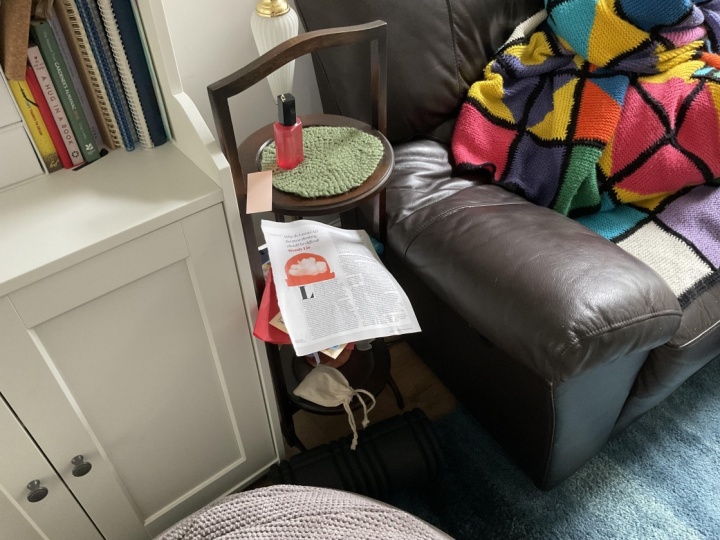
3. Impact of Clutter: Stressed, Late and Comfort Eating: So clutter is really that bad? I know we talk about it and we get stressed out and stuff, but is there any actual science? There is a real data to say the clutter is affecting us? Well, yes, there is. So let me tell you some of the really interesting things that I found about clutter. And I'm doing this so that you can put fuel in the tank so that you can realize that this is something that's affecting you and you're already in a depleted, tired stage. And it is something that is important for you to address. And we'll talk about how in a minute. But right now, it's really important whether you need to use this to convince yourself or to convince a partner, a mom, someone else you'll discover with the clever really is a big deal. Okay, so maybe this is you, surrounded by things. But let's, let's populate this picture. Let's see what happens. Okay, so one of the first things, and this is one of my favorite, fascinating studies around clutter they did a study in 2016 where they had people, they put them either in a kitchen that was tidy or a kitchen that was very messy and cluttered. And they put some cookies out in front of them. And they found that people in the messy kitchen ate almost twice as many cookies. Now these are controlled conditions. Obviously. People have similar appetites and all that kind of stuff is carefully monitored. They eat twice as much junk food, comfort food, because they were in a cluttered space. And I've always found that absolutely amazing. So that's stress, it induces and a kind of surrounded feeling can make you feel like you need to meet a need, you need to comfort eat. So just to consider that. Does it cause stress? Well, they actually looked at different families - These were families in LA. they had a partner at a child. And they found that the people who noticed the clutter, so not everybody notices it, but the people who felt the clutter were coming in on them and they took swabs in their mouths. They measured higher levels of cortisol stress hormone room throughout the day. They physically can see you are more stressed if you feel like you live in a cluttered environment. Fascinating stuff. Now, clutter also gets in the way of life. It, it affects how well you can do stuff and be places. So a survey by Pixie. This is a company where they own these little tiles, things you put on your devices and it can help you find things. So your phone, your wallet, that kinda thing, your keys. And it'll help you navigate and find those things. And they found that 60 percent of people were late for appointments or meetings and for school and work, things like that. And because they couldn't find things. So losing your things because you have so many of them and you can't find them and you're replacing them and they're unorganized. And that's because maybe you don't have the energy to do that. It has a big impact. It's a big deal. So, yeah, fantastically interesting. And another really interesting statistic is that they found that people in the same survey on average in the US and spent 2.5 days searching for things in a year. That's annoying, that's stressful, that's taxing. We don't want to be looking for stuff because we can't find them, because there's so much clutter. Now, it also not only takes up physical space and affects physical things that affects you to fix your head. So there's a great book by Fumio Sasaki called 'Goodbye Things' And he talks about how things talk to you. You know, things speak as you're walking through your house and you see unfinished projects, tasks you should do. And you know, when you have low energy, there's going to be more of them. They might be more extreme. You know, I've had I've had mouldy cups by my by my sink and, you know, it's not great. But they talk to you. They say you haven't done me. You're not a clean person, you're not responsible. People won't want to come to your house, your things start to talk to you and take up space. It's like a mental to-do list. And as you go on and on and see those things repeated or regions as you go through the day and they don't get done. As the weeks go on, that kind of thing. Those voices get louder and a bit meaner I find. So just consider your stuff is not just taking up space in your environment, it's taking up mental space.
4. Impact of Clutter: Foggy, Arguing, Putting off Big Plans: They have done groundbreaking research where they found that when you are trying to use your brain to think about something, to examine a scene. The fact that you are processing things upwards - top down and bottom up, thinking you're trying to do a task, you're trying to do a puzzle, an exam, something like that. They found that when they created a cluttered visual environment where people have to perceive multiple things, so imagine you looking and having to open the cabinet. And there's just a 100 things staring at you. Your brain is trying to work out what those are and what's going on. Because of that, it found that people couldn't focus. They did worse on tasks because their brain had so much it had to do because of the cluttered environment. So, fascinating stuff. Now, because of all this and the amount of stuff - people avoid cleaning. So the National Cleaning Survey done by an international body over in the US, they found that 69 percent had places in their house that they didn't clean, but felt that they should. So when you have more things, there is more dust. There's more to move and manoeuvre and to not knock over. And so a clear surface is an easily cleaned surface, but a messy surface, an untidy one with lots of stuff on it, often just avoided altogether. So just to say that that affects your health. And that's dust, that's mould, all these kinds of things. That's possibly a tripping hazard. It's, it's bad news. You may have found as well that you're having more arguments because a lot of the things you're talking about are, it's just this clutter. There's tasks to be done. There is nagging back and forth is trying to express that you don't have the energy to do that right now, but, you know, I need you to do it, but when and why haven't you done that? Why don't you get rid of that? You know, a mismatch of opinions between how much stuff you should have or had tidy things should be or how clean things should be. And so the things you're saying or negative and it creates a negative discourse, make it a, you know, yuckiness between you. And more arguments. If there wasn't stuff there to talk about, there wasn't a clutter to clean up. As bad - as there's always stuff to clean up, You know, you wouldn't be having those arguments, you'd be having fewer. So just something to think about. And then finally, one of the big, big ones is that we put off our plans. If you have a crazy cluttered room in your house, maybe you don't have overnight guests to stay. Maybe you can't rent that room out Maybe you want to do up the kitchen, but the thought of pulling everything out is just way too much. You'd love to have a playroom for the kids, but you know, there's loads of old papers and office equipment and old furniture in there, but you just can't do that. Or if you want to move house, move abroad, change jobs, work from home. All of these things are affected. But the fact that we have to consider all our stuff and it's, it's a huge undertaking. Just even moving house myself watching friends move country. It's enormous, it's stressful and horrible. And when you have low energy, even, even worse. So the less you have, the less you have to manage, and the more free you are to do really interesting things in your life. So that's one thing I would encourage you to do is think about if you pulled all, if you can follow the train of thought backwards and backwards and backwards, is your stuff stopping you from improving your life and making big changes. So just something to think about. So as we can see, clutter is not great. It is affecting us mentally and physically. It's affecting our homes, it's affecting the people we live with. And it's stopping us from living our best lives at stopping us from recovering. So don't take this as a scary attack. I want you to breathe. "Breathes Out" I just wanted to show you that clutter is important. It's affecting you. And if you need to talk to someone about it and encouraged them to declutter, this is all of your evidence. Here's the science to do it. And I encourage you. So, right lots, lots of crazy stuff. Next, we're going to talk about how do we take this on? How can we break this down into chunks and do it at our own pace?
5. Small Steps: 10 mins or 10 Things: All right, So how to win with small steps, de-cluttering with low-energy. So the first thing I want you to do is to lower the bar and to do things in smaller bits. So this one comes from when I have to do the dishes, when I have to fold laundry, all that kind of stuff. It can be really overwhelming and we put it off. But what if he just said, I'm just going to do 10 things. It's going to do five things. Or I set a timer on my phone and I just do ten minutes. And that could be when you're waiting for your evening class to start on Zoom. You know, it could be something are canceled and I have a few minutes spare or you're waiting for something to cook in the oven. It really, really helps to just do ten minutes. I promise those 10 minutes add up and it matters. So use those pockets of time and just give yourself a number that feels doable to you that feels good. If you end up doing more than that, super, do what you need to do. 10 things is awesome. And don't let anyone tell you that it's not worth it. It really is worth it.
6. Small Steps: Habit Stacking: Habit stacking, now this is fascinating. What this is, is piggybacking on something you are already doing because you might be so tired, so overwhelmed that you don't even know how to start the task - how to initiate it. So what you can do, is you can think about what do you do every single day already That could be things like, I brush my teeth, I have a shower. Think about what do you do? I have my coffee or a TV show I watch that's always on at the same time, before or after the task that you are already doing. Think about doing your 10 minutes. Think about taking one thing out. You're already there. So you're brushing your teeth. Maybe you look in the bathroom cabinet and you go, well, there's one thing there that's expired I've got five different face creams and I only really use one of them. You get rid of one face cream and just make it a habit to do your decluttering as you're going about doing those other things so that you pair decluttering with an existing task Just sneak it into your day. It's pretty cool.
7. Small Steps: Be a Waiter: Now another one that's really great, especially if you are in your house all the time. It's being a waiter. So I don't know about you, but I like to spread out. If I come and sit down somewhere, I have some snacks, have a drink, a hair brush, my phone, my laptop. pens. I just have endless things and that's not even when I'm doing a craft. So if you've a lot of things that around, you, you're going to have to go to the bathroom. You're going to have to go into the kitchen to get a drink of water or run upstairs to get something. So every time you get up from your seat, I want you to look around and go. What can I take with me? Right, I'll bringing that cereal bowl when I'm going to fill up my water. Oh, I need to go to the bathroom. I'm going to bring my tissue into put into the bin, or whatever it is that is a suitable to go back to where you're going and just always be carrying something. It doesn't have to be an extra task. You were already running upstairs to grab some extra socks because your feet are cold. So you're going to bring that book up and put it back on the shelf in your room. You know, be a waiter, always be carrying something and use those trips effectively. And obviously don't overload yourself with stuff as you do that just a few things at a time and then you'll find at the end of the day, you don't have that much to clean up, but it's pretty epic.
8. Small Steps: Track your Progress: Now the other thing is track your progress. When we do things in small chunks, it's easy to think. This isn't really going to make a difference. Why bother? Because we kind of forget how well we're doing. So what I would say is get a calendar, print out a piece of paper, draw a lovely charged whatever makes sense to you, and take it off every time you do it, or log how much time or how many bags or whatever you want to count on that chart. Put it on your fridge, put it in your bathroom, or on your vanity wherever you are all the time and just show yourself how far you've come. And so while every day it's just a little trickle and it doesn't feel like a big deal. Just embrace the power of tracking your progress and show yourself You're doing a great job. If that's stickers, I love a gold star. Oh my goodness. Give yourself stickers. Celebrate yourself, and show yourself that those small actions are adding up.
9. Don't Think it's Not Enough!: Now a trap we can fall into. As I said, is thinking 'this isn't enough, is it?' You know, it's it's easy to kind of go like 'unless I do a huge Marie Kondo, whole house decluttering festival, what's the point? Like, I can't do this.' But let me just show you if you did one thing per day for a month and that's removing it from a space may be decluttering it, disposing of it, all that kind of stuff. You know, by the end of the month. That is one cupboard. Particularly if it is a cupboard you use all the time. It's one cupboard. That, things are not going to fall out of. Things are organized the way you want to. They're not crammed in. You know, things are at arm's length. They're not on top of the cabinet where you can't reach them. And that matters. Nobody can take that cabinet from you. And if you go long-term, it's a bit like losing weight, like it's really hard. It takes a long time. If you keep chipping away, it all starts to add up and you start to see spaces open up and chaining is that little bit easier, just takes less time and you start to feel more motivated. And this is a snowball effect that happens. So don't be thinking it isn't enough. You can do this. And it matters. Those little steps matter and those cabinets matter, and that that drawer matters. And you just need to keep doing it a little at a time and restaurant you need to and I promise you it will get done.
10. Be Gentle: Start Easy: So how did you de-clutter when you love your stuff? When you spend a lot of time at home because you're tired and burned out and low-energy and have health issues and your stuff, you know, is your support. Not all of it could always be some of it is clutter. But how do we do that? Well, we've just gotta be gentle with ourselves and we have to let go because it's your space or the stuff. It's your headspace, It's your stress levels. It's your ease of cleaning or it's having that stuff. Let's talk about ways we can think differently about de-cluttering and be kind to ourselves in the process. The first thing is ICA start with a good project. Like anything else, decluttering as a skill, making decisions about your space and deciding to live in a different way is big. It's a skill. So we're going to start with an easy project. And the way I usually categorize these is don't start with something that is not in your every day and that's emotionally taxing. So that's the photo album here. These photo albums are boxes of photos are up in the Ashoka. We're not seeing them every day. And going through them brings up a lot of memories and stress. And it's a weighty decision. However, if you were to declutter your fridge, that's somewhere, you spend every day. You open the fridge and its food. It's fine. If it's expired, it can go or whatever. It's a lot less emotionally taxing the stuff in the phrases replaceable. Then the photos. So start with an easy project, whether that's a fridge, a drawer, and often find pantries really good as a starting point. But don't start with your papers with a crazy clauses of clothes that, that makes you feel overwhelmed. And this is a very personal thing, but start with what sounds easy to you. And you'll notice that your skills get better. You get better decluttering and deciding get more confident. And you start to really love what you see because it's in your choosing projects in your everyday life. See you seeing the difference. So pick an easy project to start with.
11. Be Gentle: Pick the Best: Now this tip is a little different than some of the stuff that might already be out there as decluttering advice where you hold one object at a time and you go, 'Does it spark joy?' 'Do I want this?' All that kinda stuff Sometimes looking at objects in isolation. It can be, yeah, 'I want this book and I want this book, and I loved this book and I love this book' And it just is hard to figure out, well, what do I keep and which why not keep? But sometimes what you need to do is gather all the things together, put them in front of you, and decide to pick the best ones. And sometimes that involves finding a magic number. For us, we have two spatulas and to serving spins because sometimes one of them Is being washed and then serving you've got your starch and then your, your curry or your main sauce. And you find that magic number and then just pick the best of the bunch. Because we want to be able to shut drawers. We want to be able to find things and put all of the essential tools by the stove. Maybe you don't need 50 tank tops. Maybe 10 is just fine. But you won't know which ones until you first take stock of what you have and then pick the best ones. So it might be that you like the height of it, the size of it, that it has a hole that you can hang it up, all those things and just pick the best. So use comparison to help you.
12. Be Gentle: Choose 'Friends': The other thing is, if you have a very strong attachment to your things, sometimes just going yeah, toss that. Yeah, keep that, that's handy, that's functional. It's very like a utilitarian way to think about your stuff. But if you're very invested, sometimes you really do feel like your friends, like your buddies. You know, whether that's childhood toys, but let's books, your clothes, you know, they almost have a personality to you. And it's hard to say goodbye to them or it's hard to feel like it almost hurt their feelings by getting rid of them. So what I encourage you to do is to give them that extra level of specialness to personify them and to go. Which of these objects, these teddies, these books feel like best friends. Which ones feel like acquaintances and which ones feel like strangers. And in that way, it might just become more of a gut reaction where it through that makes sense to you or one of my clients said that's really, really helped her and she was keeping a box of her best friends. I was like That's so lovely because then you can really celebrate your things as well. So don't feel like just because you don't have a very like cut and dry like don't need that, don't whatever. That, that's the only way to view your things. Give them their special place, but give them a ranking. And you'll, you'll certainly find, okay, I know what I want to keep.
13. Be Gentle: Set Visual Limits: Another thing that's really helpful is to think about giving yourself visual limits. So as we talked about seeing a lot of stuff in your space can be very overwhelming and it can affect, you know, how much brainpower you have to use another tasks. So rather than saying, Oh, I have to only own a certain number of things, just say when I reach a certain limit, at that point I have two options. So that could be saying, I'm only gonna keep enough books that can fit on this bookshelf or a series of bookshelves, but not any on the floor, on top, in other places, under the bed, that kinda thing. And give yourself that that cutoff point. And other could be, I'm only going to own enough tools that fit in the toolbox. Obviously, if you're really into your tools and you have a whole shed, fair enough, make space for what you love. But if you've got tools and you've got like a screwdriver over here and you've got something over here and something over here, give yourself, okay, this is the toolbox and if it doesn't fit, I have to pick. I have to go back to picking the best, pick the best screwdriver and the best nails or whatever it is, but give yourself a physical visual limit. Then also think about how many sets of sheets and towels and things can actually fit in your storage spaces. But how many are optimal? And this can be something that becomes very visual. So whether you go, Okay, I'm only going to pick things that match in one colour or a colour scheme or saying, you know, how many sets of towels do we actually need. So in our house we have two sets of towels, for each person. So we swapped them out. We have two sets of bed sheets for each bed. And then we've got a few messy towels and we've got a few under sheets just in case. But think about setting those visual limits, going how much can fit in this storage space and how many do we actually need for the number of people living here and the situations I have. Obviously, if you're in a hotel and there is a high turnover, you're going to need lots of sheets. But perhaps you don't, you need to think about I'm only going to keep the ones that match the decor in the rooms rather than the last 20 years of different mismatched rooms that these have come from. So one example from my life is, here is my memory box. This is my keepsake box. You'd have got childhood toys in there, a little picture of me age three, he wasn't I cute? But what I've said to myself is after I used to have lots and lots of stuff and that's a whole other conversation, but I realised I was keeping a lot of things I thought I should keep rather than things that when I opened it up, made me feel happy. So I decided I'm going to limit my keepsakes to this shoebox. And so far that's working really well for me. Anything else, I scan things, have a lot of digital photographs and things, but these are the physical objects. And I decided I wasn't going to keep anything from old boyfriends or from at times in my life that were not happy. So just think about what works for you. If you give yourself a limit, I could have five shoe boxes of stuff, but actually, because I just have one, I can sit down and go through that box and really enjoy everything because this is the best of the best. These are the things that make me really happy, rather than things I thought I should keep that someday someone would want to see about my life. Food for thought.
14. Bad Days: Remember Why: So now we're going to talk about having motivation for bad days. How do we conjure this head? We make things come to life and make us actually wants to de-clutter because I really don't advocate for people forcing themselves to do stuff. Sometimes you might need a little nudge or a push. But we want you to enjoy this. We want you to feel accomplished and skill and that you are enjoying your space. And so here is some fuel for the tank to help you drum up the will to do the de-cluttering because I know it can be really hard. So the first thing is you need to remember why, why are you de-cluttering? And that can be written on a little piece of paper. All the people you're going to help, and all of the stuff you'll be able to do. So a few examples here is Eddie, you know, you might want to be able to clean better. So something I do not like doing a lot of cleaning. I don't like going under my bed and getting all the dust. I find it really unpleasant, makes me sneeze. But if I have less stuff under there, that job, because so much quicker and easier. So for me I really don't want to be cleaning. So I would rather have less time cleaning and more fun rather than more stuff. Because, you know, I I've just realized that I haven't regretted the things I've gotten rid of. I've just enjoyed my space so much more. And the, another thing there's, why is their cash? Well, who lives are going to be improved by decluttering? So think about, okay, your life will get better, but also maybe your children, your partner, and the people who come and spend time with you. You can look after them there. Or maybe you just want to make your house really amazing for your pet, for your kitty cat. For me. I used to have pet rats. I know they were gorgeous, my little girls and I missed them very much. But like I wanted to give them the best life ever. I wanted to have a tidy, lovely couch where they can come and snuggle up with me and we could have watch TV together. So if you need to do it to give your dog the best life, use that as motivation. And I also have the book, Good-Bye things that I mentioned it already. A great way to remind yourself of the values of y de-cluttering is so important is to keep around things you can dip into. So I, I love this book and I have a number of different books that really fill me up, as well as YouTube channels, blogs, giving myself a playlist of things I can watch. And for example, there is a great woman called minimum. And she lives in New Zealand. And she had a wonderful video where she had so little stuff in her living room that she was able to deep steam clean her floors, move the couch in about 10 minutes because it was just so easy and that I just get so much dopamine and comfort from that video going. It's worth it. This is what life could look like. So do remember why maybe write it on a post-it or keep it on your phone background can be really helpful to remind you why.
15. Bad Days: Imagine it Done: Now, as I said, What's your dream life look like hanging out with your fur baby Imagine what life would be like when it's done. Oh my. Saturday mornings, you might not dread getting up out of bed because you don't have so many dishes to do. Your food will be organised and beautiful. Your couch won't have laundry and loads of magazines on it. You can just sit there and hang out with your buddy and have a lovely cup of coffee. And that could be your life instead of cleaning and chaos. You know, think about what. Imagine in your head, create a mood board, create a Pinterest board of houses that make you feel happy and relaxed. And that's what you're going to get when you're done.
16. Bad Days: Your One Sentence Phrase: And the way that you can make this happen for yourself is thinking about turning it into a phrase. So I want to cozy hideaway for me and Dennis. And I say Dennis because there's a cap that lives near me, a lovely ginger cat who had a name tag pulled Dennis. So I think about him often. But think about what it is. I'm going to sit down at Christmas with a glass of wine in my hand and buoyed by the fire. And I can read a book because you will have D cluttered by Christmas. When the baby gets here. You know, the bedroom is going to be so beautiful. And I'll be able to sit a nurse in quiet and how changing station and everything and feel in control of my space. Now, shorter sentences than that. But give yourself a phrase. You know, you're the lady of the house, like my house is for me and I am the lady of the house. You know, if there's a guiding phrase that makes you yet, I'm gonna get rid of this thing. Because when I'm done, I'm going to be the lady of the house and I'm going to have leisure early mornings and my robe with a coffee. Okay, So imagine it.
17. Bad Days: Take Photos: The other thing is, you have to realize, as we said with tracking things, you have to realize how far you've come. Photograph your progress, take before pictures. Sometimes I'm amazed at what we have done in a session and I look back on before pick and we go, Why such a transformation, whether that's just with a phone, with a camera, whatever you've got on hand. And just give yourself that beautiful representation, maybe share it in a WhatsApp group with your family and friends or on social media and show yourself that it's worth it. It used to look crazier. You know, here's an example. And as you can see, she had lots of supplements and different things because she's trying to sleep well, she's trying to take care of her health. We got rid of the glasses, we got rid of loads of different things and we put it in its place and got rid of expired things and all that. And we just kept the essentials and look how calm angers spaces. But I was so surprised when we look back at the picture because we didn't realize actually quite how much we had gotten rid of and how amazing it was an even just to dose those surfaces. So give yourself that before and after juicy proof. Similarly, this was her shelf. These are all the books she was hoping to read. We went through them and then we decided that these were the actual cream of the crop. These were the best ones. And then she could actually see out the window. She could clean that window and we put things in other places as well. So you'd be amazed by how much you have achieved and you don't even realize it. So take before and after pictures.
18. Bad Days: Be Silly!: And then lastly, my, one of my favorite, favorite tips, and this is the one that gets me through many days is be silly. I've done things where I have m done de-cluttering bingo. So go on Instagram and see all of that. Where I made a Bingo machine and we got a ball and went right. Today. We're getting rid of a gift. We never used. You know, I made it into a game. And on one particularly bad day, I created a Snakes and Ladders board. And I wrote a list of tiny tasks that I have to do. And as I went through, I actually put stickers on the board and I worked my way up the top and I gave myself a reward at the end. So be silly. Have a race with your kids. You know, college is silly, silly word. Call it the treasure homes to go find the treasure. And amongst all of the male that's come in. So be silly. Make light of the situation, have fun. And you'll be amazed how much better it feels when you add some music, you put a funny spin on it, make it a game, and see what happens the other end when you have such a beautiful space and you can recover. And you can enjoy your space with the energy that you have left.
19. Class Project: Declutter Your Bedside Table in 10 mIns: Hello there! I just want to tell you what your assignment is for this class. So we talk in the class about how you should try and just do 10 things, Just do 10 minutes. So your challenge is to put 10 minutes on a timer, whether that's an egg timer, whether that's your phone. I want you to declutter your bedside table. So this one's looking pretty good. Maybe just limit yourself to one book, glass of water. And then some of your toiletries and things down here, get rid of anything that's expired. The don't use anymore, broken headphones, that kind of stuff. But just see what you can do in 10 minutes. And I promise you, the first and last thing you do every day is its wake up, go to sleep right here. Let's start our decluttering dirty here and just do those 10 minutes. Just do a small amount. And I think you'll be amazed by how much better you feel and that will start you on your journey. So best of luck, I would love to see your 'before' and 'after' pictures over in the class comments. And I'm sending you love all the way here from Dublin. And I think you're gonna do great. So if you go and declutter!
 Suzy Kell, Professional Decluttering Coach