Transcripts
1. Introduction: Hi everyone. I am Chapman. Ima makes me artist and a creative wellness consultant. As a creative, I needed discipline, devotion, and motivation to show up for my creative process through the thick and thin, the inspiration and the stuckness in this class, learn about the psychology of motivation as it relates to the creative process. And create an interactive and visually simulating tool to reflect back your goals, your progress, and your devotion through a devoted practice to my creativity using a tool like this, which you will be invited to create in this class. I've built an entire creative wellness consultation business. I've published a coloring book recently and I've kept my flow of creativity replenished and ever going as I share my art and create art for myself. This class is about the mental and emotional process associated with creativity and keeping our motivation, even when we don't feel like we are producing or creating in the scale. In this class can be leveraged absolutely for your creative process, but also in other arenas of your life, like self-care and community engagement, students will simply need a printer or a journal and a ruler, as well as an assortment of colors that bring you joy. I hope to see you and I hope to engage with you more. Onward.
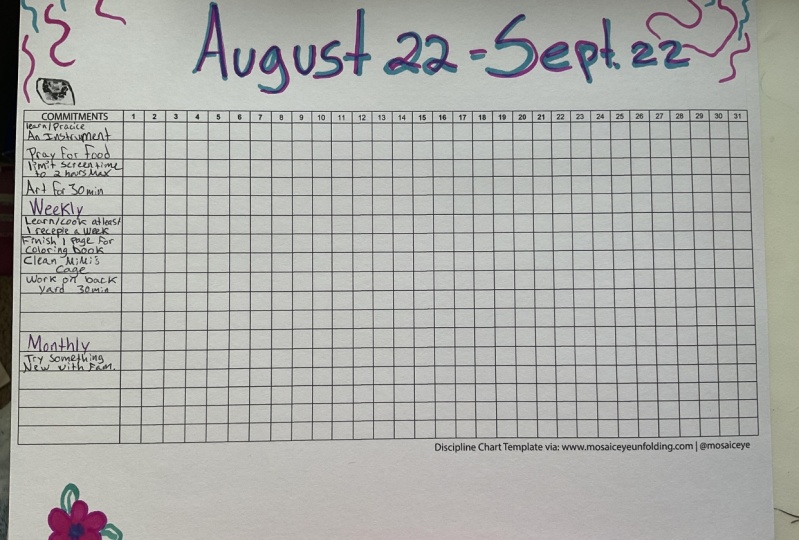
2. The Class Project: The project associated with this class is to make a discipline or devotion chart. This is the tool that you will reference to commit, to track, and to measure your progress in relation to specific and thoughtful and intentional creative goals. This will be an engaging project from start to finish. In choosing your commitments to include on your discipline or devotion chart. To crafting your chart in a way that feels joyful and inviting and inspiring. And throughout the month or the cycle that you choose to track your disciplines in which you will be inboxes, noticing what you are committed to, noticing where there could be some more attention given or some flexibility given to your commitments. Folks, including myself, have used this tool at different points in my life. If I am wanting to work toward a creative project that will require a lot of diligence, devotion, and motivation. I will bring in my chart so as to assist me in my consistency. Then there are months where people don't necessarily want to give attention to a devotion chart and they let it go until it comes back again when they're wanting to practice more routine, diligence, certain commitments.
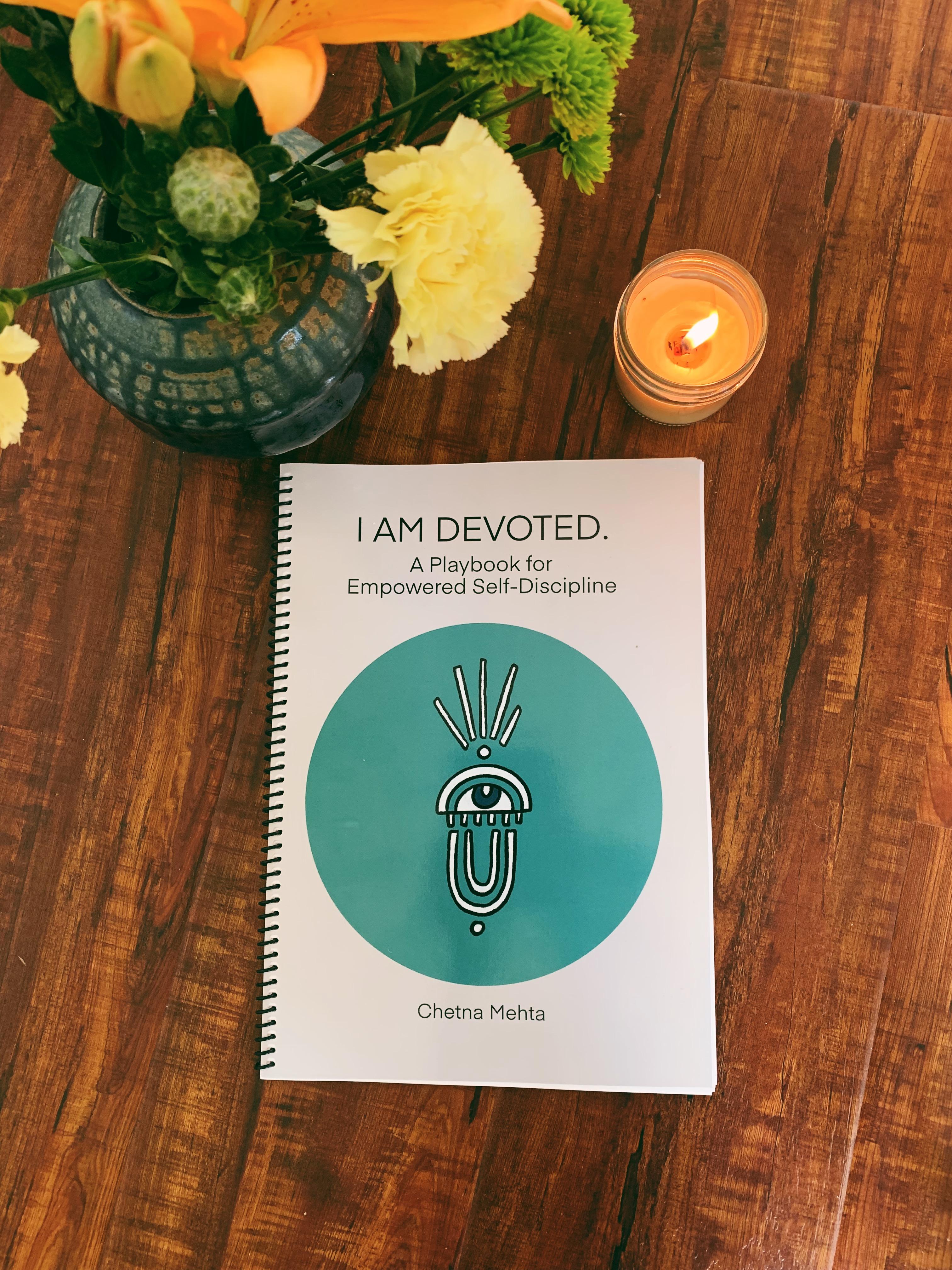
3. An update! A book to record your Disciplines!: And it took my printer
breaking down, disabling me from printing out disciplined chart templates
to finally create this. I am devoted playbook, including 12 devotion charts, space to reflect on
the y and fears of your chosen commitments and to reinforce the beliefs
you want to choose, rooted in your
values and purpose. This playbook makes devotion and self-discipline, fun,
and celebratory, bringing color and celebration
and acknowledgment and contemplation with
coloring pages to reinforce your
chosen beliefs. And review pages. Take knowledge your successes, challenges, and adaptations. Month after month,
cycle after cycle. If you love checking things
off your list and tracking your behaviors and actions
and coloring life me. This book was made for you. Serve your devotional
practices and reinforce the power in
your self-discipline.
4. The Benefits: There are loads of benefits associated with the discipline devotion chart. I've been practicing with this tool for the last two years. And I have cultivated a sense of discipline with myself that I never thought was possible. I never considered myself a disciplined person. I always felt that I was more go with the flow, see what comes, honor, inspiration when it hits me. However, this tool has helped me cultivate space with devotion to listening to the inspiration around me, to showing up and putting on paper. When I need to put on paper in order to develop something, in order to master a skill and in order to show up for the creative process, that doesn't always feel within my control. The beautiful thing about this tool is that while we can center it on creativity and on creative practices, this tool is also widely used with our self care practices, with our community care and service practices. And they can all be interwoven into the chart if you chose to do it that way.
5. The Need: Why do we as creatives, need discipline when creativity is such a flowy and mystical process, why is centering in some kind of routine or discipline practice important? If you are an artist, which I imagine you are in some capacity, you know that the creative process is not always feel like an abundantly flowing river. We can take it within our own agency to make the space to carve that river bed so that flow of a river, that is creativity may have its course. There is a necessity. Sticking with creative endeavors, even when it doesn't feel easy or fluid. Julia Cameron, the author of The Artist's Way, said, art is not about thinking something up. It is about the opposite, getting something down. So while we have a million ideas at times, the discipline is actually grabbing a piece of paper or taking notes in our phone as to what that idea is to further develop it, to materialize it, or tangible eyes it. And that does take a sense of discipline. The creative process can be a roller coaster ride from feeling incredibly inspired and brilliance to feeling completely imbued with the inner critic. Absolutely feel useless and helpless and stuck. And that's the part of the creative process when we need discipline and devotion the most, so that we may continue to show up and measure our success, not by what we produce, but by the act of showing up for a creative process and being open to listening to what the process has to tell us.
6. Beginning Reflection: Let's start with our beginning reflections, where all disciplined in various ways, we may just not be disciplined to what we want to be disciplined toward. For example, I'm very disciplined when things are feeling easy and flowy and I can jump right into that state of creation without sitting in silence or in stillness. Listen to what needs to be manifested when it gets hard, when it gets challenging, what I do have to sit or give it space or be patient with the process, I lose my discipline. Another thing, for example, that I'm disciplined toward is the quickness of creating something in this day and age with social media, with our attention spans, especially as millennials, elder millennials, I tend to enjoy when I could whip something up really quickly and share it to get immediate validation, for example. So I'm very disciplined to creating small drawing, simple drawings to share when it comes to developing a book or developing a long-term project, something that requires more hours without that immediate reward, discipline is more compromise, and that's when it's going to take more intentionality for me to master something or to create a long-term project where the reward will come later. So with that being said, keep a few moments to reflect and to write in your journal a bullet-pointed list of things that you are disciplined toward.
7. You Are Disciplined: Once you've written a list, perhaps some bulleted points and things that you are disciplined toward. Please add that in the discussion. The purpose here is to acknowledge that you are disciplined. We are all disciplined. It's part of being human. The thing to know is, what are we disciplined toward and what do we want to intentionally be disciplined toward? So share it in the discussion, read some others that might be there and recognize that home. Yeah. I might be disciplined toward that. Do I want to be disciplined toward that? Yes, no, maybe cell. And from there we bring more intentionality of consciousness to our disciplines.
8. Choosing Commitments: Now we're going to begin to develop our discipline chart. Before we actually go to the chart itself, we are going to reflect on the commitments we are choosing. Y, we're choosing them. What fears we might have that come up in regards to those specific disciplines and committing to those disciplines as well as what we choose to believe. This is a way to set ourselves up for long-term success when it comes to choosing our commitments. Sometimes we choose our commitments because we feel like we should, or that's what other people are doing. Or it seems like that could work, which is good experimentation is important. But if we don't know why we're doing what we're doing, we're not going to stay motivated or access the source of our motivation when we need it most. Find this template at mosaic I unfolded.com under free art, or you can download it directly here below. You can also simply write this in your journal is for columns, and we'll go through each column separately so as to put some thoughts and intentionality into each. In the first column, we will write commitments. What do you want to commit to? Now here I suggest prioritizing your commitments according to daily commitments, weekly commitments and monthly commitments. This will allow you to prioritize your time and frequency when you're thinking about what you want to commit to. Not everything will be something you wanna do on a daily basis. The second thing to really keep in mind here is to make these commitments small and specific. To make them small means to have them be byte size when we're talking about long-term devotion and discipline. Doing byte size and tracking our bite-size accomplishments is what matters and what snowballs into something big, like a book or a movie or a play, et cetera. And to make them specific will help you be successful with it. As opposed to it being abstract. For example, like right period on a daily basis. Making it specific, we'll help you track your progress and hit the mark. So making it specific would look like, right for 15 minutes daily. Or if it works better for you, write 1000 words daily, For example, in whatever way you want to measure your success. And this is all an experiment, all meant to be flexible month after month. Here are a few examples of some small and specific commitments in relation to creative practice to offer you some inspiration. Now it's up to you to take some time within this column of the chart to choose your commitments that are small and specific, perhaps according to daily, weekly, and monthly high frequencies.
9. Centering "Why?": The second column is for you to write down why you want to commit to each of these. And this is a space to distinguish whether you're choosing this commitments because again, you should or you've seen other people do it successfully and you think it might work for you, or because you know what it's like to live up to these commitments. You know what it's like from a felt sense in your body to show up to this commitment on a regular basis, based on what you've done in the past. And you can draw from not positive and embodied memory around why this commitment matters to you. What we're talking about, the psychology of motivation. I'd love to bring in here the Golden Circle by Simon Sinek. He talks a lot about this model in relation to corporate leadership and corporate missions. But this also applies really beautifully to the creative process when we're talking about what we want to do or how we want to do it. These are really the commitments that we're choosing. For example, I want to draw daily for ten minutes. That is what we wanna do. How we want to do it. Maybe for ten minutes each morning on my sketchpad at my work desk. And I want to schedule it on my calendar and make sure nothing else is conflicting with that time. For example, the how in which we will do it. Or we're talking about why this goes deeper into our motivation system when we're talking about why this engages our limbic brain, which is an older part of our brains and its associated more with our feelings, our beliefs, and ultimately our decision-making behavior. What we're talking about, how and what we're engaging the neocortex Brain, which is a newer part of our brains, associated with important things like planning and functioning and executive aspects of our behavior, like rational, analytical, and language-based behaviour and thinking. This is great in order to specify things and choose our commitments. But when it comes ultimately to the motivation, when we're feeling most stuck or feeling most unmotivated. We're going to want to turn to why we're doing what we're doing. So, for example, for me at drawing daily helps me process my feelings. I often feel more grounded after it's almost like I'm taking a few deep breaths or outputting some of my feelings on paper so as to create more space within myself, which thereby enables me to show up for what's next with a little bit more presence and attention. And I know this is my body, I know how it feels and it feels really good. And that's the place that I want to be living my life from. And drawing daily helps me do that. Mostly, especially when my inner critic is not hyper loud in my head. So as you go through this, think about what feelings you've gotten from committing to these in the past or what your experience has been in the past of these commitments. If you don't have a whole lot of experience and you're trying something completely new. Think about why you want to do this. What do you want to grow toward? Why this feels important to give your time to on a daily, weekly, or monthly basis. Here are a few examples of some reasons why folks I've worked with have chosen their commitments, what they know to be true and what they want you to remember when they're feeling least motivated or inspired to commit to their fitness.
10. Acknowledging the Fears: The third column allows us space to express our fears, however, irrational, however silly, however, seemingly true. This is a space for us to acknowledge some of the barriers emotionally that keep us from honoring our commitments and showing up to them. This is often the voice of the inner critic, voice that comes in to deter us, to demotivate us and to make us feel like we might not deserve what fruits staying committed to our commitments may grow or made manifest. So this is the space to acknowledge those fears. While we acknowledge them, when we name the fears, we tame the fears, and we don't automatically believe them when they come up. This will help us recognize them as they do so that we are in a space of awareness and insight. For example, when I was working on a coloring book that I published recently, a long-term project that I didn't get immediate validation for. One of the fears was that this is a waste of time at no one's going to buy the book. Don't have the appropriate tools to make this process fluid. That I just don't know how a lot of these are fears that i can tend to, but if I'm not aware when they come up, I can easily believe them and then move on to something else that's not honoring this inspiration, desire to manifest a coloring book, for example. So for you, write down all the figures that come up in relation to specific commitments that you've made or that come up when you imagine staying committed to something, not having enough time, falling off the bandwagon is a very common thing. We often fear something before we even give us some time to try it. These are all OK and normal and very, very common. So something I will say with these fears is that you're likely not the only one who's had the fears that you will be right down. That often as I've worked with folks with this tool, the fears are so similar and very, very universal. So take some time to write doubtless fears in relationship to the commitments that you're choosing for yourself, so that he can acknowledge them, name them, and perhaps even tame them.
11. Chosen Beliefs: After you've made some space for your fears, let's circle back to why you want to commit to these commitments. In the fourth and final column, we're going to write down what you want to believe in the face of these spheres in general, what is it that you want to consistently remind yourself as you are showing up to these commitments on a daily, weekly, and monthly basis. These can be simple, simple reminders to you to give to yourself intentionally, especially when those fear voices come up. Examples here could be, I'll take it one day at a time. I'm doing this day by day. Or as long as I show up to the process I'm succeeding, I'll move at my own pace. You can even be IM devoted to my creative process or my creativity is healing. My creativity gives me joy. These are all simple but really important reminders to give to ourselves from a place of affirmation and from a place of redefining what success is to us. Sometimes we feel like success is measuring up to all the people we see outside of us and comparing ourselves. Sometimes we see success as that end goal of producing that book or that album, or that play, or that choreographed dance. But there's so many little steps that are necessary before we get there. And all of those little steps are what defines our success in the moment. So here's where we can choose what we want to remind ourselves on all the little steps as we culminate to something larger. That larger thing is made up of all these small little steps that we show up for in discipline and devotion and commitment. And that's where we can actually celebrate. We can celebrate throughout the process, not just when we had this big thing that we're trying to manifest. So take some time to write down a few things that you want to remember. It could be in response to why you're choosing, what you're choosing to commit to. It could be a kind of response to the fears.
12. Charting Commitments: Now's the time to come to the actual discipline chart. Feel free to find a template at mosaic unfolding.com under free art, or you can download it below. You can also feel free to create this in your journal or to create the lines yourself. Some folks like to do that as it is a process. Sometimes having a template makes it easier so that you can go right to your commitments, especially if you do this month after month. Now that you have this chart, what your commitments are, the frequency, why you're choosing these commitments? What are some fears that come up and also what you choose to believe. Now you can include your commitments on your discipline chart. What I normally do is I will paste this reflection. If it's not in my journal on the back of my discipline chart, I do this reflection of my commitments, my y's, my fears and my chosen beliefs on a quarterly basis so that I may state conscious and intentional with the commitments that I choose and change and adjust, et cetera, throughout the months. So I have it there to easily reference when are running feeling like I'm falling off commitments. So take your time to write your commitments on the left column, distinguishing daily, weekly and monthly, convincing you have the organized in that way. And then we'll move forward.
13. Positive Reinforcement: Wherever you are in the month, you can start today. Some folks do this at the start of the month. Some folks do this at the start of a new moon or full moon. It just depends on what you prefer. Some people just pick up exactly where they are on this day and do it for the remainder of the month or the cycle that they want to be in alignment with. And then pick up again at the beginning of a new cycle as you progress through the month, fill in your commitments. Color in the boxes. Some folks do little dots, some folks do line, some folks colored in, choose colors that bring you joy, that make you excited to see. I'll be experiencing dopamine as I'm coloring in these boxes with the colors. Give me joy acknowledging that. Yes, I did this today. Yes, it wasn't easy, but I showed up for it anyway. This is a means of positive reinforcement when we are acknowledging the small ways in which we are showing up to work commitments, we tend to feel more motivated to do so. Negativity bias in our heads wants to focus on what we didn't do, what is missing, what is lacking, especially in comparison to others. This is pervasive in the creative process because creativity is sometimes so abstract, especially in the process before we can do the lie something and have something to share with the world. It can be written with negativity bias with the inner critic. This visually shows us on the piece of paper that I showed up to my writing process five days in the week. That is pretty damn good. I'm proud of myself. Let's see how I can do next week. Let me try to shoot for at least five, maybe even seven. It also gives us a visual representation of what our commitments are, keeping them at the forefront of our minds because they're small and specific, they're also likely to be easily forgotten. And this is where having that, they're having our progress tracked through colorful boxes and symbols can help us be aware of what we're working towards and see our progress across feats.
14. Staying Flexible: Leveraging this chart can be beneficial for one cycle or month or across months on end. I've been using this chart every month for the last two years, and I've noticed that my commitments change over time. Sometimes I am choosing to write for 15 minutes daily. Sometimes I'll be approaching a month or a cycle where I know I'm going to be extra busy with other meetings, with other things and I need to readjust that. And if I can commit to maybe ten minutes of writing daily or at least an hour of writing a week. That is a successful readjustment that I am going to be flexible with and that's what I recommend. While this tool can trigger our inner critics in that we might hyper focus on the things that we're not doing. Really. It's inviting us to celebrate the things that we are doing as we visually see it on our charts. And to be flexible and reassessing of the things that we're not showing up to, there's a reason why we're not showing up to it. And if we need to readjust its specificity or its frequency, we have to do that so that we can allow this tool to help us be successful. So being flexible month after month, It's really important. Sometimes the first discipline or devotion chart that you make is really just showing you what you are diligent with. Sometimes that's just ground level feedback, then you can build upon it and say, okay, it looks like dancing every day for 30 minutes is not actually what my body wants to do and not what I'm doing. How about for an hour a week or for ten minutes a day, et cetera. Being flexible with this is really important so as to keep us motivated and to keep us engaged and to meet ourselves where we are and build from there. Starting small is really important. For example, starting with cooking one meal at home a week is a good way to start if that's where it feels inviting and inspiring. And if you enjoy that, you collect more experiences in your body, in your memory, to know that this really, really feels good. It strengthens your why. And maybe a month after, two months after, etc. in the future, you realize, no, I want to prioritize once more. I went up this 23 meals cooked at home a week, really at the end of a cycle, we're going to be reflecting on what did I show up or when can I celebrate? Yea Fn what worked and what didn't work with things that didn't work. We need to readjust. Is this commitment really important to me? Do I want to stay with it? Why do I want to stay with it? And doing that reflection again every few months with our wives and our fear is, and what we choose to believe is a way to save very intentional unconscious with our creative discipline, holding a growth mindset here is incredibly important with the boxes that we're coloring in, knowing that it's not a linear process. And that sometimes we move forward and back pedal to readjust and we'll keep going. And sometimes our back pedal could help us propel us into more action in the future, extinct in a growth mindset, knowing that this tool gives us feedback to help us see motivated to notice what we're doing well and what, where, what needs more attention or readjustment can help us progress long-term.
15. Discipline in Community: Of course, we are social creatures and social accountability is incredibly important when it comes to our devotions and commitments, no matter how strong our reason for committing to those things are. So with this, I really encourage you to bring in a friend with your discipline chart practice, create charts together with somebody and keep in touch with them to see how their charts are going. It share it on social media. I really loved the tag, my discipline chart as a way for folks to share their work, their progress every month. I love seeing when folks create their own and the processes in which they take on whether it be a crafter noon with the friend or his birth, discipline chart, step with magnets on the refrigerator so as to keep what another motivated and accountable. Let's do this socially and let's lose together. Because that's when we are most disciplined, when we are accountable not only to ourselves absolutely, but also to one another.
16. Key Take-Aways: So some key points that I just want to review before we close, it's so important to be intentional with our commitments for our long-term success. Knowing our y helps us tap into a deeper part of our brains that's associated with our feelings and our motivation and our ultimate decision-making behaviors. Being kind with our fears and affirming our beliefs that we want to choose is important. Making room for our fears allows us to tame them and not be completely overtaken by them. Choosing colors of joy or our charts, It's a wonderful way to visually stimulate us and increase that dopamine hit when we color in the boxes. Visiting our chart regularly is important. Of course, you don't need to color in the boxes on a daily basis unless you want to. I come to my discipline chart sometimes every few days and I sometimes have to remember, OK, what did I do? What didn't I do? I try to come to it on a regular basis so that I can keep it up-to-date and keeping the chart in a place where you can see it, whether it be in your journal that you write and regularly, whether it be on your desk so that you could see it on your refrigerator, by your bedside, whatever it is, you have that visual stimulation celebrating what's working is incredibly important. That's what this is for, that positive reinforcement to see what is working, even if it's one commitment that we've stayed diligent with throughout the month. Amazing. Keep that on there. And how can we readjust and reset these other commitments to start even smaller or sometimes more specific so as to enable us to show up to that inhabit feel inviting, sharing our trends and community is incredibly important. It's motivating, it's inspiring. That's how I've invited folks in on this practice through me just sharing my excitement for my chart. So please share it. My discipline chart is a beautiful hashtag to use, sharing it on social media, sharing it here, please do that and get feedback from others. And seeing other charts as well.
17. Thank You!: Thank you so much for joining this class. I really appreciate you, I hope see and touch to see what you've crafted and created from this, as well as what you've been able to show up more in master and cultivate through a devoted practice. I wish you so much peace and power and creativity. Even when it doesn't feel easy. Especially when it doesn't feel easy.
 Mosaiceye, For Creative Realization + Community