Transcripts
1. Introduction and Supplies You Will Need: Hi, friends. How are you? I hope you're having
a great day today. I'm excited about sharing
this project with you. This is a drawing and
watercolor painting project that I designed,
especially for kids. Students do not need to have any drawing or
painting experience at all to be successful
with this project. I will guide students step by step through all the steps
that they need to take. Today we are going to be
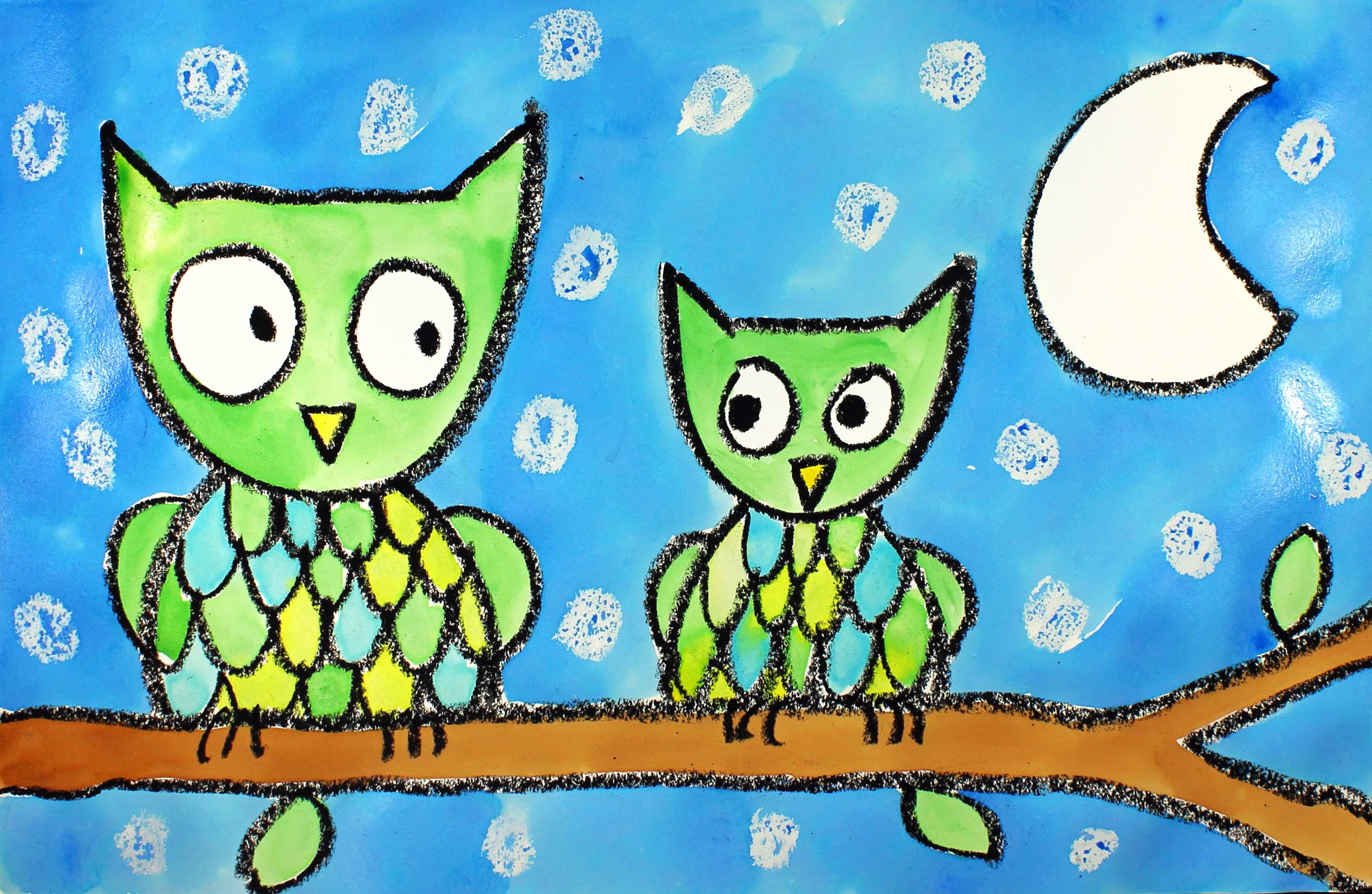
creating two owls sitting on a branch enjoying
the moonlit sky. Okay. Et's talk about the supplies and the materials that you will need
for this project. The first thing
that you'll need is a sheet of watercolor paper. You will need a set
of watercolor paints. You will need a paintbrush. I like to use this
size paintbrush, but just use what you
have available to you. You will need a cup or a
bowl with clean water. You will need a black oil
pastel or a black crayon and a white oil pastel or a white crayon
and a paper towel. So go ahead and gather all of those supplies and materials, and I'll see you back
here in the next video.
2. Step 1: Draw an Owl Design: In this step, we are
going to draw our design. So let's get started. We're going to create two owls, and they're going to be
sitting on a branch. So the first thing
that we're going to draw is the branch down
here at the bottom. Go ahead and pick up your black oil pastel or your black crayon. And what we're going to do first is we're going to start at the left side of our piece of paper, all the way to the edge, and we're going to
make a line that goes all the way to the right
side of our piece of paper, and we are going
to go to the edge. At the end of our line, we're going to create more
of a curve line going down. So let me show you what I
mean. I'm going to start here. I'm not going to
be super careful about being very straight
because this is a branch. When I get to about right here, I'm going to move my
line so it goes down. Okay? Now I'm going to
come back over onto the side and make another
part of my branch, and it's going to
go this is going to be the place where my branch
separates from each other. So I'm going to put a V,
a sideways V right there. Now that I have my branch, I'm going to make two owls, one owl about right here
and one right here. So the way that I'm going
to make my owls is this. I'm going to make two Us, so a larger and then a smaller And these are going
to be the faces of my owls. So let me finish those up. So now I'm going to come
down with a angled line, and then I'm going to
close those lines up. I'm going to close
that shape up, and then I'm going
to do the same thing on this side with
the smaller owl. So these are the faces
and heads of our owls. Now we're going to
make two curve lines that go all the
way down and touch the branch for this owl
and then for this owl. And then what we're going to do is we're going to
make some feet, some claws that are
holding onto the branch. And let's make some wings
on the sides of our owls. Now let's go back
up to the faces, and we're going to make
some really big eyes. So those are going
to be some circles. If one of your circles is larger than the
other, that's okay. Just adds a little bit more
character to your owl. I'm going to have my owls
looking at each other, so the pupils are going to be facing each other like this. I like my pupils to be roughly the same
size. There we go. Now I'm going to make a
triangle for the beak. And then I'm going
to add a little bit of detail some feathers. There's a different way that
you'd like to make feathers, you can go ahead and do that. I just like to make a series of wes that are
connected together. I like this type of feather. There we go. Now what I'm going to
do is I'm going to find a spot on my
sheet of paper, and I'm going to make
a pretty large moon as large as I can make it. There we go. So the moon, I like to make the moon as a sea letter and then a curve
line inside that C. Now, if you don't want to make
this type of a moon or you want to make it going
the other way, that's fine. Maybe you just want to
make a sliver of a moon. So you can do that, as well. Alright, now that we have our
moon and we have our owls, and we have our branch. Let's move on and let's
create some stars. My hands are pretty dirty at
this point, pretty messy. So I'm going to wipe
my fingers off on my paper towel because I know that those
black oil pastels, especially can get pretty messy. Okay, so now go ahead and pick up your white oil pastel
or your white crayon, and you'll want to
press fairly hard. We're going to make
just some circles. Now, it's going to be challenging for you
to see these circles. But basically, I'm just making circles that
are about this big, and I'm scattering them
throughout my background. Alright? You can't see them, and I can barely see them. I'm not quite sure
where they are, but I kind of like that because I'm surprised when I add
the paint and they pop out. The trick is making
sure that you press fairly hard with
your oil pastel. So I think I want
one right here. And then sometimes if you feel your paper,
you can feel them. I'm going to make a few
stars down here as well, because this is part
of the sky, as well. Maybe I'll even I was gonna make one here, but
I don't think I'm going to. So let me make one
more about right here. Alright, so I'm taking
a look at my artwork, and there's one thing
I think that I'd like to add that you
don't have to add, but I think I'm going to
because I think it will add a little bit more detail
and interest to my artwork. And I think I want
to add a few leaves. So I'm not going to
add very many leaves, but I am going to add a few. And I just made a last
minute decision on this. So if you do or if you
don't want to add leaves, you can go ahead and
make that decision. Okay? I'm just going
to maybe add three. That way, I'll add a little bit more
detail to my artwork. Right. So when we come back, what we will do is we
will start applying watercolor paint to our design.
3. Step 2: Paint the Design: H in this step, we are going to add some
watercolor paints to our design. So let's get started. The first thing that we're
going to do is we are going to add a drop or two of water
into each pan of paint. And what this will do is it will soften up the paint
just a little bit, and it will make it much
easier for us to use. So I always encourage
students to take this step because it
really does help. It's really nice
when you can just dip your paint brush into your paints and they
come out very easily. Now that our paints
are softening up, let's turn our attention
to our drawing. So here we have two small owls sitting on a branch at night, and we know that it's night because we have a
moon right here. So I am going to
leave my moon white. If you want to paint your moon a certain color, go
ahead and do that. I'm going to leave the
eyeballs of my owls white, and I think I'm going to
paint my branch brown. I'm not sure about my leaves. I don't know if I
want to make them brown as well or maybe green. And then I know that my
night sky is going to be either a dark
purple or a dark blue. I haven't decided yet. So I'm going to make sure
that my owls are not dark purple or dark blue because I want them to
stand out a little bit. Alright? So I think I'm
going to start with the owls and then the branch and the leaves, and
then that's it. In the next step, we will
be painting the background, but just have in your mind the colors that you'd like to
paint your background so that you can know or have an idea of the colors that you'd like to paint
your owls. Okay. Makes sense. Alright,
I'm going to start by painting my owls, heads and faces green. I might switch greens. Maybe I'll choose this green. Alright, so I'm going to
try to stay in the lines. And if I feel like
switching colors, I'm just going to switch
colors and move along. So I'm going to
speed up this video. You can watch me, and I'll
be back in just a minute. Alright, friend. So
I'm finished painting my owls and my branches
and my leaves. And I've noticed that
I have some puddles here that I'd like to
soak up a little bit. So let me show you a neat trick that you can do with
your paper towel. Take your paper towel. If you find an area
that you'd like the paint to be less watery, hover over that area
with your paper towel, touch gently, and that will
bring up some of the paint. So that's not something
that you have to do, but if you want to do that, it's a good technique to use. Okay. So when we come back, what we will do is we will
start painting the background.
4. Step 3: Paint the Background: In this step, we are going
to paint the background. So let's get started. So here I have a night sky. I have a few color choices. I can choose to
paint my night sky, a dark blue, or a
purple or even a black. Those three choices
would be perfect. And I think I'm going
to go with a dark blue, and I might switch out to use a little bit of
purple at some points. I may or may not, depending
on how I feel about it. So I'm going to go ahead
and I'm going to put a few drops of water
into one of my wells, and then I'm going to add some dark blue, this
one right here. You may or may not have the same colors in
your pan that I have. So just work with what you have. So I'm going to make
sure it's pretty dark. There we go. Let me test it out. Yeah, that's nice. Maybe
even a little bit darker. Okay, so what I'm going to do is I'm just going to
go ahead and paint. And then as I'm painting, I'm going to notice that my white stars are popping out
and they look really cool. Alright, friends. I'm finished
painting my background. I really like how it turned out. I like those big
old white stars. I hope that you had a lot
of fun with this project. I will see you next time. O.
 Em Winn, Teacher, Art Instructor, Artist