Transcripts
1. Introduction and Supplies You Will Need: Okay Hi, friends. How are you? I hope you're having
a great day today. I'm excited about sharing
this project with you. This is a drawing and
watercolor painting project that I designed,
especially for kids. Students do not need to have any drawing or
painting experience at all to be successful
with this project. I will guide students step by step through the entire
creative process. Today, we are going to be
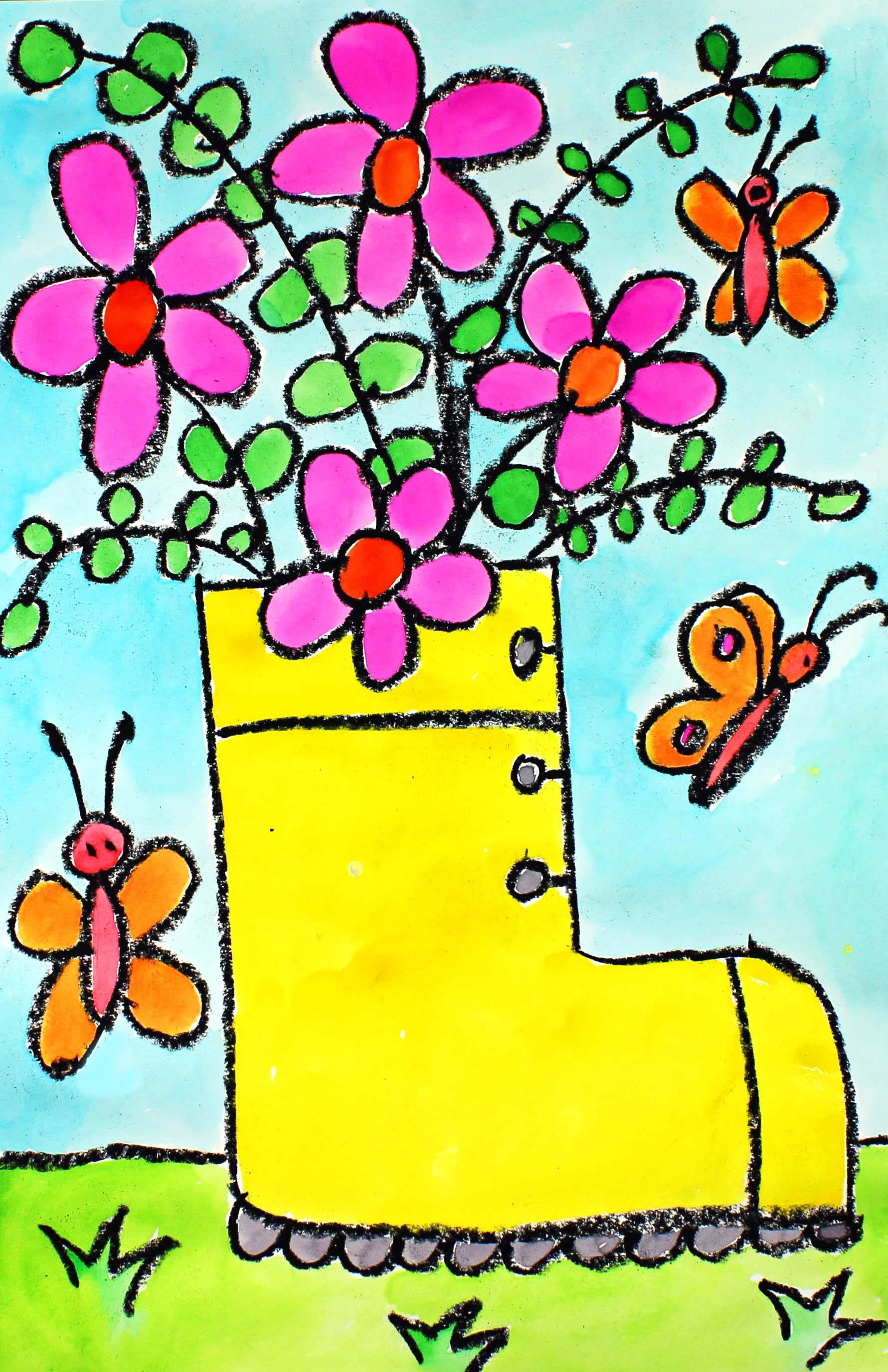
creating this cute garden boot, and inside of this garden boot, we have planted some
flowers and some leaves, and then flying around, we have some butterflies. I hope that you have a lot
of fun with this project. Let's get started. Let's talk about
the supplies and the materials that you will
need for this project. The first thing
that you'll need is a sheet of watercolor paper. You will need a set of watercolor painting
and a paint brush. I'm going to use a paint
brush that's this size, but just use what you
have available to you. You will need a cup or a
bowl with clean water. You will need a black oil
pastel or a black crayon. Either one will work, and
you will need a paper towel. So go ahead and gather all of those supplies and materials, and I'll see you back
here in the next video.
2. Step 1: Draw a Garden Boot Design: In this step, we are going
to create our design. So let's get started. So for this design, we are
going to create a boot, a garden boot down
here at the bottom, and then some flowers on the top part of
our piece of paper. The flowers are going to be
planted inside of the boot. A lot of times, if you
look out in gardens, you will see a garden boot, and that's what we're going
to be creating today. So go ahead and pick up your black oil pastel
or your black crayon. I'm using an oil pastel. And what we're going to do
is find about the middle of our piece of paper and
go up just a little bit, and we're going
to make a circle. Now, surrounding that circle, we're going to make
some little petals. This is going to be
our first flower, and it's going to guide us
for the rest of our drawing. It doesn't have to be perfect. Alright, so from here, the rest of the top
part of our piece of paper is going to be
filled up with flowers, and the bottom portion is going to be filled
up with the boot. Okay? So what we're going to do is we are
going to come out from the middle of
this flower and make a short little line
just like this. And then coming out from
this side of the flower, we're going to make a short
little line just like this. Now we're going to come
down from this line, and we're going to make
the heel part of the boot. So I'm going to make
this pretty straight. And then once I get pretty
close to the bottom, I'm going to curve
and then go straight. And I'm not going to touch
the edge of the paper, but I'm going to stop a
little bit from the edge. Now I'm going to come down here. And then when I feel is the
right amount of spacing, I'm going to curve around
and then come down and meet that line that I made for the
bottom of the boot. Alright, so there's our boot. There's the basic
shape of our boot. If your boot looks
different from mine, that's okay. That's
actually a good thing. We want your boot to look
like your boot. All right. Let's add a little bit of tread to the bottom of our boot. So we're just going to
make some curve lines that connect this will help when
the boot is in the garden, we don't want it
to slip around too much. So there's our tread. Let's add a little bit of
detail inside the boot. So I'm going to add a line here, and then I'm going to
add a line up here. And then I'm going to
add some little buckles. So I'm just going to
add some circles here. Maybe three or four circles. I think three would be good. And then a little
line that goes from the circle to this
line right here. Alright. So there's my boot. If you'd like to add some more designs on this center on the
inside of this boot, after we're finished
creating our flowers, you can go ahead and do that. Alright? Alright, so
here's my first flower. Now we're going to work
on the flowers up here. Think about the flowers
that you've seen in your garden or other gardens
that you've seen around you. I'm going to add
some more daisies, so I'm going to just start
out with making some circles. And if you want to do the
same thing that I'm doing, you can certainly do that. So I think I'm going
to start out with those three extra daisies. So now we have our flowers, and we're going to add a
little bit more detail. So if you'd like to add some leaves or some
different types of flowers, you can go ahead and do that. Let me show you the type of
leaf that I like to add. It's actually a little It almost reminds
me of eucalyptus. So we have a straight line, and then we add some circles. And sometimes we even put circles next to
circles like this. And then I want
to make sure that if I run into my flowers, I stop before I go all
the way through. Okay? So you can make
that type of leaf, or you can make just a
leaf that looks like this. You can make a stem, a
leaf that looks like this. Just start filling in your space around your boot with
anything that you'd like. Now that we have our
drawing of our boot and flowers and leaves that are
coming out of the boot, let's add a little bit of grass right here
down at the bottom, so our boot can be
sitting on the grass. And then if you'd like to
add some details here, you can do that, as well if
you want to add a little bug, if you have room for
that or some flowers or some little blades
of grass like this. I'm not sure if you can
see that down there, but I'm just making some little blades of grass that I think
will look interesting. And then if there's
anything that you'd like to fill in in the sky,
if you have the space, or if you'd like to fill
in this area on the boot, you can put some hearts
on there or flowers or any type of design
that you'd like to. It's completely up to you. So if you'd like to make
some little butterflies, you can do that. Let me show you how
to make a butterfly. So we have a circle, and then we have a long
circle and then some wings. This butterfly is flying. Maybe an eye, you can just see
the side of the butterfly. There we go. The back wing. That's a really cute butterfly. I'm going to make
another one over here. But for this butterfly,
I'm going to make a butterfly that's looking
more straight towards us. So circle a little antenna, a couple of eyes, a body, and then some wings. Whoopsi. Did you
see what happened? My oil pastel broke. Oil pastels are really soft, so they break very, very easily. That's a very common thing. Alright, so it looks to me
like I'm just about finished. Actually, I might make
something just small up here. I might make a little
tiny little butterfly. Tiny baby one.
Looking to the side. Just with that one eye,
that's kind of funny. Maybe maybe I'll turn
that into big eye. There we go. Alright, keep in mind, if you are using
your oil pastels, they can get pretty messy. So what you can do after you're finished
drawing your design is you can wipe your hands off with your handy dandy paper towel. Your handy dandy paper
towel might not get all of your oil pastels off of
your hands and fingers, but it will get most of it off. All right, friends, so I'm
finished drawing my design. When we come back, we will
start painting our design.
3. Step 2: Paint the Design: I in this step, we are going to
paint our design. So let's get started. So we're going to focus on painting our flowers and leaves, our boot, and our butterflies,
if you have them. If you have a different
type of a bog, those are the ones that you're going to be painting, okay? We're not going to focus
on the background, meaning the sky and the
grass at this point. We're going to save
that for the next step. Alright, so what
we're going to do first is we are going to add a drop or two of water
into each pan of paint. And what this will do is it will soften up the
paint a little bit, so it's easier for us to use. So I always encourage
my students to add a drop or two of water before they begin
the painting process. And that way, those
paints will be nice and soft and ready to use. Now that our paints
are softening up, let's turn our attention
to our design. So as I mentioned before, we're going to be painting
our flowers and leaves, our butterflies or other
bugs, and our boot. I'm going to be painting
my boot yellow. My flowers, I'm
going to be painting probably pink and orange
and my leaves green. And then I haven't decided
quite yet on my butterflies. Okay? So I'm going to start
painting my boot first. I like to use a lot of paint and just a little bit
of water because I want my boot color, my yellow. Be very, very bright. So keep in mind, if you
want bright colors, you use just a little bit of
water and a lot of paint. And if you want soft colors, then you use a lot of water
and a little bit of paint. So it's completely up to you. I'm going to try to
stay inside the lines, but if I go outside the lines a little bit,
that's no problem. That happens to me all the time. Alrighty friends, I'm
finished painting my design. I did choose to use a gray color for my
buttons and the sole, and I made that gray color
out of some black paint, a little tiny bit of black
paint with a lot of water. And that's what made
this gray color. So when we come back,
we are going to paint the background
of our design.
4. Step 3: Paint the Background: In this step, we are going to paint the background
of our design. So let's get started. So we have some
little tiny spaces. Here we're going to
have to be pretty careful with our paint. If your paint starts to run around just understand that that's what watercolor
painting like to do. They like to spread around. That's the nature of the type of paint that we are
working with here. So I try to embrace it, which means that I try to
just accept it and say, Oh, well, that's pretty
cool and then move on. So what we're going to do
is we're going to paint all the little spaces
here for the sky. I'm going to use the color blue, but you can use any
color that you like. I'm also going to paint my
grass down here, green. Alright? So you get to choose
the colors that you like, and I'm going to choose
the colors that I like. My blue paint, I am going
to prepare some paint here. I'm going to put some
drops of water in one of my wells because
I want my paint, my blue paint to
be pretty light. So I'm going to add
some water here, and then I'm going
to add my paint, and it's going to
be pretty light. I want it to be pretty
light, not too dark. Let me test it out.
Oh, that looks good. So what I'm going to do is I'm going to speed up this video, and I'm just going to focus on painting my sky
and then my grass. Alrighty friends, I'm
finished painting my design. I'm really happy with it. I hope that you had a lot
of fun with this project. I will see you next time.
 Em Winn, Teacher, Art Instructor, Artist