Transcripts
1. Introduction and Supplies You Will Need: Hi, friends. How are you? I hope you're having
a great day today. I'm excited about sharing
this project with you. This is a drawing and
watercolor painting project that I designed,
especially for kids. Students do not need to have any drawing or
painting experience at all to be successful
with this project. I will guide students step by step through the entire
creative process, so they will feel
comfortable at all times. Today, we are going to
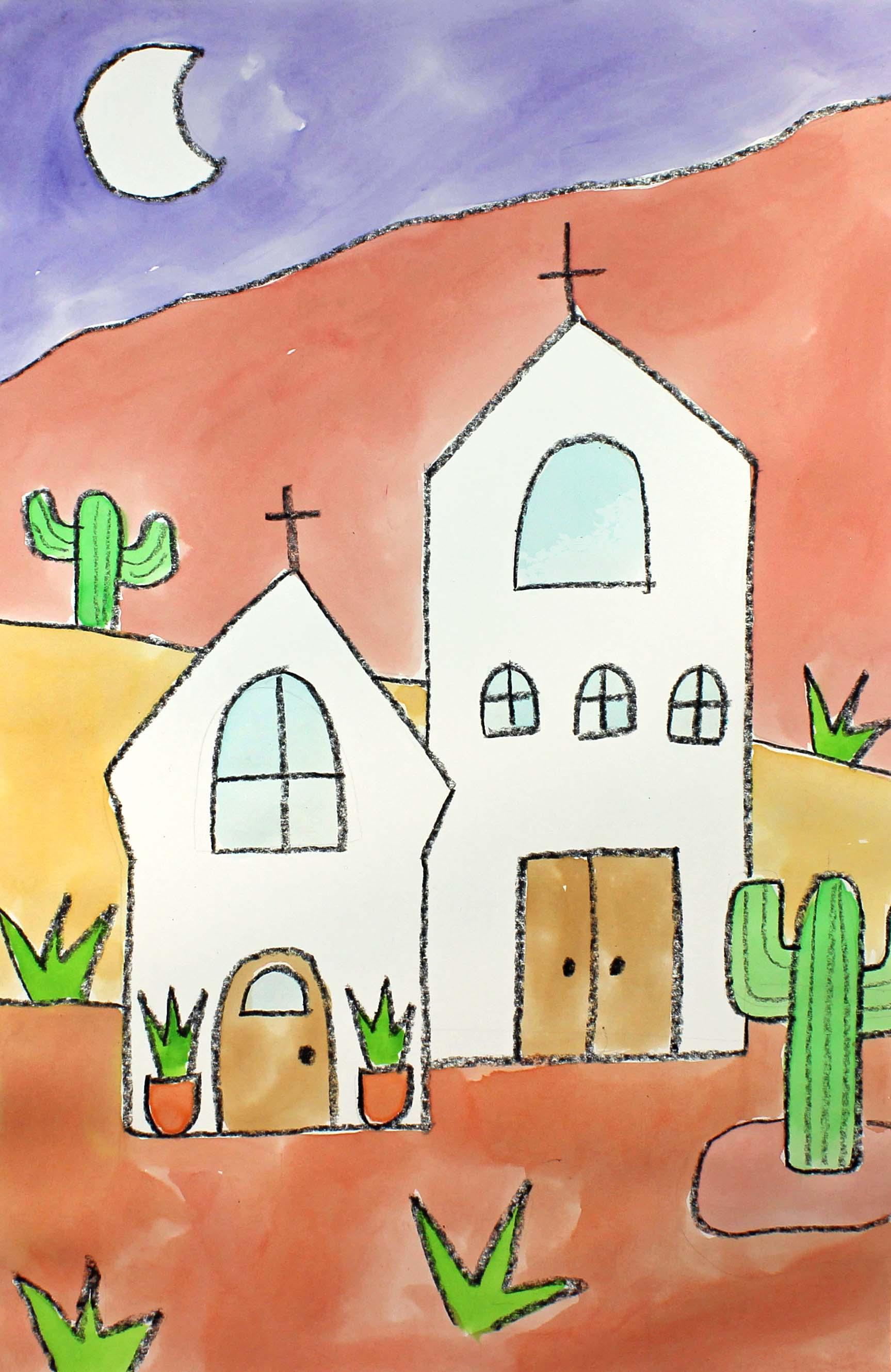
be creating this church. Let's talk about
the supplies and the materials that you will
need for this project. The first thing
that you'll need is a sheet of watercolor paper. You will need a set of watercolor paints
and a paintbrush. I'm going to use this
size paintbrush, but just use what you
have available to you. You will need a cup or a
bowl with clean water, a black crayon,
and a paper towel. So go ahead and gather all of those supplies and materials, and I'll see you back
here in the next video.
2. Step 1: Draw a Desert Church Design: In this step, we are going
to draw our church design. So let's get started. What we're going to do is
we're going to pick up our black crayon and go to about the middle of
our sheet of paper. The middle of my sheet of
paper is about right here. And we're going to go a
little above the middle, and we're going to make a very large upside down letter B, on the left side of
our piece of paper. So now attached to
this B is going to be two lines coming down this way and then a straight line
coming down about this far. If your lines are not exactly the same as mine, that's okay. Now we're going to
close up at the bottom. This is going to be the
main part of our church. Now we're going to
have another part of our church over
here on this side. So we're going to start here a little bit away from this angle, and we're going
to come up pretty far with a straight line. Now, from here,
we're going to angle up and then we're
going to angle down. Now, what we're going to do
is we're going to come down, not all the way but
about this far. And then we're going to create
something else right here, so that's why we
stopped right here. Alright, let's move back to
this part of our church, and let's add some details. So the first thing that
we're going to add is a cross at the top. And then we're going to add a window and a door. Let's
start with the door. You can either make
a rectangle door or an arched doorway like I am. And then if you'd like
to add something into the inside of this
doorway, you can go ahead. For example, you can
add a door knob, you can add a small window. Whatever happens to fit
inside of your door. Now let's make a larger window, an arched window, and then
close up at the bottom. If you'd like to add
some window panes, you can go ahead and do that. If not, you can leave
your window just plain. Now I'm going to make
a few flower pots, a couple flower
pots, I should say, two flower pots,
one on each side. And then inside the flower pots, you can put flowers or you can put any type of plant
that you'd like. I'm going to put this
kind of a plant. There we go. Now what
we're going to do is we're going to move back over to this tower and let's
put a cross at the top. And then let's add an arched window right here
at the top of our tower. So an upside down U and
then close that up. Now's the time
we're going to move down here and we're
going to put a cactus. So the way that we're going
to make a cactus is come down further than
this line right here. So we're going to come
down a little bit. We're going to make a really
long upside down letter and then close that
up at the bottom. And then attached to this, we're going to make
some arms for a cactus. So let me show you
how I did that. I started on the main
part of the cactus. I came in just a little bit. I came up, I went
over, I came down, and I went back to touch that
main part of the cactus. Now, on this side, I'm
running out of room. So this part of my
cactus is going to go off the piece of
paper, but that's okay. I'm just making that, so it's going off of
the piece of paper. So there's my cactus. If you'd like to add some
details to your cactus, like some lines or
some little spines, you can go ahead and do that. I'm making some
really light lines, some light crayon lines. Alright, now what we can do now that we have our cactus is we can continue on with
this shape right here. We're going to come down
a little bit and then come over with a straight line, and that closes up that
part of the church. So as you can see, this cactus is in front of this
part of the church. If you'd like to add a
little bit more detail here down at the bottom,
go ahead and do that. I think I'll add a few
more little plants that when I think of the desert, I think of this type of a plant. You can also add a little bit of detail around
the cactus, if you'd like. Now let's make a
line that goes from the church to the end
of our piece of paper. And then on this
side, the cactus is covering that line.
At least mine is. If yours is not
covering the line, then go ahead and
make a line there. And now we're going to make some detail in the background. Alright? So I think I'm going to just make some hills
and mountains. So I'm going to start
here on the end, come down, jump over the church, continue my line here, jump over this part
of the church, and then come out
the other side. Do you see how that's a
hill behind my church? Alright, the next thing
that I'm going to do is I am going to
make another line here. It's not going to
be super straight because I want it to look
like a hill or a mountain. There we go. And then I'm going to make a
moon up in the sky, so the letter C and
then close that up. Now if there's anything else
that you'd like to add, you can add some more plants or anything that you'd
like in the background. For example, I think I'm
going to add something right here to give a little
bit more detail, a little bit more interest. So I'm going to make
a small cactus, because remember, back here, it's a little bit further
away than in the front. So I'm going to make a small
cactus about right here. Make some little
lines on the cactus. Maybe I'll make one of
these spiky plants here. Maybe I'll make one
over here, too. So now I'm just filling
in the different spaces. If I see an area that needs
a little bit more detail, I'm going to put some
more drawing there. For example, now that I'm
looking at my artwork, I see that there's
a big space here. Now that I'm looking at
it, I feel like it might benefit from a drawing detail. So I think I'm going
to make a door. This is going to be a
rectangle door, a double door. And then I'll have the
door knobs right here. Yes, I like that. Sometimes that will happen. As you're creating, you will see different spaces
or different areas that you might like to
add something and just go ahead and do it if you
feel like you'd like to. If you'd like to add
something right here, maybe, maybe I'll add
three more windows. This was not part
of my initial plan, but I think that
the drawing would benefit from me adding some
more windows right here. I'm going to add some pans for those windows.
Much, much better. Mm hmm. I like it. Alright, so go
ahead at this time, add anything else that
you'd like to your design. When you're finished, go ahead
and put your crayon down. And in the next step, we will be painting our design.
3. Step 2: Paint the Design: A In this step, we are going to
paint our design. So let's get started. The first thing
that we're going to do is we're going to add a drop or two of water into
each of our pans of paint. And what this will do is it will soften up our
paint a little bit, so it makes it easier
for us to use the paint. So I always encourage my
students to go ahead and take a moment to put a drop or two of water into
each pan of paint. Now that our paints
are softening up, let's turn our attention
to our design. So here we have a church, and it's in the desert, as you can see, by the different types of
plants, including the cactus. And so you get to decide
the colors that you like to paint your church
and your background. I am going to choose to
leave my church white, and I'm going to paint
the windows a very, very light blue and I'm going to paint the doors brown
and the plants, I'm going to paint
green. All right. So what we're going to do in
this step is we are going to paint everything that's
not in the background. So these are the things
that we're going to paint. If you decide to
paint your church, go ahead and paint your church, all of the details inside
the church building. And your plants. Okay. Then in the next step, we are going to paint
the background, which is the sky, the hills, and the area that the church is sitting
on in the foreground. Sound good. Okay. So I'm going
to leave my church white, as I mentioned before, but I am going to paint
my windows a light blue. So to make a light blue, I am going to add quite a bit of water into one of my wells, and I'm going to add a
little bit of blue paint. And then, yes,
that's really light. I don't even know if
you'll be able to see this paint because
it's so light. But on all of my windows, I'm going to paint with this
really light light blue, and I'm going to try to
stay inside those lines. There we go. So if I have
a blue that's a little bit too dark and I want to soak some of that paint up,
what I'm going to do. So I'm going to take my
handy dandy paper towel, hover over that area that I want to soak up a
little bit of the paint, and I will bring it up
with the paper towel. Okay. All right. So my next step
is going to be to paint my doors, a light brown. So I'm going to go ahead and
make some light brown by adding some water and
some paint together. And I'm going to go ahead
and paint those doors. There we go. Now I'm going
to paint these pots. I think I'm going to paint
the pots a terra cotta color. So a combination of some orange and maybe a little bit of
brown. See how that looks. Maybe even a little bit of red. Sometimes it's fun to mix paint colors together so
you get unique colors. There we go. It's pretty light, but it's a terra cotta color, a little orangish,
brownish, reddish color. Now what I'm going to do
because I have my windows, my doors, and my pots painted, I'm going to go ahead and
move to my green paint, and I'm going to paint the different cactus,
the different plants. I'm going to paint them green. So now we have our
plants painted and our doors and our
pots and our windows. So in the next step
when we come back, we are going to be
painting the background.
4. Step 3: Paint the Background: In this step, we are going
to paint our background. So let's get started. So I'm going to offer
you a suggestion, and you can follow
these suggestions or you can just paint
your background, any colors that you like. What I'm going to
do is I am going to do a little bit
of color mixing. I'm going to color mix
with my red orange, maybe yellow and brown to create different colors
for my background. I am going to paint my sky
either blue or purple. I haven't decided yet, but right now, I'm just
going to focus on the hills. So I'm going to paint
this hill, one color, and then do a little color
mixing and then paint this hill and then this
ground right here. Okay? So I'm going to put some water into one of
my wells like this. And I'm just going
to think about it. Hm. Which colors
do I want to use? How about red? And maybe
a little bit of brown. And let's see what happens. Alright, I came up
with this color. I'm not quite sure what
it's going to look like as it goes onto
my piece of paper, but I'm excited to find out. I'm going to paint
this color up here. Oh, love it. Go to paint this color. It's almost like a
brick red color. I hope that you can see that on the video
cause it's really, really a cool color. Alright, I'm going
to spread that out. And I'm going to paint
this whole space this color. Alrighty friends. I've also decided to paint this area right here
the same color as this, so let me go ahead and do that. There we go. Alright, now I need to paint this
area right here. So this area, this little sliver right here and then
this area over here because it's all part
of the same hill. So I want this color for this little hill to be different
from this other color. So I'm going to add
some different colors. I think I'm going
to put some water into this part of my
well, add some orange. Oh, look at that bright orange and a little bit of yellow. Remember, it's important
to rinse your brush out between dips different paint. I think I'll add a little bit
of red here and some brown. I'm not sure what color this
will be, but let's find out. Yes, I love it. It's different from
the other color, right? That's what I wanted. I wanted it to be a
little bit different. So I just added some
colors together. I added red, orange,
yellow, and brown. Get that little
triangle right there. And Alright, friends. So I have more of
a brick red color, and then I have an
orangish color here. So what I'm going to do down here is a little bit different. I'd like this to be a
little bit more brown, so I'm just going to use some brown down
here at the bottom. And maybe I'll add
just a tiny bit of yellow and see what
happens down here. So this is pretty similar
to this one, right? So I want that to be a
little bit different. So I'll add a little
bit more brown. And do you know that with art, a lot of it is just trying
new things and experimenting. And sometimes you think
something's going to turn out one way
and it doesn't. But you just keep experimenting until you're happy with
the color that you get. So I have a color here. It's a little bit
darker than this one, but I think I'm going to add
a little bit more red to it. And I'm not sure how
it's going to turn out. It might be more similar to
this one, and that's okay. See that? Oh, that's a
nice color right there. I'm glad that I did that. I'm going to go ahead, push this color around now. Awesome. So this is more
reddish brown, up here. This is more yellowish brown, and this is more orangish brown. Now what I'm going to
do last is I'm going to add some purple paint
here up to the top, up at the top, and it's
going to be fairly light. There we go. It's nice. Usually the night sky
is a little bit darker. But because the other
colors are not that dark, I wanted this color to
be a little bit lighter. Add a little bit
more water there. Alrighty friends, I'm
finished painting my church. I'm really happy with
the colours that I decided to use
for my painting. And I hope that you had a lot
of fun with this project. I had a lot of fun teaching you. Thank you so much, and I will see you next time.
 Em Winn, Teacher, Art Instructor, Artist