Transcripts
1. Class introduction: [MUSIC] Many of us have mental health
challenges and we all know that meditation and
mindfulness can help. But what if concentrating on your breathing
just isn't enough? I felt the same way
when I realized that calligraphy and lettering can work as a mindfulness
practice for me. It helped me to gain more self-knowledge
and self-acceptance. Hi, I am Esther. I'm a mom of two adorable kids, a self-taught calligrapher, a math teacher, and
a freedom seeker. In this class, I will teach you how you can
use calligraphy as a mindfulness technique and how you can integrate it into
your day-to-day life and crafts to gain
self-knowledge and start your own healing journey because self-care
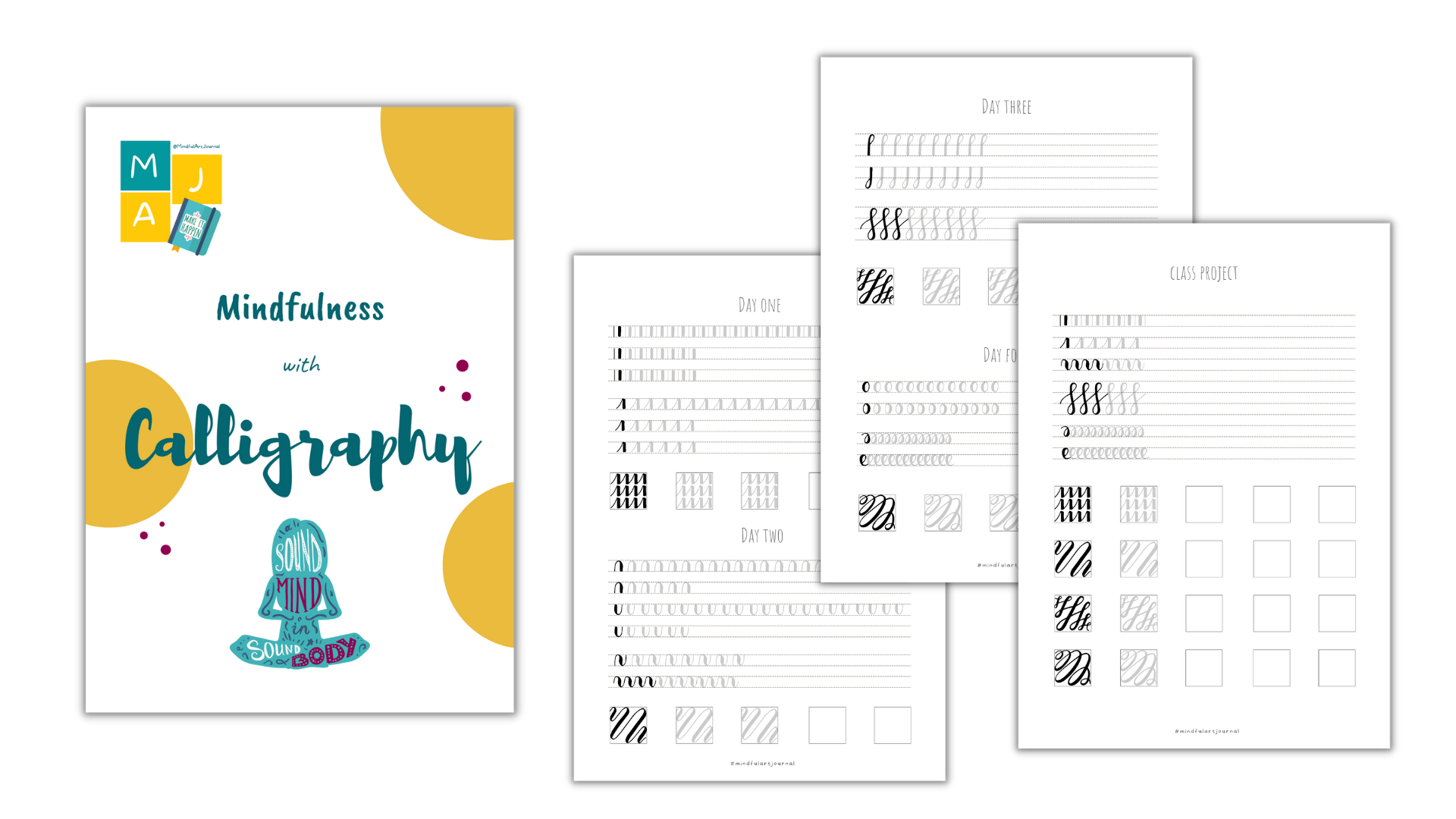
is not selfish. I want you to remember this. I've created a workbook with a five-day challenge in it
so you can follow along with the guided lessons
as you walk through the classes and enjoy the calming strokes and
[inaudible] of calligraphy. I will talk about how you can use your experience
to turn it into practice and how
you can continue your mindfulness calligraphy
journey after the class. I will also share the number 1 thing I wish I knew when I started calligraphy, which is how practice
make permanence and why perfectionism
is still harmful. I want you to look at calligraphy
with a fresh new eye. I hope I can help you
rewrite your life. See you in class.
2. Materials needed: [MUSIC] For this course, you can use fancier and
simple printer paper. It's really not about a fancy and expensive calligraphy tools, just experience. But if you have or want
to buy a brush pen, I recommend the Tombow Fudenosuke hard tip
brush pen because it is beginner friendly
and the size of the tip is perfect
for the workbook. In this case though, I don't recommend the normal
printing paper. It can fray the tip of your pen. But if you print the wordbook to an HP Premium32 printer paper, it will be perfect. Or you can use
tracing paper if you don't want to work on
the printed pages. That's all you need
and 10 minutes of your life for five days. Enjoy the process. [MUSIC]
3. Brush pen / pencil tips: [MUSIC] If you decide to use a regular pencil, there are two things
you need to know. One, the softer pencil
you use, B, 2B, or 4B, the more difference you can
achieve in line weight. I don't recommend harder
pencil though, H, 2H, or 4H, it can damage your paper. Two, to achieve
those thicker lines, you can vary your tip of
the pencil like this. If you use a brush pen, be sure to use a small tip pen, like the Tombow Fudenosuke, or Zebra Extra Fine color brush, or the Marvy Le Pen Flex. Because the big pens
like Tombow ABT or Karin Brushmarker
Pro are too big for this workbook and you wont be
able to use them properly. To make the best
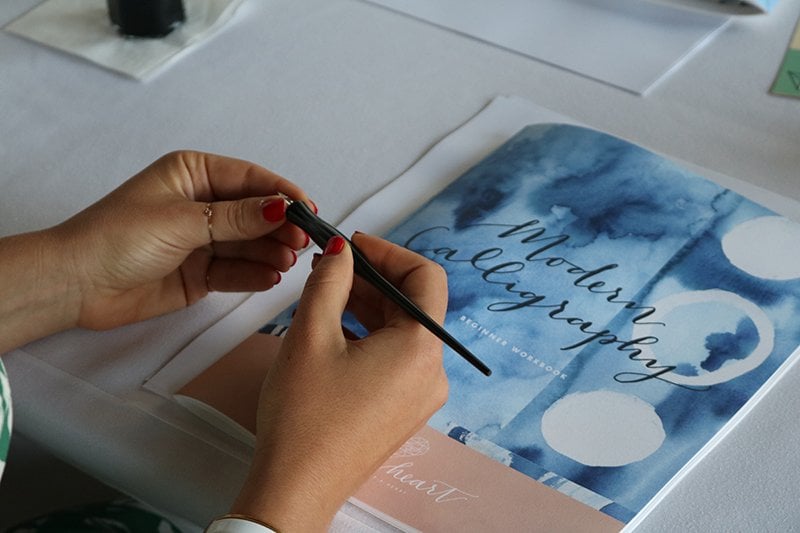
out of your pen, you should tilt it in a
45-degree angle, like this. It doesn't matter
what tool you use, be sure to relax your arm and ideally put your
elbows on the table. The more room you have in
your table, the better. Because there is a
golden zone to write, that is why you should
move the paper under your hands so you
can write in it.
4. What to expect?: [MUSIC] Hi and welcome to this class. It doesn't matter what
level you are at in your calligraphy journey
from beginner to advanced. Everyone is welcomed. Though I want to start
with a disclaimer. I'm not a health
care practitioner. If you have mental
health issues, I highly recommend you to see a therapist or your physician. I have mine and she
helps me immensely. This technique I will teach you, can help you identify
your struggles easier, but you have to
work with them in your own way and
at your own speed. With that said, let's jump in. For five days, you will do exercises
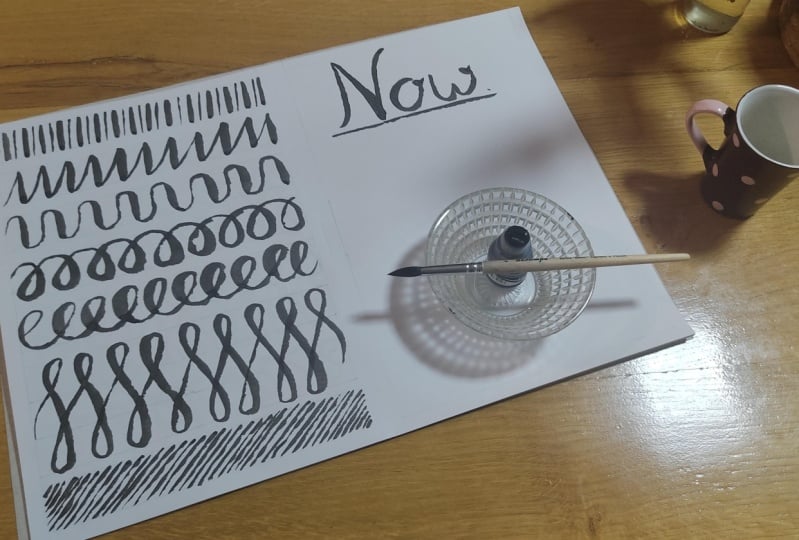
that will help you relax and practice calligraphy through the basic strokes and drills. Because these are the
foundations of calligraphy. If you learn these basics, you can write
anything after that. These are the simplest part
of your calligraphy study. You can concentrate on the mindfulness aspect
of your journey, because you are not
distracted with letters or connections
or flourishes. After the five-day challenge, I will show you how
you can build up your letters and words
with these basic strokes. How you can use your verbs
to rewrite your life. You can download the verb book in the class resources section. The goal is to learn
to enjoy the process. Make as many mistakes
as you can and find peace and calm
through calligraphy. As I said, I wish I
knew that earlier. Practice makes permanent. Because if you practice
your strokes, letters, and drills in a way that is uncomfortable but
looks better at first, your muscle memory will store the painful and harmful moments. It is harder to
quit a bad habit, then form a right one. Experiment. Welcome
your mistakes and shaky strokes
at first because they will lead you to a beautiful and pain-free
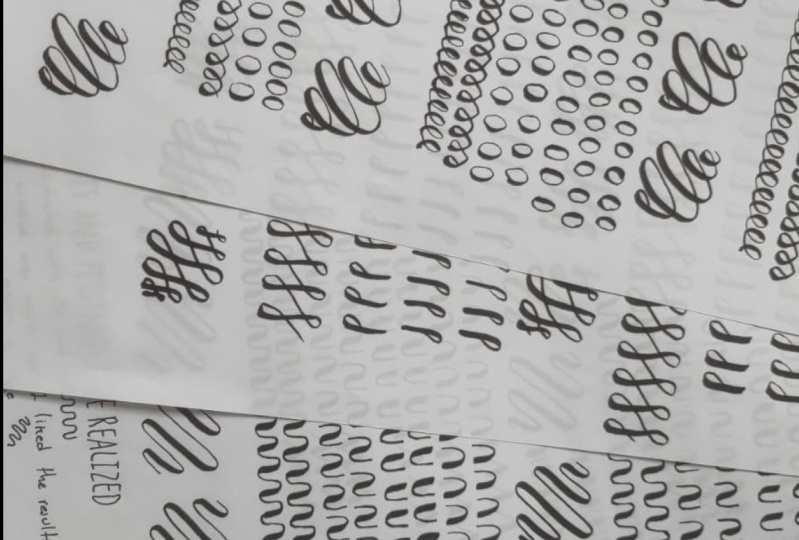
calligraphy style. The class project is to
fill a breakfast page with your drills at the end of
day five in your verb root, please share them with us. I'm looking forward to
seeing your drills. I'll comment on
each and everyone. Without any further
ado, let's dive in.
5. Wandering mind: the mindfulness practice: [MUSIC] The basic dynamics of a mindfulness
practice is this; you pay attention to
the present moment. Do your strokes in this case, then your attention
wanders. You notice it. Then you let go of
what distracted you, and you pay your attention
to your practice again. Then inevitably, your attention
wanders again, and so on. Every time your mind wanders, there will be patterns
that are always with you but when you
practice mindfulness, you are more aware of your
thoughts and feelings. After every daily practice, it is beneficial to write down the most disturbing thoughts
and feelings of yours. You can seek help
to process them. For example, nowadays, I
found out my main theme is loneliness and a fear
from my unknown past. But also I feel curiosity too, it is new to me. Though I can start
working on it with my therapist because
it feels that, maybe I'm ready to go
deeper in that rabbit hole. Now grab your pencil or pen
and start your strokes.
6. Breathing technique: [MUSIC] Lungs breathing is a warrior bell
mindfulness technique that can aid in
stress management. It is a deep breathing technique that can help you slow
down your breathing. It works by distracting your
mind as you count to four. Calming your nervous system and decreasing
stress in your body. The technique is simple. You start with
inhaling to a count of four and holding air in your
lungs for a count of four, then you exhale at the same pace than
holding your lungs empty for a four-count before inhaling and beginning
the pattern again. You can do this
circle four times. If you feel dizzy or
uncomfortable at first, you can stop it earlier. It is beneficial for you to practice this technique one or two times a day to relax
your nervous system. Let's start it together. Inhale, 2,3,4, hold 2,3,4, exhale, 2,3,4, hold 2,3,4, inhale 2,3,4, hold 2,3,4, exhale 2,3,4, hold 2,3,4. Inhale, 2,3,4, hold 2,3,4, exhale, 2,3,4, hold 2,3,4, inhale 2,3,4, hold 2,3,4, exhale
2,3,4, hold 2,3,4. I hope you enjoyed it. I recommend you to start your daily exercises with this to set the tone
of your practice.
7. Day one: upstroke, downstroke: Today you will practice
the thin upstrokes, the thick downstrokes, and the rooftop shaped
mixture of them. Allow yourself to make
mistakes, experiment, have uneven and crooked lines, have half broken
and shaky drills. The point is to relax
your muscles and find a way to draw these
lines as comfortably as you can to let your muscle memory learn the strokes without
any additional effort. While you are
practicing, be present. If you notice that
you are wandering, acknowledge it, and
return to the present, to your calligraphy lines. The upstrokes are always thin and the downstrokes
are always thick. This is the rule of
thumb in calligraphy. Today you can experiment with your choice of pencil or pen, how thin and how thick lines
you can create with it. Finally, pay attention to your breathing while you
are drawing these lines. Try to connect them
with your strokes. Upstroke, breathe in,
downstroke, breathe out. In the rooftop shade
lines upstroke inhale, downstroke exhale. Enjoy your me time. You deserve it. Have a nice day and I'll see you tomorrow.
8. Day two: overturn, underturn, compound curve: [MUSIC] Today you will practice the overtone, undertone, and compound curve. The new element
is the transition between the thick
and the thin lines. Experiment with it, start with the transition in different
places in each stroke, and notice what is the best
starting point for you. Be present and watch the
lines as you create them. Don't forget to pay attention
to your present moment, and know that your
mind will wander. You will think about
the future or the past, you will start worrying
about things in your life. It is perfectly normal, notice it, and then let them go. The only thing that is important now is you and your lines. Today focus on your speed, draw the strokes slower, observe what happens
when you slow down, are your curves
bigger or smaller? Can you handle your
pen or pencil better? Can you ease your grip
in your pen or pencil? Layer little with time. You can put on your
favorite slow song. Use the tempo of it,
while you write. Enjoy your me-time,
you deserve it. Have a nice day and
I'll see you tomorrow.
9. Day three: loops: [MUSIC] Today you will
practice the loops. These strokes are higher, you can learn to use
bigger hand movement here. Experiment with it. Try to stay in your
golden writing zone. Move the paper as you
need to achieve that. Don't forget to pay attention
to the present moment, when your mind wanders
without any judgment, let your thoughts
or feelings go. You can try the
labeling technique. Every time something
distracted you, put label on it, "it was an emotion" or, "it was thought." It helps your brain
process it easier. Today, focus on your
breathing again. Find your own rhythm connect
it with your writing. Enjoy the fresh air
while you create. Be present and let everything
go for 10 minutes. Enjoy your me time. You deserve it. Have a nice day and I'll see you tomorrow.
10. Day four: ovals: [MUSIC] Today we will
practice the ovals. These are harder than they look. Go easy on yourself. Experiment. It doesn't matter how shaky or wobbly they are. Every so-called mistake has its own purpose if
you learn from it. Take the time to find out
what was the problem. You started transition too soon. You wrote the stroke too fast. You hold your pen
in the wrong angle. Try to answer these
and you will find the most comfortable way to write these tricky
ovals of yours. Don't forget to pay attention
to the present moment. Your mind will wander. Everyone experiences
this. We are human. Be sure that there are
others know who use mindfulness technique too or write calligraphy or meditate, and that you are connected. We shared a human
experience together. You are not alone. Today
focus on the speed again. Write your ovals slower, faster, more slower. Observe, what's the difference
in the finished strokes? Which one do you like better? You can listen to music again and connect the lines to it. Be present and feel
the connection. Enjoy your me time
like so many of us. You deserve it. Have a nice day and I'll see you tomorrow.
11. Class project: calligraphy drills sheet: [MUSIC] Today is project day. You will fill the
full-page with the strokes today you learned in
the past four days. You can choose what
you want to focus on, the breathing or the
speed of your strokes. Be present and
enjoy the process, and try to use the
labeling technique when your mind wanders. Please upload your work to the class project section
so everybody can see it. Have a nice day and
enjoy your me-time.
12. What's the next step in your mindfulness calligraphy journey?: [MUSIC] A little extra. In this video, I will show
you how you can connect your strokes to form
letters and words. I hope you will enjoy it. [MUSIC]
13. Final thoughts: [MUSIC] Congratulations. You have learned the
basics of calligraphy and how you can use it as
a mindfulness practice. You can use this technique in your day-to-day life and in your other craft
projects too. I hope I will see you in my other classes if you want to learn more
about calligraphy, mindfulness, lettering,
and watercolor. Have a nice day and please don't forget that you are wonderful.
 Eszter Szilágyi, You are not your thoughts or feelings!