Transcripts
1. 3 Minute Maths Fractions Introduction: hello and welcome to three minute maths fractions. This set of lessons will have your mastering fractions in no time. But don't think that you have to work through this whole course in one go. This course is perfect for the student who only has a few minutes to spare each day. I have set out each lesson so they can be completed in short bursts. Whenever you find yourself with a moment of freedom before you start this course, let me share with you an extremely handy learning tip that helped me to progress quickly and effectively in learning anything. When most people start studying for something, they tend to spend the first day or two studying for hours and hours and get through loads of work. However, very quickly this begins to dwindle. You might feel like spending hours studying maths, which is great, but you want that feeling of motivation to continue. However, your motivation won't continue. If you actually do spend hours studying, limit your story time to chunks of just three minutes. No more. If you limit your studying to just three minute chunks, there are three things that will happen. Firstly, you're maintain your enthusiasm. If you want to learn anything, you have to maintain enthusiasm or else you won't want to continue. If you limit your story time to just three minutes, you'll keep maths fresh and exciting and you'll be eager to learn. If you spend hours studying very quickly, you'll get bored with math and it'll turn into a chore. You're study more consistently. It's much better to study for just three minutes once a day, then to study for three hours once a week. A spare three minutes is relatively easy to find, even in the most hectic schedules. If you make sure you complete at least 13 minutes to recession every day, it will quickly become a habit that you will do without thinking. It's much easier to fit in a daily three minute habit than a weekly one hour habit On. By doing this, you'll become a much more consistent learner, and consistency is the key to success. Finally, you'll remember things better. This is my favorite reason as to why you should limit your study to just three minute chunks. If you study something for just three minutes every day, you'll trick your brain into memorizing the information more quickly than if it were to see the information for hours each day. It will think I see this information every day, so it must be important. But I don't see it for very long, so I better hold onto it making to a memory. First, you'll be amazed at how much more easily things tend to stay in your brain if you limit yourself to just three minutes a day, so three minutes is the key. Do a three minutes to recession and then give yourself at least half an hour before you do under three minutes. You should aim to do at least 13 minute chunk every day, any more than that is a bonus. But one is fine. Just go through the course and completely exercises, and you'll be amazed at how much you plan.
2. 3 Minute Maths Fractions Lesson 1 (Finding fractions of whole numbers): finding a fraction off a whole number. If you were asked to find something like 4/9 off 18 there is a really simple way to do it or we have to remember is divide by the bottom thin times by the top divide by the bottom, then times by the top. Now you might be asking yourself, What does that mean? Well, well, you have to do is 18 divided by nine, which is the bottom and then times by the top, which is full. So 18 divided by nine is, too, and then two times four is eight. So 4/9 off 18 is eight. Let's try another one. How would you find 7/8 off 24 while divide by the bottom on times by the top? So you do 24. Divided by eight, which is the bottom on that gives you three and then three times seven, which is the top is 21. So 7/8 of 24 is 21. What would be 3/7 off 35 35 divided by seven is five and then five times three is 15 so 3/7 of 35 is 15 6/11 off 77 77 divided by 11 is seven and then seven times six is 42 and so 6 11 Some 77 is 42 2/3 off six six. Divided by three is, too, and then two times two is four 89 off 36 36. Divided by nine is full on, then four times eight is 32. Now I'm leaving you a gap to work out the answer in your head. But if you need a little bit more time than just pause the video and then press play when you've worked out what would be to ninth of 18 18 divided by nine is two and then two times two is four 1/5 off. 90 90 divided by five is 18 and then 18 times. One is 18. What would be 3/4 off? 92 92 divided by four is 23 and then 23 times three is 69 so three quarts of 92 is 69
3. 3 Minute Maths Fractions Lesson 2 (Multiplying fractions): in the last lesson, we learned how to find a fraction off a whole number. So let me just give you a few questions to recap that what would be 5/6 off 48? So remember you divide by the bottom and then times by the top 48 divided by six is eight and then eight times five is 40. What would be 4/5 soft 20 20 divided by five is full, and then four times four is 16. What would be 3/7 off? 21 21 divided by seven is three and then three times three is nine. Now there are four more things that weaken do with fractions. Adam, subtract, multiply and divide them. But let's start with the easiest of those multiplying fractions. Now the top off a fraction is called the numerator. On the bottom of a fraction is called the denominator. When you multiply two fractions together, all you have to do is times the numerator is together and then times the denominators together. So you times the tops together and then you times the bottoms together. For example, if you had 2/3 times 4/5 so well, you do two times four on the top, which is eight and then three times five on the bottom, which is 15. So 2/3 times 4/5 is 8/15. Let's try into the one what would be to fifth times 3/7? Well, on the top you do two times three, which is six. And then on the bottom you have five times seven, which is 35. So 2/5 times 3/7 is 6 35th So it see if you can work out 4/9 times 3/4 12 36. What would be? Ah half times 8/9. 8/18 6/7 times 2/3. 12/21. What would be 2/3 times 3/4. Six twelves. Two faiths times 3/5 6/25. 4/11 times 5/7 20/77. What would be 8/9 times 3/10 24/90. So to multiply two fractions together, all you have to do is times the numerator is together and then times the denominators together
4. 3 Minute Maths Fractions Lesson 3 (Simplifying fractions): in the last lesson, we learned that to multiply two fractions together, all you have to do is times the numerator together and then times the denominators together . And the numerator is the top of a fraction on the denominator is the bottom of a fraction. So let me just give you a few questions to recap that and what would be 3/8 times 1/2 3/16 4/7 times 1/3 for over 21 and ninth times 7/8 7/72. Now there were a couple of answers in the questions at the end of the last lesson that weren't in what we call their simplest form. For example, if you look back at the question 4/9 times 3/4 we got 12/36. Now the answer 12/36 is perfectly fine. But if you ever ask to give your answer in its simplest form, then you'll have to do an extra thing. And so let's look at how to simplify fractions. So let's look at the Fraction 12/36. Now 12 and 36 are both even numbers on. This means that you can have them easily. If you take a fraction and you have the top and you have the bottom, then you're simplifying it. So 12/36 if we have the numerator and the denominator, becomes 6/18 because half of 12 is six on Behalf of 36 is 18 now. 6/18 is a simpler version, off 12/36. But it's the same fraction, in fact, because six and 18 are both even numbers. We could go and have them again and get 3/9. And so 3/9 is a simpler version off 6/18 and also a simpler version off 12/36. What we could also do is simplify 3/9 both three and nine are in the three times table, which means we could divide them both by three. So three divided by three is one on nine. Divided by three is three, and so we'd get 1/3 or 1/3 and so 1/3 is a simplified version off 3/9, which is a simplified version off 6/18 which is a simplified version off 12/36. So all these four fractions are the same fraction, just in different versions. So we Harvard it twice and then divided it by three. But we could have done all that in one step. We could have just divided it by 12 at the beginning because 12 divided by 12 is one and 36 . Divided by 12 is three, meaning we would have got a fed so you can simplify any fraction by seeing what you could divine the top on the bottom by. I always tried to Harv it first. If it's an even number on, then see if there's another number that you can divide it by to make it simple.
5. 3 Minute Maths Fractions Lesson 4 (Simplifying fractions): so to simplify a fraction, all you have to do is see if there's a number that you can divide both the top on the bottom by and then do that. So let's do another example. If we look at the question Ah, half times 8/9 while 1/2 times 8/9 is 8/18 because one times eight on the top is eight and then two times nine on the bottom is 18. What we can do is simplify 8/18 because both eight and 18 are even numbers. Then we can have them and get 4/9. So 4/9 is a simpler version off 8/18. There's no other number that we can divide both four and nine by So 4/9 is actually the simplest version that we can get. Let's do another example. 2/3 times 3/4 while 2/3 times 3/4 is 6/12 because two times three is six and then three times four is 12. We can simplify 6/12 because both six and 12 are even so we can have them. If we have this fraction, then we get 3/6, so 36 is a simpler version off 6/12 but it's basically the same fraction. If there's a number that weaken divide 316 by then, we can make it even more simple. In fact, three and six are both in the three times table, so we can divide them both by three. So three divided by three is one and six. Divided by three is, too, which gives you 1/2 or 1/2. So the simplest version, off 6/12 is actually ah, half. Let's try one more. What would be 3/4 times 5/12 three times five is 15 as the numerator and then four times 12 is 48 as the denominator. And so 3/4 times 5/12 is 15/48. Now, when you look at 15/48 straight away, you can see that the top 15 isn't an even number, and this means we can't have it, so we'll have to do something else to it. To simplify. 15 on Day 48 are both in the three times tables, so what we can do is divide them both by three 15. Divided by three is five on 48 divided by three is 16 so 15/48 in its simplest form is 5/16 . Say 5/16. How did I know that 48 was in the three times table he used Green? Well, in the next lesson, I'll show you a little trick that'll make simplifying fractions a lot easier.
6. 3 Minute Maths Fractions Lesson 5 (The 3 Times Table): the three times table. Now, if you add all the digits in a number together, you can work out whether or not it's in the three times table, and therefore you can work out whether or not you can divide it by three. For example, if you look at the number 48 four plus eight is 12 and if we do the same thing again with 12 1 plus two is three, and so this means that 48 is divisible by three 48. Divided by three is 16. So if you add all the digits in a number together and then do the same with the answer until you get down to a single digit. If you end up with either a three a six or a nine, then you can divide the original number by three. So here's a list of numbers. See if you can work out which ones are divisible by three, or which ones are in the three times tables. So pause the video, work out which numbers are in the three times table and then press play, and we'll see if you got it right. So 4298. Well, this isn't in the three times table because four plus two plus nine plus eight is 23. And then if you add the numbers two and three together you get five. And so that isn't a 36 or a nine, so you can't divide 4298 by three. The second number, 1231 is also not divisible by three. Because one at two at three at one is seven. The third number you should have got as yes, it is divisible by three. Because if you had together 983028 and three you get 33 and then three at three is six and so you can divide this number 9,830,283 by three before the number is not divisible by three. Because to add three, add one at nine at two is 17 and then one at seven is eight, 23,192 is not divisible. By three, 894 you should have got as yes, it is divisible by three. So it's in the three times table because eight at nine at four is 21 and then two at one is three and similarly, the last number, 340 million, 873,452 is divisible by three. So it's in the three times table because if you had all the digits together, three at four, at zero at eight at seven at three at four at five at two, then you get 36 and then three plus six is nine. So to work out whether a number is divisible by three or not just at all the digits together. And keep doing that until you get down to a single digit. Andi, If that digit is 36 or nine, then the original number can be divided by three. And you can use this when you are simplifying fractions to see if you're able to divide the numerator. Andi The denominator by three
7. 3 Minute Maths Fractions Lesson 6 (Simplifying tips): when you're simplifying a fraction, there are a few things to look out for that will make it easier. So we know that if you look at the numerator, Andi the denominator and they're both even then you can divide it by two. And in the last lesson, we learned that if you add all the digits together and you get a three or six or a nine, then that means you can divide the original number by three. If a number ends in a zero, then you can divide it by 10. If the numbers and in a zero or a five, then you can divide them by five. And finally, if in your fraction you have a numerator and a denominator that are both double digit numbers, such as 22 or 55 or 77 then this means you can divide it by 11. So even numbers you can divide by two on even numbers are those that end in a zero. A 246 or eight. If you add all the digits of a number together on, do you get a 36 or a nine, then you can divide it by three. If the number ends in a zero, you can divide it by 10. If the numbers end in a zero or a five, you can divide them by five. Andi If they are double digit numbers, then you can divide them by 11. So, using those little nuggets of wisdom, let's see if you can simplify these fractions. Try and put in its simplest form 415 over 985. So pause the video. Have a look to see what number you could divide the numerator. Andi the denominator by on then, either on a scrap of paper or in your head, simplify the fraction as's faras, you can go and then press played. Steve, you got it right. So 415 Andi 985 both end in the number five, which means they're divisible by five. And so 415 divided by five is 83 on 985. Divided by five is 197. So to simplify 415 over 985 you get 83 over 197 and that's as far as you can go with that man. How would you simplify? 322 Over 704. Now, both of these numbers are even, which means we can have them. And so half off. 322 is 161 on behalf off. 704 is 352 now 161 is not an even number. So we can't have it on either the top or the bottom of this fraction are divisible by three . And so this is the simplest weaken. Go. So 161 over 352 is a simplified version off 322 over. 704. What about 99? Over. 120 both 99 on 120 are divisible by three. So we can divide them both by three. Andi, get 33/40. So 99 divided by three is 33 on the 120 divided by three is 40. How would you simplify 66/88? You could do this in two ways. They're both double digit numbers, which means you could divide it by 11 on. Then you get 6/8, and then when you get 6/8, both those numbers are even, which means you can have them and say, You'll get 3/4 or you could do it the other way round. Onda Harvick first. So if you have it first, you get 33/44 then both of those are double digit numbers, which means you can divide them by 11 and get 3/4. But either way, you end up with 3/4 or 3/4.
8. 3 Minute Maths Fractions Lesson 7 (Multiplying fractions with whole numbers): in the last lesson, we learned how to simplify a fraction. So that's just do one quick example. How would you simplify 72 over 102? Both 70 to 102 are even numbers, which means we can divide them by two on get 36/51 on. Then both 36 51 are divisible by three because if you add three and six and 36 you get nine on five. Ad one is six, so we can divide them both by three on we end up with 12/17. Now let's get back to multiplying fractions. And so we know that if we multiply two fractions together, all you have to do is multiply the numerator is together and then multiply the denominators together. But what about if you wanted to multiply a fraction with a normal whole number? Well, any normal whole number can be turned into a fraction extremely easily, or you have to do is place it over a denominator off one, for example. 15 as a fraction is 15/1. So if you wanted to do an equation like 4/5 times 12 Well, you can start by turning 12 into a fraction, so you'll get 4/5 times 12/1 and then just multiply it as normal. So four times 12 is 48 onda five times one is five, and so you end up with 48 5th What about eight times 2/3? Well, eight can be turned to a fraction, and you get 8/1, and then you just multiply eight times two is 16 as the numerator, and then one times three is three as the denominator. So eight times 2/3 is 16 3rd what would be full times 3/5. So if you turn four into a fraction, you get 4/1 and then four times three is 12 on top, and then one times five is five. So 12 5th what would be 2/3 times seven? So you turn the seven into a fraction by placing it over a denominator off one, and you get 7/1 and then just multiply. Two times seven is 14 on three times. One is three, so 14 3rd what would be eight times 1/10. So eight you can write as 8/1, and then you get eight times. One is eight on top, and then one times 10 is 10 so 8/10. But you can also divide eight on 10 both by two, because they're even on. So you can simplify this fraction and get 4/5. So eight times 1/10 is forfeits would be 3/7 times eight. So you can write eight as 8/1, and then you get three times eight is 24 7 times one is seven, so 3/7 times eight is 24 7th
9. 3 Minute Maths Fractions Lesson 8 (Dividing fractions): in the last lesson, we learnt that if you multiply, ah, whole number by a fraction or a fraction by a whole number, or you have to do is turn the whole number into a fraction by placing it over a denominator of one. So what would be four times 1/2? So we can change the 4 to 4/1, and then you get four times one on the top is full on one times two on the bottom is too. Andi for over two is the same as to over one and 2/1 is just too. So the answer is to. So now we know how to multiply fractions. Let's move on to the next topic, which is dividing fractions. Now. Dividing fractions is almost as easy as multiplying fractions, but there's one extra little step. Let's look at an example, 2/3 divided by 56 Now there are two steps to dividing fractions. Step one is to flip the second fraction upside down. So, for example, 5/6 would become 6/5, and then a step to is just to multiply as normal. So when we had 2/3 divided by 56 while 1st 56 becomes 6/5 and then you just multiply. So 2/3 times 6/5. Well, two times six is 12 on three times five is 15 as the denominator. So we get 12/15 on. We can simplify 12/15 if you want. We can divide both by three because they're both in the three times tables on DSO you get 4/5. So that means that 2/3 divided by 5/6 is 4/5. Let's do another couple of questions together. What would be 3/7 divided by, ah half. So Step one is to flip the second fraction upside down, and Step two is to multiply. So if you flip the half upside down, we get to over one, and then we mortify so 3/7 times to over one or on the top. We have three times to which is six on the bottom. We have seven times one, which is 7 6/7 So 3/7 divided by 1/2 is 6/7 and we can't simplify this fraction. It's a simple it's Cumbie. Let's do one more 4/5 divided by 2/3. So the first step is to flip the second fraction over, and then we have to multiply. So 2/3 is the second fraction that becomes 3/2 or three halfs. And then we can multiply. So 4/5 times three halves on the top. We have four times three, which is 12 and on the bottom we have five times to, which is 10. So 4/5 divided by 2/3 is 12 months. So that's how you divide fractions.
10. 3 Minute Maths Fractions Lesson 9 (Turning improper fractions into mixed fractions): at the end of the last lesson, we ended with this question 4/5 divided by 2/3. And so to do this, we said we flip the second fraction upside down and then you multiply. So we end up with 4/5 times three harps, which gave us 12/10. But if you look at 12/10 you can see that the numerator 12 is bigger than the denominator, which is 10 on whenever you see this in a fraction, it's called an improper fraction. Sometimes you see it called a top heavy fraction. What we can do with improper fractions or top heavy fractions is turned them into a mixed fraction. So let's start by looking at 12/10. To begin with, we can simplify it and make it a small as we can get it. So it's easy to handle so 12/10 where they're both even, which means we can have the top on the bottom. And so we get 6/5. But 675 is still an improper fraction. It's just a simpler one. So here's how to turn an improper fraction into a mixed fraction Step one work out how many times the denominator can fit into the numerator on write it as a big number on the left. Then Step two. Whatever is left over goes as the new numerator. So 6/5? Well, step one was to say how many times the denominator can fit into the numerator so five can fit into six just one time, as they were right, a big one. But there's one left over, and so that is the new numerator. So 6/5 as a mixed fraction is one on 1/5. So a mixed fraction is when you have a whole number and a fraction put together. So one on 1/5 is the same as 6/5. It's just six. Fifth is an improper fraction on one on 1/5 is the mixed fraction. Let's do another so you can get the pattern. 17/5 is an improper fraction because 17 is bigger than five. Let's make it into a mixed fraction. So Step One was to work out how many times the denominator fits into the numerator on right , that as a big number, so five fits into 17 3 times, and then there are two left over. So we write a big three and then two is the new numerator. So we write a big Three and then to over five. So three and 2/5 is a mixed fraction off. 17/5. Let's do a little more 29/6. So first we ask How many times just six fit into 29? Well, it fits in four times with five left over. So we write a big four and then make five the new numerator, so as a mixed fraction 29/6 is four and 56 If you're not sure how to work out, how many times the denominator fits into the numerator or you have to do is count in the donator until you get as close as you can to the numerator. And so, in this example, 29/6. If you count in your sixes, you get six 12 18 24 on. That's as close you can get because the next one is 30. That's too big. And so as close as you can get below the numerator. So 6 12 18 24 that's four times or four sixes so it fits four times, and then from 24 to 29 it's five left over. That's how we got four and 56 So to turn an improper fraction into a mixed fraction, you work out how many times the denominator fits into the numerator on right, that as a big number. And then whatever is left over is the new numerator.
11. 3 Minute Maths Fractions Lesson 10 (Turning improper fractions into mixed fractions): So we've just learned that to turn an improper fraction into a mixed fraction. You work out how many times the denominator fits into the numerator on right that as a big number. And then whatever is left over is the new numerator. That's tackle another one. What would be 56/32 as a mixed fraction? Well, because this one has two even numbers. We can simplify it first to make it easier so we could have them and get 28/16. And then again because 28/16 are both even. We could have it again on get 14/8 and, in fact 14 on date are both. Even so, we could hard both of them on simplify it even further to get 7/4. So 7/4 is the simplest version off 56/32. But it's still an improper fraction because the top is bigger than the bottom. So let's turn it into a mixed fraction. How many times just four fit into seven just once, very right, A big one. And then there are three left over and so three is the new numerator and so 7/4 as a mixed fraction is one and 3/4 now for this one. I said that we should simplify the faction first, but what if you don't want to? Well, the good news is that you don't have to, because you can simplify at the end instead. And so let's do the same question again. But let's not simplify it first. So 56/32. Well, if we don't simplify it, we just have to ask how many times? Just 30 to fit into 56. Well, it only fits one time, but there are 24 left over. So we write a big one on the new numerator is 24. So we get one on 24/32 so we can simplify the fraction part because both 24 32 are even so we can have them both and get 12/16. We can then have them again because 12 and 16 above even on we get 6/8 and that we can have them 1/3 time because six on data both even weaken, say 3/4. And so, if you put the big one back, we get one and 3/4 which is exactly the same as we got by simplifying the fraction at the start. And so you can simplify either at the very beginning or at the very end. It doesn't matter cause you'll end up with the same answer. Now there's one more type of improper fraction that you might come across something like this. 20/5 so we can do it the same way. We just ask, How many times does five fit into 20 and the enter is four with non left over, so it fits in exactly four times. So this means the answer is just for so 20/5 is the same as for if we have simplified this first, then you could divide the top on the bottom by five to get 4/1. Any time you have a fraction with one as the denominator, you can just ignore the denominator. And so the answer is still just for so if you have an improper fraction where the denominator fits perfectly into the numerator without any left over, then the answer will just be a whole number
12. 3 Minute Maths Fractions Lesson 11: have a go at turning these improper fractions into mixed fractions. You might want to simplify them a little first to make it easier, but you don't have to, because you can simplify him at the end if you prefer instead. So how would you turn 19/3 into a mixed fraction? So we asked, How many times does three fit into 19? And the answer is six. Because if you count in your threes, you get 369 12 15 18 and that's as close as you can get. So it's six times with one left over, and so the answer is six and 1/3. How would you turn 45/7 into a mixed fraction? So we asked How many times just seven fit into 45 on? The answer is it fits six times with three left over, and so the mixed fraction is six and 3/7. How would you turn 16 5th into a mixed fraction? So we asked how many times just five fit into 16 where the answer is three with one left over, and so we get three and 1/5. What would be as a mixed fraction 23/12. So how many times does 12 fit into 23? It's just once with 11 left over, and so the mixed fraction is one on day 11 12th. What would be 27/12 as a mixed fraction? Now, if you like, you could simplify this one first. Eso because both 27 on 12 are in the three times table. We can divide it by three and get 9/4. And then we can ask, How many times does fall fit into nine? Well, it's two times with one left over, and so the answer is two and 1/4 or two and 1/4. If you didn't simply fire first, then you would ask, How many times does 12 fit in 27? Andi. The answer is to with three left over, and so you get two and 3/12. But you can then simplify the 3 12 spot by dividing the top and the bottom by three, and you get 1/4 or 1/4. And so the answer is still two and 1/4
13. 3 Minute Maths Fractions Lesson 12 (Turning improper fractions into mixed fractions): How would you turn 108 over 56 into a mixed fraction? If you simplify the fraction first, then you could have the top of the bottom to get 54 on 28. So 54/28 then, Because both of these numbers are even, you could have it again and get 27/14. Then you simply ask, How many times does 14 fit into 27 on? The answer is one time with 13 left over. So you do a big one and then 13/14. If you don't simplify it first, then you could just say How many times does 56 fit into 108? And the answer is one time with 52 left over. And so 52 is the new numerator. So you say it's one on 50 to over 56. You can then simplify 50 to over 56 by dividing the numerator. Andi the denominator by two on you get 26/28 on Both of these numbers are even so you could have him again and say 13/14 so you'll end up with one on 13/14. No matter whether you choose to simplify the fraction first or simplify it at the end, how would you turn the fraction 240 over 32 into a mixed fraction? If you simplify the fraction first because the top and the bottom are both, even you could have them both and get 120 over 16 on. Do you ended up with two more even numbers, that you could have the top in the bottom again on Get 60/8, which again are both Even so you could Harvard again and get 30 over fall. But you could also have again and get 15/2. And then you simply ask, How many times does to fit into 15? And the answer is seven with one left over, and so the answer is seven on behalf. If you didn't want to simplify first, you could just ask How many times does 32 bit into 240 which is a bit trickier. But if you worked out, then you get seven with 16 left over Andi, you can simplify the 16/32 part by Harding. It and you get 8/16 which you could have the top of the bottom again and get 4/8, and you can divide them by two again and get to over four. And then, if you have it again, you get 1/2, which is 1/2. And so the answer is 7.5. Whether you simplify it first or simplified at the end, how would you turn 500 over 200 into a mixed fraction? Well, this one is a bit easier because you could divide the top and the bottom of this fraction by 100 to simplify it first. And so, if you divide the 500 the 200 by 100 then you get 5/2. And all you have to do then is say, how many times does to fitting to five on? The answer is to with one left over, and so the answer is 2.5. If you don't want to simplify it first, then you could just say, How many times does 200 fit into 500 on? The answer is to with 100 left over, and that gives you two on 100 over 200. And then you can divide this fraction the talking, the bottom by 100 to get 1/2. And so you end up with 2.5. How would you turn the improper Fraction 99 over 33 into a mixed fraction? Well, because you've got double digits on the top and the bottom, you could divide them both by 11 to simplify and you get 9/3. And then if you divide not the nine on the three by three, then you contempt. If I it to 3/1. Whenever you have a fraction over one, you can just ignore the denominator. And so the answer is three. If you don't want simplify first, then you could just say How many times does 33 fit into 99? And the answer is three times exactly. And so the answer for both methods is three so again to turn an improper fraction into a mixed fraction. You just say How many times does the denominator fit into the numerator and you write that as a big number and then whatever is left over is the new numerator
14. 3 Minute Maths Fractions Lesson 13 (Turning mixed fractions into improper fractions): in the last couple of lessons, we learned how to turn an improper fraction into a mixed fraction. So just to recap, how would you turn three Harp's into a mixed fraction? So you say, How many times does to fit into three on The answer is one with one left over, and so you end up with 1.5 Now, you could also do this the other way around and turn a mixed fraction into an improper fraction. And so let's say you start out with a mixed fraction, like two and 5/7 and you want to turn it into an improper fraction. Well, all you have to do is do two times seven to get 14 and then added to the numerator. So two times seven is 14 14 at five, which is the numerator is 19 and that becomes a new numerator. So you get 19/7, and that's all you have to do. You multiply the big number by the denominator and added to the numerator. Let's try another. How would you turn four and 8/11 into an improper fraction? Well, you multiply four by 11 and get 44 then you add it to the eight. So 44 Slater's 52. And so you get 50 to over 11. If it's possible, you could simplify the fraction bit first. For example, if you have three and 12 15th then you can simplify the 12 15th 1st by dividing the top and the bottom by three, given you 4/5 and then you turn three and 4/5 into an improper fraction by doing three times five, which is 15. And then you add the 15 to the fall, which gives you 19/5. If you didn't simplify it first, you could still do it. But you just have a slightly tricky and multiplication and so to turn three and 12 15th into an improper fraction without simplifying or you have to do is do three times 15 which is 45 and then added to the 12 and that gives you 57/15. Both the numerator and denominator off this fraction are divisible by three, and so if you divide 15 on day 57 by three, then you end up with 19/5. So how would you turn five and 2/3 into an improper fraction. Five times three is 15 and then 15 at two gives you 17/3. How would you turn six and 7/10 into an improper fraction? So we do six times 10 which is 60 and added to the seven, and you get 67/10. What would be 20 and 3/8 as an improper fraction? 20 times eight is 160 on then, 160 had three is 163 over eight. How will you turn four and 1/4 into an improper fraction? Four times four is 16 and 16. Add one is 17 and so you get 17/4 and so to turn a mixed fraction into an improper fraction , you multiply the big number by the denominator and then added to the numerator.
15. 3 Minute Maths Fractions Lesson 14 (Turning mixed fractions into improper fractions): in the last lesson, we learned how you can turn a mixed fraction into an improper fraction. You just multiply the big number by the denominator and then added to the numerator. So how would you turn 5.5 into an improper fraction? Five times two is 10 and then 10. Add one is 11 and so you get 11/2 or 11 half's. How would you? 10 9 on 1/10 into an improper fraction. Nine times 10 is 90 and then 90. AD one is 91. It's that gives you 91 over at 10. What would be three and 1/12 as an improper fraction? Three times 12 is 36 then 36. AD one is 37 so that gives you 37/12. What would be four and 6/7 as an improper fraction? Four times seven is 28 and then 28 at six is 34 that gives you 34/7. What would be 10 11/22 as an improper fraction so you can do 10 times 22 which is 220 and 220 at 11 is 231 which gives you 231 over 22. Both of these numbers are divisible by 11 and so you can divide the top in the bottom by 11 to get 21/2 or 21 half's. What you can do with this fraction, though, is simplify it at the start before you begin, because the top in the bottom of the fraction are both double digits. You can divide them both by 11 to simplify it, and you get one on behalf on. Then you just do 10 times to which is 20 and 20. Add one is 21 that gives you 21/2 or 21 half's. Finally, how would you turn 10 on 4/6 into an improper fraction? You would do 10 times six, which is 60 and then 60 had forest 64. That gives you 64/6. Both 64 6 are even, so you can have them both and get 32/3 or again if you wanted to. With this fraction, you can simplify it first by harming the numerator and the denominator because four and six are both even. And so you would end up with 2/3. Then you do 10 times three, which is 30 on 32 is 32. And so you end up with 32/3.
16. 3 Minute Maths Fractions Lesson 15 (Dividing fractions): Let's get back to dividing fractions. And so remember that when you divide fractions, you have to start by flipping over the second fraction, and then you just multiply them. So what would be 4/5 divided by 8/9? Well, you flip over the second fraction, and then you multiply so you get 4/5 times 9/8 4 times nine is 36 on five times eight is 40 and so you get 36/40. Both 36 40 are even, so you can have them both on get 18/20 on day 18 and 20 or both. Even so, you can have them both again and you get 9/10. So cancer is 9/10. What would be 3/7 divided by 9/11? Well, if you flip over the second fraction and then multiply, you get 3/7 times 11 9th which gives you 33/63 on 33 63 are both divisible by three, so you can divide them both by three on simplify them to get 11/21. What would be ah, half divided by 5/9? Well, if you flip the second fraction over. You get 1/2 times 9/5. One times nine is nine and two times five is 10 and say you get 9/10. What would be 6/13 divided by 2/3? If you flip the second fraction over, you get 6/13 times by 3/2, which gives you 18/26. Both 18 and 26 are even so you can have them both and get 9/13. What would be 8/9 divided by 1/10? Well, you flip the second fraction over, and you get 8/9 times 10/1 eight times 10 is 80 and nine times one is 9 80/9 You can make this into a mixed fraction by asking. How many times does nine fit into 80? And the answer is it fits eight times with eight left over, and so the answer is eight. On day 8/9
17. 3 Minute Maths Fractions Lesson 16 (Dividing fractions): don't forget that to divide fractions, what you have to do is flip the second fraction upside down on they multiply them. So what would be 6/11 divided by 1/3 where you flip 1/3 upside down to get 3/1 and then multiply? So, 6/11 times 3/1 six times three is 18 and 11 times one is 11 and you can turn this faction into a mixed fraction by saying, How many times does 11 going to 18 when it goes in? Once were seven left over, so that gives you one on 7/11. What would be 1/3 divided by 1/4? You do 1/3 times by 4/1, which gives you for over three or 4/3 and you can mix this fraction by saying, How many times does three go into four? Well, it's one time with one left over, and so you get one on the third. What would be 1/4 divided by 1/2? You flip the second fraction over Andi multiply. Say you get 1/4 times by 2/1, so one times two is to on four times one is for So you get to over four because two and four, both even you can have them both on get 1/2. And so the answer is 1/2. What would be, ah, half divided by 1/4. You flip 1/4 over and get 4/1. Then you do ah, half times by for everyone, which gives you for over two. You can then ask How many times does to go into four? Well, it's two times exactly. So the answer is to finally, how would you do an eighth divided by 2/7. You flip the second fraction over and get 7/2, and then you do in eighth times by 7/2, which gives you 7/16 7/16.
18. 3 Minute Maths Fractions Lesson 17 (Dividing with fractions and whole numbers): Now we know how to divide two fractions. But what about if he wanted to do ah whole number divided by a fraction or a fraction divided by a whole number when it's easy? Remember how I said that any whole number can be made into a fraction simply by placing it over a denominator of one? Well, if you had to work out something like 3/4 divided by four, what you should start by doing is turning four into a fraction, so it will be 4/1. Then the equation instead would be 3/4 divided by 4/1, which looks a much more familiar. So what we can do is to split the second fraction over and then multiply. So 3/4 divided by 4/1 becomes 3/4 times by 1/4 three times one is three and four times four is 16 and that gives us 3/16 in a similar way. If you want to take a whole number and divide it by a fraction, you do the same thing again. So if you want to do seven divided by 2/3 well, start by turning seven into 7/1 and then 7/1 divided by 2/3. While you flip the second fraction over and you get 7/1 times by 3/2, which gives us 21/2. We can turn 21/2 into a mixed fraction. How many times has to go into 21? Well, it goes in 10 times with one left over, and so we get 10.5. How would you do? Five divided by 4/7. Well, you turn the five into a fraction 5/1, and then you flip the second fraction upside down. So you get five everyone times by 7/4, five times seven is 35 1 times four is for 35/4. We can then say How many times does thought go into 35? Well, it goes in eight times with three left over. That makes eight and 3/4. What would be 8/9 divided by four, where we change the four into 4/1 and then flip it over to become 1/4 and then we multiply . So 8/9 times, 1/4 equals 8/36. Both eight and 36 are actually divisible by four. So we can divide them both by four on get to over nine to nineths.
19. 3 Minute Maths Fractions Lesson 18 (Dividing with fractions and whole numbers): in the last lesson. We said, If you want to do a division that includes a fraction and a whole number, you change the whole name into a fraction to make it easier. So what would be 6/11? Divided by a where you turn eight into 8/1 and then flip it over and then you multiply. So you get 6/11 times by 1/8, six times one is six and 11 times eight is 88 and that gives us 6/88 which are both even numbers, and we can divide them both by two, giving us 3/44. What would be 10 divided by 2/5? While we turned the 10 into a fraction by placing it over a denominator of one. Giving was 10/1. We then, times by the second fraction, flipped over, so we get 10/1 times by 5/2. 10 times five is 50 on one times two is two. We can then say, because this is an improper fraction. How many times does to go into 50? Well, the answer is 25 times exactly. And so the answer is 25. What would be 2/3 divided by two? Well, we turned to into a fraction to over one on, then flip it over to become 1/2 or 1/2. And then we get 2/3 times by 1/2 while two times one is two and three times two is six. Say, get to six and then we can have the numerator and the denominator because they're both even and it gives us 1/3. And so the answer is 1/3. So now we know how to multiply fractions or you have to do is multiply the enumerators together and then multiply the denominators together on. We also know how to divide fractions. You flip the second fraction over, and then you multiply them well. In the next lesson, we'll look at how toe add fractions.
20. 3 Minute Maths Fractions Lesson 19 (Adding fractions): adding fractions. Adding two fractions together is slightly trickier than multiplying and dividing waas. But it's not. Too bad, we have to remember is that the denominators have to be the same. The reason the denominators have to be the same is so that they are both the same sort of fraction. It's the same idea as if you were to have 20 euros in one hand on £30 in the other. You couldn't add 20 euros and £30 together and say you have 50 euros or £50 because they're not the same currency. However, if you went and exchange your euros for pounds, then you could add them together. So let's have a look at how to make sure the denominators are the same when you're adding fractions 2/3 plus five six. But if you look at these two fractions, the denominators are different, but you can make them the same if you multiply the top on the bottom off 2/3 by two. Your turn it into 46 which is the same fraction, just a different way of saying it like a different currency. What you have are two fractions now with the same denominators. 46 at 56 Well, 46 plus 56 is 96 Once you have the same denominators, you just add the numerator together. Let's try another one 3/8. Add 1/4. Well, if you take the 1/4 on, multiply the numerator and is dominated by two, you'll get to eighth to eighth has the same denominator as 3/8 and so we can put it back into the equation on Add the numerator 3/8 Add 2/8 is 5/8. What about 1/5? Add 4/15? Well, one denominator is five on the other. Denominator is 15. Five can be turned into 15 by multiplying by three. So if you multiply the bottom of the factory by three, you also have to multiply the top of the fact from by three. So it stays the same sort of fraction. And so 1/5. If we times in both by three becomes 3/15 which is now the same denominator as 4/15 and so we can put it back into the equation. Andi, get 3/15 plus 4/15. Well, if we add the numerator is you get 7/15. So just take note that you don't add the denominators. You just add the numerator so the denominators will be the same throughout. So 3/15 Add 4 15th is 7/15
21. 3 Minute Maths Fractions Lesson 20 (Adding fractions): in the last lesson relearned that if you want to add two fractions together, you have to make sure the denominators are the same. Well, so far, we've only had to change one denominator. So we had things like times in them by two or times in them by three so that they were the same as the or the denominator. But let's have a look at this one 3/4 plus 2/3. Now the denominators in these two fractions are four and three, and you can't make three into four by multiplying it by anything. So instead, we're going to have to change both denominators into a completely new common denominator. Common denominator just means the same denominator when we have to do this. A very easy way to do it is to multiply both of the numbers in the first fraction by the denominator off the second fraction on to multiply both of the numbers in the second fraction by the denominator off the first fraction. So, for example, in this 1 3/4 plus 2/3 well, if we multiply the top and bottom off 3/4 by three, which is the denominator off 2/3 Then you get 9/12. And if you multiply the top and bottom off 2/3 by four, which is the denominator off 3/4 then you get 8/12. And so now we have two fractions that have the same denominator. 12. They have a common denominator, so we can just add the numerator together. So 9/12 plus 8/12 gives us 17/12. So 17 12th is the answer. This is an improper fraction. So what we can do is make it into a mixed fraction by saying how many times? Just 12 going to 17 when it's one time with five left over. And so we get one and 5/12. Now, this is a bit tricky, so please don't panic. If you don't get it straight away. Let's try another one 4/5 plus 1/3. So we've got two completely different denominators, so we're going to have to make a whole new common denominator. Let's multiply the top and the bottom of the first fraction by the denominator off the second fraction, and then multiply the top and the bottom of the second fraction by the denominator off the first fraction. So if you multiply the top in the bottom of 4/5 by three, you get 12 15th. If you multiply the top and the bottom off 1/3 by five, you get 5/15. So now they have a common denominator, so we can just add the numerator. 12 15th at 5/15 is 17 fifteens or as a mixed fraction, it's one and 2/15.
22. 3 Minute Maths Fractions Lesson 21 (Adding fractions): So to add to fractions together, you have to make sure that they both have the same denominator. Let's work through one more example. How would you act together? 3/10 on 2/7. So they both have different denominators. Andi, there isn't really a way off making seven into 10 or 10 into seven quite easily. So what we shall do is make them into a new common denominator. If we multiply the top and bottom off 3/10 by seven, then we get 2170 deaths. If we multiply the top and bottom off 2/7 by 10 then we get 2070. It's now. They both have the same denominator. We can add them together. 2170 deaths add 2070 deaths is where we just add the numerator together 41 70 deaths. So we multiplied the top and bottom off the first fraction by the denominator off the second fraction. And then we multiplied the top and bottom off the second fraction by the denominator off the first fraction. So see if you can work out how to add together to fifth. So on day 16 So if you multiply the top and bottom off the first fraction by six. Then that gives you 12 30th. So and if you multiply the top and bottom of the second fraction by five, it gives you 5 30 deaths, which we can now add together to make 17 30 deaths. What would be 3/4 at 1/7? So the top of the bottom of the first fraction will multiply by seven. To get 21/28 on the top and the bottom of the second fraction, we shall multiply by four to get 4/28 we add them together and you get 25/28. What would be 7/8? Add 4/7. If we multiply the first fraction, the top of the bottom by seven, we get 49/56. And if we multiply that the top in the bottom of the second fraction by eight, then we get 32/56. 49 out of 32 is 81/56. This is an improper fraction, so we can ask, how many times does 56 go into 81? Well, the answer is one time with 25 left over, and so the answer is one and 25/56
23. 3 Minute Maths Fractions Lesson 22 (Adding fractions): How would you work together to ninth on day? 2/3 where we multiply at the top and the bottom of the first fraction by three to get 6/27 and then we multiply the top in the bottom of the second fraction by nine. To get 18/27 18 at six is 24 so you get 24/27 and you might notice that 24 27 are both in the three times table, which means you can divide them by three to simplify them and you end up with 8/9 or 8/9. How would you act together? 3/7 and 1/10? So we multiply three and seven by 10 to get 30/70 and we multiply the one and 10 off the other fraction by seven. To get seven seventeenth's 30 70 ifs, add 7 70 ifs. Is 37 seventeenth's what would be 2/3 at 2/10 so we'll multiply the top and bottom off each fraction by the denominator off the other fraction Onda, we get 20/30 at 6/30. If we add them together, we get 26/30. They're both even numbers, which means you can divide them by two to simplify them on. We end up with 13/15 would be 5/9 at 2/7 5/9. If we multiply both those numbers by seven, you end up with 35/63 and if you multiply two and seven by nine, you get 18/63 35/63. Add 18/63 is 53/63 you can't simplify that because there's no number that you can divide both those numbers by what would be 1/8 at 3/11. If you multiply one and eight by 11 you get 11/88. Andi If you multiply three and 11 by eight, you end up with 24/88 11 88th. Add 24 88. Give you 35 80 eights
24. 3 Minute Maths Fractions Lesson 23 (Adding fractions): in the last lesson, we learned that if you want to add two fractions together, you have to make sure that they have the same denominator. So let's just do a couple of quick recap ones. How would you have together 6/7 Andi 5/12 If we multiply the six and the seven by 12 on the five in the 12 by seven, then you end up with 72/84 at 35 of 84. 72 at 35 is 107. So the answer is 107 over 84. Because this is an improper fraction, we can turn it into a mixed fraction by asking how many times Doors 84 go into 107. And the answer is, it goes in one time with 23 left over. And so it's one on 23/84. How would you act together? 4/5 Onda 1/3 If you multiply the four and the five by three. Andi the one and the three by five. We get 12/15 plus 5/15 which makes 17/15 and again, this is an improper fraction because the top is heavier than the bottom. So we ask, How many times doors 15 fit into 17 on? The answer is it fits one time with two left over, and so the mixed fraction is one and 2/15. But what about if you want to add fractions to whole numbers? Well, this is quite easy to, and there are two ways you can do it. Firstly, you could make the whole thing into a mixed fraction simply by putting the whole number next to the fraction. For example, if we had 2/3 at five what it's five and 2/3 or if you had four on 1/7 what it's four on 17 so that's a really easy way to do it. But what you could also do is make the whole number into a fraction like before by placing it over a denominator of one. So 2/3 plus five would become 2/3 plus five ever one on. Then you can multiply the top in the bottom off the second fraction by three to get 15/3. So then you have 2/3 plus 15 3rd which makes 17 3rd or another example with this method would be if we had four plus 1/7, where we turn the four into 4/1. So the new equation would be 4/1 plus 1/7. If we multiply the 4/1 by seven, then it becomes 28/7, which is the same denominator as the second fraction. So now we have 28/7. Add 1/7 becomes 29 ever since. So when you're adding fractions together, you have to make sure that the denominators are the same. And it's the same concept when we're subtracting fractions. So that's have a look at that in the next lesson.
25. 3 Minute Maths Fractions Lesson 24 (Subtracting fractions): subtracting fractions. When you subtract fractions, you have to make sure that the denominators are the same. If you concede an easy way to change one of the factions so that it has the same denominator as the other fraction, then you can just do that. If not, then use the same technique as we used. When adding fractions together, multiply the top and bottom of the first fraction by the bottom of the second fraction, and vice versa. So let's have a look at an example. 5/6. Take away 2/3. Well, if you look at these two fractions, the denominators are different. But there seems to be a very easy way that you can make them the same. Because if we multiply the top and bottom of 2/3 by two, then we get 4/6. And so now we have two fractions that have the same denominator. 5/6 take away for over six on, just like before, we only subtract the numerator. The denominator stays the same. So 56 take away 46 is 1/6. Let's try under the one 3/8 take away 1/4. Well, if we take 1/4 on multiply the numerator and the denominator by two. Then you get to over eight, which has the same denominator as the first fraction. So we'll put it back into the equation on Subtract the numerator. 3/8. Take away to over eight is 1/8 1/8. What about this one? 4/15. Take away 1/5. Well, one denominator is five on the other is 15. Five can be turned into 15 by multiplying it by three. So if we multiply the top and the bottom off 1/5 by three, we get 3/15. So now we can subtract them. 4/15 take away 3 15th is 1/15. What about 3/4? Take away 2/3. It's not so easy to change. Just one denominated in this one. To make it the same as the other will have to change both of them. Using the same method that we used when adding fractions, we multiply the top and the bottom off the first fraction by the bottom off the second fraction and vice versa. So if you multiply the top on the bottom off 3/4 by three, you get 9/12. If you multiply the top of the bottom off 2/3 by four, you get 8/12. And so now they have the same denominator. You can subtract them. So 9/12 take away 1/12 is 1 12 Let's try one more 4/5. Take away 1/3. So that's multiply the top and the bottom of the first fraction by three on the top of the bottom of the second fraction by five. So if you multiply the four in the five by three, we get 12 15th. And if we multiply the one of the three by five, you get 5/15 12 15th take away 5/15 is 7/15.
26. 3 Minute Maths Fractions Lesson 25 (Subtracting fractions): We've just learned in the last lesson that you can subtract fractions as long as they have the same denominators. So let's work through one more example. What would be 3/10 take away 2/7? Well, we have to multiply the top and the bottom off. 3/10 by seven. To get 21/70 on, we have to multiply the top of the bottom off 2/7 by 10 to get 20/70 2170 deaths. Take away 20 seventeenth's leaves us with 1 78th So let's now have a go at some practice. Questions. What would be to fifth? Take away? 1/6 two and five times six. Gives us 12/30 on the one and six times by five. Gives US 5/30 12 30th. Take away 5 30th is 7 30 deaths. What would be 3/4? Take away 1/7 3/4 where we can multiply the top of the bottom of that by seven to get 21/28 and we can multiply the top in the bottom of 1/7 by four to get for 28th 21 28th. Take away for 28th is 17 28th. What would be 7/8? Take away 4/7 seven and eight. We can multiply by seven to change the fraction into 49 56. Andi the four and the seven We can multiply by eight to get 30 to 56 49 56. Subtract 30 to 56 is 17 56. What would be 2/3? Subtract 2/9 the two and the three. We can multiply by nine to get 18/27 on the two in the nine. On the other faction, we can multiply by three to get 6/27 18 27th. Subtract 6 27th is 12 27th on 12 and 27 are both in the three times table. If we divided by three to make a simpler fraction, we get 4/9. If we look at this equation again, a simpler way would be to multiply the first fraction 2/3 by three, because then we'll get 6/9 on, then both denominators of the same. So 6/9 take away to ninth is 4/9. What would be 3/7? Subtract 1/10 well, three and seven times by 10 is 30. 70 deaths on one and 10 times by seven is seven seventeenth's 30 70 ifs. Subtract seven seventeenth's is 23 70 deaths.
27. 3 Minute Maths Fractions Lesson 26 (Subtracting fractions): what would be 2/3 take away? 2/10 two and three, multiplied by 10 is 50th and the two in the 10 multiplied by three is 6 30 deaths. So we get 50th take way. 6/30 is 14 30th 14 and 30 are both even numbers, so you can have them both and get 7/15 as a simple a fraction. What would be 5/9 take way to seventh? The five and the nine? We can multiply by seven and the two in the seven. We can multiply by nine, and that gives us 35/63. Take away 18/63 35. Take away 18 is 17 so it gives us 17/63. What would be 3/11? Take away an eighth, the three and the 11. We can multiply by eight to give us 24/88 on the one in the eight week and multiply by 11 to give us 11/88 24 88th. Subtract 11 88th is 13 88th. Now these fractions. You can do them in your head if you've been working them out on paper. that's fine, but a way to work them out in your head quite quickly is once you get the pattern just to multiply. The numerator is first, and so in my head I would come out like this. Three times eight is 24 1 times 11 is 11 24. Take away. 11 is 13 and then I look at the denominator, and so I see 11 on eight will become 88 so you can see it's 13/88. See if you can work these next two out in your head. What would be 6/7? Take away 5/12 So six times 12 is 72. Five times seven is 35 70 to take away. 35 is 37 then you multiply the denominators together. Seven times 12 is 84. So 37/84. How about 4/5? Subtract 1/3. Four times three is 12 5 times one is 5 12 Take away. Five is seven and then five times three is 15. So 7/15. The more you do these in your head, the quicker you'll be calm because the pattern will become so familiar. You won't really have to think about it, Andi. Also, it's a good way of practising your times tables, and so the more you practice with them, just right down to random fractions on, then decide. Are you going to add them together or subtract them or even multiply or divide them and then have a go at doing them in your head? The more you do them, you'll find you get a lot more competent at doing them on. Do you also find you get a lot faster at doing them? And as you make progress in maths, it's good to have a solid foundation off doing things like these, because when you move on to more advanced maths, then fractions in your head will save you loads of time and make everything a lot easier.
28. 3 Minute Maths Fractions Lesson 27 (Whole numbers subtracting fractions): Now What if you want to subtract a fraction from a whole number? Well, just like before we have to do is to in the whole number into a fraction by putting it over a denominator off one. So if we had five, take away 2/3 write it as 5/1, take away to over three, then we can multiply the top in the bottom of the first fraction by three. We don't need to do the same to you. The fraction, because now they both already have a denominator off three. So they share a common denominator. So now we have 15/3. Take away to over three, which makes 13/3. Because this is an improper fraction, we can say. How many times does three go into 13? Well, the answer is four times with one left over, and so five take away. 2/3 is four and 1/3. Or how about seven? Take away 4/5. Well, we rewrite it as 7/1, take away 4/5 and then we can multiply the numerator and the denominator of the first fraction by five so that they share a common denominator. 35/5. Take away forever. Five well, 35 take way for is 31 so it's 31 5th But then again, because this is an improper fraction. Weaken, Say, How many times does five going to 31? And the answer is six times with one left over. So seven take away 4/5 is six on the fifth. Now, that's one way of doing this. But let me show you another way off. Subtracting a fraction from a whole number. A fraction is a number less than one. So when you subtract them from a whole number, you're not even going to taking away one. So if we had, for example, eight take away 1/4 Well, because 1/4 is less than one, we're not even going to be taking away one. So the answer is going to be bigger than seven. It's going to be seven on something. Think about what would you have left if you had eight whole pizzas and you took quarter of just one of them away? We're still have seven whole pizzas and you'd have 3/4 off another one left, so eight take away 1/4 is seven and 3/4 or you have to do to subtract a fraction from a whole number is take away one and then add on the rest of the fraction. What you need to work out is what fraction is left over, which isn't too tricky to do. Imagine it in terms of pizzas. If you had a pizza and took away 2/3 what would you have left one thing Or if you had a whole pizza and you took away 5/7 off the pizza, what would you have left? Well, you would have to seventh left. A tip is to work out what you have to add to the numerator to make the denominator. So what? You have to add to five to make seven. But it's to sew one hole or one take away. 5/7 is 2/7. So see, if can work out these three. What would you have left if you did one take away 1/10 9/10. What would be one pizza? Take away 5/12 7/12 because seven at five is 12. And so what you have to think is, what do I have to add to the numerator to make the denominator? What would be one take away? 7/8 1/8
29. 3 Minute Maths Fractions Lesson 28 (Whole numbers subtracting fractions): So we've just learned that if you want to take a fraction away from one, you just have to think. What do you add to the numerator to make the denominator? So one example was ah, whole or one. Take away 7/8 when you left with 1/8 because seven add one is eight. But if you had more than one pizza or more than one whole number or you have to do is subtract one and then add on a fraction. So, for example, if we had five pizzas take away 3/5 well, you take away one. So we've got four whole pizzas. And then what's the fraction leftover off the pizza that we took some away from? Well, 2/5. Because 3/5 at 2/5 is the whole. So what would be eight pizzas? Take away 1/9 off one of them. Seven on 8/9. What would be two pizzas? Take away 7/12 of one of them. One whole pizza on 5/12. What would be four? Take away 5/6. This is the same as saying four whole pizzas. Take away 5/6 of one of them. We get three and 1/6 because we take away one from the whole number and then work out what fraction is left. Well, five plus one in six. So four take away 56 is three and one sick. What would be eight? Take away 1/11 seven and 21st because eight take away. One is seven and then the fraction leftover is 10. 11th. What would be 12? Take away 4/9 11 and five nights. 20. Take away 1/2. 19.5. 19. Take away 1/3 18 and 2/3. Four Take away. 7/15 three and 8 15th What would be three take away 6/7 two and 1/7. Now, this last way was just an extra way toe work out how to subtract fractions from whole numbers. But if you prefer the other way off making the whole number into a fraction first by placing it over a denominator of one, then use that one is dead. Both ways work just the same
30. 3 Minute Maths Fractions Lesson 29 (Recap): We now know how to find fractions of whole numbers. We know how to multiply fractions, divide fractions, add fractions, subtract them on. We also know how to make whole numbers into a fraction. So to find a fraction of a whole number, we divide by the bottom and times by the top. To multiply fractions, we multiply the numerator together and then multiply the denominators together to divide fractions. You flip the second fraction upside down and then multiply toe add fractions. You have to make sure the denominators of the same, and then you add the numerator and to subtract fractions. You also have to make sure the genomics of the same. And then you subtract the numerator. Finally, to make any whole number into a fraction, you simply place it over a denominator of one. Now let's look at four questions with the same fractions we'll use 2/3 on day, 1/2 on will multiply them, divide them Adam and subtract them. So what would be 2/3 times 1/2? Well, this is easy to times. One is two and three times two is six. So to over six on. We can simplify that by harming each number to get 1/3 or 1/3. What would be 2/3 divided by 1/2? Well, we flipped the second fraction upside down, and so we get to over one and then we multiply 2/3 times to over one. Two times two is four and three times one is three, so it's 4/3. This is an improper fraction or a top heavy fraction. So we say, How many times does three go into four and it goes in once with one left over? And so the answer is one and 1/3. What would be 2/3 plus 1/2 when we multiply the top in the bottom off 2/3 by two? To get 4/6? I mean more to belie the top of the bottom of ah, half by three to get 3/6, and then we add them together. 4/6 at 3/6 is 7/6, which is an improper fraction. So six goes into 71 time with one left over, so it's one on 1/6. Finally, what would be 2/3 take away 1/2 when we make sure they have the same denominators the same way as we did with the adding on. So we get 4/6. Take away 36 Well, four take away. Three is one. So the answer is 1/6.
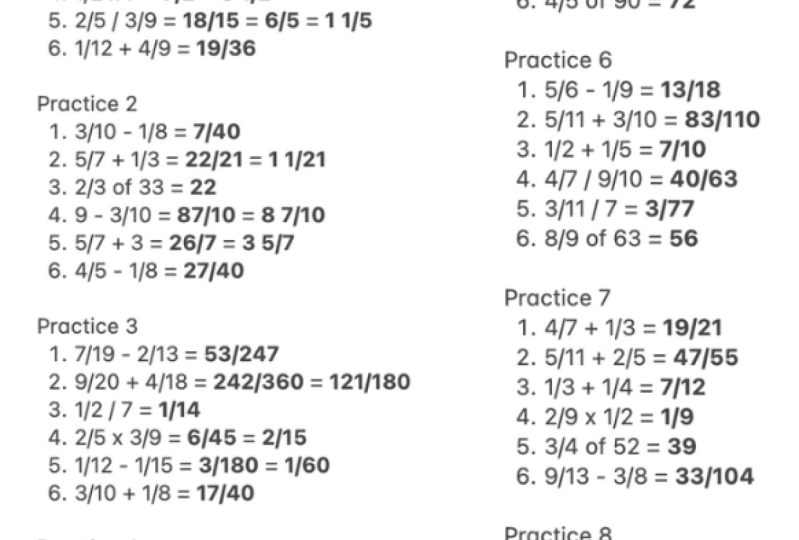
31. 3 Minute Maths Fractions Lesson 30 (Practice questions): Here's a mixture of questions for you to have a go at it. Don't do the morning long ago. Just do two or three now and again to keep on top of it. That way you won't forget what you've learned, and you won't have to do lots of questions. All the mongo when you revise what would be 4/5 at 5/8 57/40 which you can simplify into a mixed Fraction one and 17/40. What would be 7/9? Plus 7/13 154 over 117 which you can simplify to one and 37 over 117. What would be 9/20? So take away 4 18th 80 to over 360 which you can simplify by having the top in the bottom. 2 41 over 180. What would be 1/2 times seven 7/2 more seven harps, which you can simplify into a mixed fraction and get 3.5 What would be to fifth so divided by 3/9 18/15. You can simplify this to 6/5, which is an improper fraction so you could make it into a mixed fraction and get one on 1/5 . What would be 1 12 at 4/9? 57 over 108 on day 57. And 108 are both in the three times table, so you can divide the top and the bottom of this fraction by three on. Do you get 19/36?
32. 3 Minute Maths Fractions Lesson 31 (Practice questions): what would be 3/10? Take away 1/8 14/80 and you can simplify this to 7/14. What would be 5/7? Add 1/3 22/21 and this is an improper fraction, so we can turn it into a mixed fraction on get one on 1/21. What would be 2/3 off 33 if we divide by the bottom Andi Times by the top, then you get 33 divided by three, which is 11 on 11 times two is 22. What would be nine? Take away 3/10 87/10 which is a top heavy fraction or an improper fraction on we can make it into a mixed fraction on get eight on 7/10. What would be 5/7 plus three. We make three into a fraction by placing it over a denominator of one and get 3/1. The mules blight by seven and you get 21/7. So five plus 21 is 26 26/7, which is an improper fraction that we can make into a mixed fraction and get three and 5/7 . what would be 4/5 minus 1/8. Eight times four is 32 five times one is five on 30 to take away five is 27. For the denominator, we get five times eight, which is 40 so the answer is 27/40.
33. 3 Minute Maths Fractions Lesson 32 (Practice questions): what would be 7/19 take away to 13th? 53 over 247? What would be 9/20 plus 4/18 242 over 360. Both these numbers are even so we can have them both and get a simpler fraction off 121 over 180. What would be, ah, half divided by seven. If you make seven into a fraction 7/1 and then flip it over and multiply, you get 1/14 because one times one is one and two times seven is 14. What would be to fifth times 3/9? Two times three is six and five times nine is 45. Both of these numbers are in the three times table, so if we divide them both by three, we can simplify it and get to 15th. What would be 1/12 take away? 1/15 three over 180 and again, both of these numbers are in the three times table, so you can divide them by three and simplify it to get 1/60 or 1/60. What would be 3/10 plus 1/8 34/80 and you can have both these numbers and get 17/40
34. 3 Minute Maths Fractions Lesson 33 (Practice questions): what would be 5/7 take away 1/3. Five times three is 15. Take away seven times one, which is 7 15 Take away. Seven is eight. Andi For the denominator, We have seven times three, which is 21 so 8/21. What would be to fifth off? 40 40 divided by five is eight and eight times two is 16. What would be four plus a fared? If you make four into 4/1 and multiply it by three, you get 12/3 plus 1/3, which makes 13/3. Has a mixed fraction. This is four and 1/3 but you probably noticed that you can just put those two numbers together. Four plus 1/3 makes foreigner third, which is an easier way. What would be to fifth off? 15 15 divided by five is three on three times two is six. What would be five times 2/7? Five times two is 10 on day one time seven is seven so 10/7, which as a mixed fraction is one on day 3/7 and what would be 4/9 times 3/4 four times three is 12 and nine times fault is 36 12/36. Both of these numbers are actually in the 12 times table, and so you'll just divide them by 12 and get 1/3 or third. If you didn't know that in the 12 times table, then you might have noticed that there in the three times table so you can divide them by three. Or you might have also noticed that they're both even numbers, so you can divide them by two. Either way, you'll eventually get down to 1/3.
35. 3 Minute Maths Fractions Lesson 34 (Practice questions): what would be 1/2 divided by 3/5. One times five is five and two times three is six so 56 7/9 plus 1/8 65/72. And that's as simple as you can make that one. What would be 7/9? Take away 1/8 47/72? What would be 4/5 take away 1/3? We can turn the denominators of both these factions into 15. If we multiply four and five by three, we get 12 15th. And if we multiply one in three by five, we get 5/15 12. Take away. Five is seven so 7/15 What would be 4/8 plus 1/4 four times four is 16 eight times one is 8 16 I date is 24. And then for the denominator we have eight times for which is 32. So 24/32. We can divide the top and bottom of this fraction by eight and get 3/4. Obviously, you could just have each number on. Go down that way and you'll get the same answer. So if you have 24 32 you will get 12/16 which you can have again to get 6/8 and then have once more to get 3/4. What would be 4/5 of 90 90 divided by five is 18 and then 18 times four is 72.
36. 3 Minute Maths Fractions Lesson 35 (Practice questions): What would be 56? Take away 1/9. Nine times five is 45 6 times one is six 45. Take away six is 39 and for the denominator, six times nine is 54. So 39/54 both 39 54 or in the three times table, so we can divide them both by three and get a simple a fraction off. 13/18. What would be 5/11 plus 3/10? Five times 10 is 50 11 times three is 33 50 plus 33 is 83. Andi as the denominator. We have 11 times 10 which is 110 83 over 110. What would be 1/2? Plus 1/5? Five times one is five, two times one is two and 52 is seven. That's the numerator, Andi. The denominator is five times to which is 10. So 7/10 more, 7/10 What would be 4/7 divided by 9/10? If we flip the second fraction over, we get 10/9 and then we can multiply them four times. 10 is 40 on nine times seven is 63. 40/63 is the answer. What would be 3/11 divided by seven? We change seven into 7/1. Flip it over to get 1/7. Three times one is three and 11 times seven is 77 3/77. Finally, what would be 8/9 off 63 63 divided by nine is seven and seven times eight is 56 so the answer is 56.
37. 3 Minute Maths Fractions Lesson 36 (Practice questions): what would be 4/7 plus 1/3? Well, the denominator would be 21 because seven times three is 21. And then, as the numerator is, we have four times three, which is 12 and seven times one, which is seven and 12. At seven is 19. So 19/21. What would be 5/11 plus 2/5 11 times five as the denominator will make 55 and then on the top we have five times five is 25 11 times two is 22 22 plus 25 is 47. So 47/55. What would be 1/3 plus 1/4? Well, four times one is four and three times one is three. So we add those together for the numerator and get seven. And then three times four is 12 as the denominator. So 7/12 what would be to nineths times 1/2? Two times one is two and nine times two is 18. So we get to over 18 on these, both even numbers, so we can divide them both by two to simplify it and get won over nine or 1/9 what would be 3/4 off? 52 52 divided by four is 13 and then 13 times three is 39. So the answer is 39 on. Finally, what would be 9/13 take away 3/8? The common denominator would be 100 and four because 13 times eight is 104 and then nine times eight is 72 on 13 times three is 39. So 70 to take away 39 is 33. So the answer is 33 over 104.
38. 3 Minute Maths Fractions Lesson 37 (Practice questions): what would be 56 off 72 72 divided by six is 12 and then 12 times five is 16. What would be 56? Add 56? Well, this one's needs one, because the denominators are already the same. So all we have to do is at five and five, and you get 10 6 You can then simplify this by Harding 10 and six, and you get 5/3 which is an improper fraction. So you can turn that into one and 2/3. What would be 1/4 times 1/5? One times one is one onda, four times five is 20. So 1/20 what would be 9/10 divided by 3/4? Well, if you flip 3/4 upside down, you get 4/3. So nine times four is 36 10 times three is 30. We can divide 36 30 by six, and you end up with 6/5. This is an improper fraction, and safer Turn it into a mixed fraction. You get one under fifth. What would be 2/7? Take away 1/10. We can turn to sevenths into 20/70 by multiplying them both by 10 on weaken turn 1/10 in 2 7/70 20/70. Take away 7/70 is 13/70. And finally, what would be to 11th off 55 55 divided by 11 is five and then five times two is 10.
 Kieran Ball, Learn a language in 3-minute chunks